

World
Disappointed
Steinhardt vows cuts and changes in his funding of Jewish causes.
Jacob Berkman
Jewish Telegraphic Agency
New York
U
nhappy with the results of his
$125 million investment in
Jewish causes over the past 12
years, philanthropic trailblazer Michael
Steinhardt says that he is scaling back
and refocusing the efforts of his signature
foundation.
The hedge-fund mogul made waves
when he retired in the mid-1990s from the
money management business with rough-
ly half a billion dollars in the bank, pledg-
ing to devote his energies to the Jewish
philanthropic world. He quickly made a
significant impact through his founda-
tions and Jewish Life Network think
tank. He became a founding partner of
Birthright Israel, a program that provides
young Jews with free trips to Israel and
is widely regarded as the most successful
Jewish philanthropic initiative in decades.
He also invested in several other
groundbreaking efforts, including philan-
thropic partnerships that have generated
tens of millions of dollars to boost day-
school education and make synagogues
more appealing to marginal members
and unaffiliated Jews. And he is chairman
of Jewish Renaissance Media, the parent
company of the Detroit Jewish News.
But now Steinhardt, well known for
acerbic comments and ruffling feathers, is
slamming his own record and promising
major changes.
This could prove a potentially momen-
tous turn of events for perhaps the chief
architect of the Jewish community's new
philanthropic landscape, where individual
donors and private foundations, rather
than local Jewish charitable federations,
lead the way on a host of issues.
In an extensive interview last week at
his Manhattan office, Steinhardt said he
will be narrowing his foundation's atten-
tion to three major areas: creating follow-
up programs for Birthright participants
after they return home; building a $100
million Fund for the Jewish Future, also
known as Areivim, to transform formal
and informal Jewish education, and
the Jewish Early Childhood Education
Initiative.
He voiced plans to end his financial sup-
port for at least 18 of the 100 or so initia-
20
August 2 2007
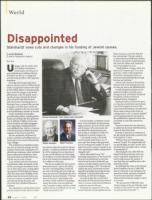
Michael Steinhardt: 'Have things really improved?'
William Davidson
Robert Aronson
tives that he funds, but would not discuss
specifics. In addition, Steinhardt said that
he will be stepping down as chairman of
the day-school initiative, the Partnership
for Excellence in Jewish Education, (PEJE)
but he will continue his commitment of
$1.5 million over five years.
"The last six months have been particu-
larly hard because I came to the realiza-
tion that I was doing things I really did
not want to be doing, that were really not
where my head was:' Steinhardt said of his
foundation's many investments. "I felt that
some of the places I spent money were
not where I really wanted to be spending
money, that I knew were not achieving
what I wanted to achieve, and they created
conflicts for me and difficulty for me, and
I think that period is over."
In recent months, according to sources
close to him, Steinhardt became increas-
ingly pessimistic about the Jewish world
and the impact of his investments. He
articulated this disappointment pub-
licly in May, at a banquet for Hillel: The
Foundation for Jewish Campus Life.
"I ask myself, overall, is the Jewish
world any better today than it was 13
years ago? Have things really improved?
Are we reaching more people?" he said. "I
don't have positive answers. Outside of our
self-congratulatory bubbles, things haven't
changed much:'
Shortly after, Rabbi Irving "Yitz"
Greenberg stepped down as the Jewish Life
Network's top professional, a post from
which he had served as Steinhardt's top
adviser on Jewish initiatives since the orga-
nization's founding in 1995. The departure
marked the end of a prominent and ideo-
logically improbable partnership between
Steinhardt, a self-described atheist, and
Greenberg, an Orthodox theologian.
In recent months, the overall staff at
the Jewish Life Network has been reduced
from 12 to seven. Rabbi David Gedzelman
remains its executive director.
Steinhardt has tapped the CEO of the
Jewish Federation of Metropolitan Detroit,
Robert Aronson, to head the $100 mil-
lion Areivim fund. The fund, which is
co-chaired by Detroit billionaire William
Davidson, will include 20 philanthropists
who invest $5 million each. Steinhardt
said 13 have signed on so far.
"I think Michael is taking a whole new
look at JLN," Aronson said. "It is a very
good idea. I think it will energize him.
He has had a tremendous impact on
American Jewish philanthropy, through
his ideas and initiatives."
Aronson will continue to devote three
days per week to his Federation job and
two days per week to the philanthropists.
In total, Steinhardt has given an esti-
mated $125 million to Jewish causes
through the Judy and Michael Steinhardt
Foundation and the Israel-based
Steinhardt Family Foundation.
Steinhardt said he will honor his previ-
ous financial commitments and maintain
some level of support for many of the
causes that his foundations currently fund.
But he wants to focus in the future on
crafting what he calls a "common Judaism"
and developing programs that speak to
the unaffiliated, as opposed to those who
are already in some way connected to
Judaism.
These have always been his objectives,
he added, but the Jewish Life Network has
strayed at times from them.
He plans to step down as chairman of
the day-school partnership, a position that
he has held for 10 years.
"PEJE has been an outstanding orga-
nization," he said. "It is exceptionally well
run by Josh Elkin, its staff is terrific and I
feel it has done unusually well in a variety
of circumstances."
Still, Steinhardt said, while PEJE has
helped build the Jewish day-school sys-
tem, he wanted the organization to do
more to help increase the number of
non-Orthodox and unaffiliated Jews who
attend day schools.
He challenged the claim in the National
Jewish Population Survey of 2000-2001
that 10-15 percent of non-Orthodox Jews
attend day schools, saying the Steinhardt
Social Research Institute at Brandeis
University found that the number is closer
to 3 percent.
"You ask yourself, if PEJE didn't exist,
what percentage of the non-Orthodox world
would go to day schools?" he said. "Would it
be much less than 3 percent?"