

Staff photos by Angie Bean
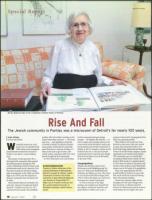
Shirley Babcock looks at her scrapbooks of family history in Pontiac.
Rise And Fall
The Jewish community in Pontiac was a microcosm of Detroit's for nearly 100 years.
Alan Hitsky
Associate Editor
W
oodward Avenue was a dirt
track in the second half of the
1890s when recent immigrant
Joseph Barnett traveled from Detroit to
Pontiac to see about a vacant clothing
store.
His journey was the precursor for a
thriving Jewish community that enjoyed
abundant prosperity during the 20th
century. Ultimately, Jewish merchants and
professionals made up the majority of the
downtown businesses. But the swirling
tides of integration in the 1960s and white
flight in the 1970s and '80s dispersed a
diaspora community that was known for
its unity.
Sylvia Barnett Babcock remembers the
early days. The last of Joseph and Rachel
Barnett's 13 children was born in 1913
and turns 94 this month. The Southfield
16
August 2 • 2007
resident tells of her father traveling on the
Detroit interurban streetcars — two hours
each way — and spending a whole day
in Detroit to obtain 70 pounds of kosher
meat, poultry and bread. He carried the
parcel from bus to streetcar and then 1.5
miles on his back to get it home. That
weekly routine continued until 1916, when
Barnett bought his first automobile.
In 1919, when Sylvia was 6, the Pontiac
Acknowledgements
Thanks to Sharon Alterman at the
Jewish Federation of Metropolitan
Detroit's Leonard N. Simons Jewish
Community Archives; the private
collection of Sylvia Barnett Babcock;
Jan Durecki at Temple Beth El's
Rabbi Leo M. Franklin Archives; and
the Jewish Historical Society of
Michigan's Michigan Jewish History
series.
Jewish community had grown large
enough — 60 families, she believes — to
start a temple and a Sunday school in two
rooms above Jacob Kovinsky's candy store.
Incorporated as the Jewish Community of
Pontiac in 1923, it moved to a house at 164
Orchard Lake Ave. in 1924 as the Jewish
Community Center, which became Temple
Beth Jacob (in honor of Jacob Kovinsky)
in the early 1930s.
Congregations
Judaism and Zionism created some
divisiveness in the fledgling group. For
years, JCC-Beth Jacob maintained both
Orthodox and Reform services. The tenure
of anti-Zionist Rabbi Elmer Berger, from
1932 to 1936 as the Nazis rose to power in
Germany, also created controversy.
In 1934, in advance of the High
Holidays, the temple board decided that
the religious orientation would be com-
pletely Reform. Within a few years, a
separate, Conservative Congregation B'nai
Israel was operating nearby.
While Pontiac's Jews may have been
divided in observance, they were united
in spirit. The community had its own
B'nai B'rith lodge, Hadassah and National.
Council of Jewish Women chapters, Zionist
organization and United Jewish Appeal.
The community was very closely knit,
according to Rabbi Ernst Conrad. He was
hired by Beth Jacob to be spiritual leader
in 1962 when, he believes, the Jewish com-
munity at the northern end of Woodward
Avenue was at the height of its population.
There were approximately 450-460
Jewish families in Pontiac, he says, with
Beth Jacob and B'nai Israel each having
about 120 member families.
Conrad was a human rights activist
throughout his life and a refugee from
Nazi Germany. In 1964, he joined 30
citizens in a Huron Street march in down-
town Pontiac for civil rights. Two years