
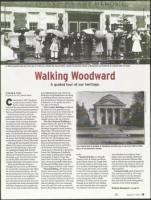

In 1947, parents lined up in the rain at 7:30 a.m. outside the Aaron DeRoy Jewish Community Center at Woodward and Holbrook to register kids for camp.
Walking Woodward
A guided tour of our heritage.
Gerald S. Cook
Special to the Jewish News
C
onstructed in 1807, Woodward
Avenue became Detroit's "Main
Street:' a major transportation
route and the most prominent street in the
city. A strong Jewish community presence
thrived on Woodward from its inception.
Jewish business owners, who emi-
grated from Germany in the mid-1800s,
built homes and stores on Woodward.
For example, Emil and Fanny Heineman
manufactured and sold clothing down-
town. Their names are inscribed at Hart
Plaza's Underground Railroad statue,
commemorating those who aided fugitive
slaves. The Heavenrich factory and cloth-
ing store also were located downtown on
the avenue. Both families had large homes
on Woodward north of Grand Circus Park.
Following the lead of gentile Detroiters,
affluent 20th century Jews resided on or
adjacent to Woodward and constructed
two magnificent Temple Beth El build-
ings there. The Jewish Community Center
and Jewish Vocational Service were on
Woodward, as are several Jewish cemeter-
ies and the offices and stores of many
Jewish professionals and business owners.
Today, Jewish Historical Society of
Michigan bus tours drive up Woodward
for several miles, showing sites that reflect
the Jewish community's history and tell-
ing interesting stories about the past. They
trace the movement of our neighborhoods
away from the river as our population
grew and achieved success here and as the
city expanded into former farmland, fields
and forests. Experienced tour guides also
point out new and recently restored build-
ings, highlighting the large role Jewish
developers and philanthropists are taking
in rebuilding Detroit. Here are some his-
toric Jewish sites on Woodward, beginning
at Jefferson. E or W signifies the east or
west side of Woodward:
• City-County Building, at Jefferson
(E). Here Carl Levin presided over the
Detroit City Council in the 1960s before he
was elected one of Michigan's U.S. sena-
tors, and where many other Jews rendered
valuable service to the city of Detroit.
• The First National Building, at
Campus Martius (E). Built in the 1920s,
this is one of the many buildings on
Woodward designed by Jewish architect
Albert Kahn. The largest tenant in the
building for many years has been the
law firm of Honigman Miller Schwartz
and Cohn LLC. The Honigman name
appears above the Woodward entrance.
Many Jewish professionals have prac-
ticed in downtown Detroit and further
up Woodward. Jewish businessmen
owned stores on Woodward in downtown
Detroit, like Winkelmans, Himelhochs
and B. Siegal, all selling ladies' clothing;
Cunningham & Shapero Drugs; Max
Osnos' Sam's Cut Rate Dept. Store; Hack
Shoes; Norman Rosenfeld's Sibley Shoes;
the Eizenstat's Phillips Shoes; and the
Pincuses' Hughes & Hatcher men's clothes.
• Butzel Building, 163 Madison (E).
Plainly visible across Grand Circus Park
is the former headquarters of the Jewish
Federation, United Jewish Foundation,
Jewish Community Relations Council, ADL
and other Jewish organizations. This mag-
nificent building served our community
from 1951 until 1991 and was named for
Fred M. Butzel, beloved Jewish community
This Temple Beth El building at Woodward and Eliot was in use from 1903 to 1922.
Now it is the Bonstelle Theater.
leader.
• Temple Beth El (now Bonstelle
Theater), north of Erskine, two blocks
south of Mack Avenue (E). Temple Beth
El built this temple in 1903, when many
of its members owned large brick homes
on the nearby side streets, and occupied
it until 1922. Early members were mainly
from Germany or the children of German
Jews. Most Eastern European Jews, more
recent immigrants, lived in smaller
dwellings a few blocks east of here near
Hastings Street. Beth El's new building
was more beautiful than it now appears;
the columned entryway was removed
when Woodward was widened. Down
Erskine Street, now plainly visible from
Woodward, is the former Phoenix Club,
built in 1906 for the social club created by
Detroit Jewry's early citizens in 1872, and
used for many Jewish weddings and wed-
ding receptions.
• Orchestra Hall, north of Mack (W).
This structure was built in 1919 in less
than six months to meet the demands
of conductor Ossip Gabrilowitsch for a
first-class hall. He was the distinguished
conductor of the Detroit Symphony
Walking Woodward on page 14
August 2 • 2007
13