

Arts & Entertainment
A Passage To Jewish India
With sadness and humor, Sophie Judah's stories evoke
the disappearing world of the Bene Israel.
Sandee Brawarsky
Special to the Jewish News
A
Bene Israel custom is to put
something sweet into the
mouths of people who bring
good news. So the parents of a bride in
Jwalanagar, India, are fed bits of sugar and
sweets as they crisscross the town, pre-
senting wedding invitations by hand.
Jwalanagar is an imaginary place
in central India, the setting for Sophie
Judah's linked stories about the Bene
Israel community, recently published in
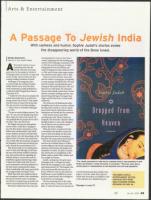
a collection titled Dropped from Heaven
(Schocken; $23).
"I wanted to write about my people: the
Indian-born Judah says in an interview
during a brief visit to the U.S. last month
from her home in Israel. Now in her late
50s, she moved to Israel from Jabalpur
— which seems to resemble Jwalanagar
— in 1972.
"I'm not an overly religious person: she
says. "If I can serve my people, keep them
alive, maybe I've done a bit of good. I'm
very grateful that my people are not off of
the map." This is her first book.
Her highly textured and atmospheric
stories evoke a world that is disappear-
ing. The Bene Israel community, as these
Indian Jews call themselves (and which
means children of Israel) are believed by
some scholars to be the descendants of the
biblical tribe of Zevulun, who made their
way to India after the Assyrians conquered
the Kingdom of Israel and sent them into
exile, around the second century B.C.E.
They lived mostly on the southwestern
coast of India and although cut off from
the rest of the Jewish world for centuries,
they observed Jewish law regarding the
Sabbath, kashrut, circumcision and the
prohibition against intermarriage. Many
of them later settled with other Jews in
rural communities. But the population of
the Bene Israel community has dimin-
ished considerably, with many, particularly
the younger people, leaving for Israel.
While there have been anthropological
and journalistic studies of the community,
this may be the first work of contempo-
rary fiction to emerge from an insider; the
stories are personal and full of humanity.
The book is divided into three time peri-
ods spanning the course of more than a
century, beginning with the founding gen-
eration of the Jwalanagar community, 1890
to 1930; the period leading up to India's
independence from Great Britain and
Israel's founding and early statehood, 1930
to 1964; and the years when many commu-
nity members made aliyah, 1965 to 2000.
These are stories of home. Some tales
take the reader to synagogues, to hospitals,
to army postings during the Boer War and
later the violence surrounding the parti-
tioning of India and Pakistan in 1947 and
then the war with China; but ultimately
they are about family connections. Several
involve courtship, weddings and the com-
plicated maneuverings of arranged mar-
riages; and the final story is about death
and burial.
The stories are old-fashioned in style,
straightforward in their narration, without
the edge that's evident in a lot of contem-
porary short fiction. Judah layers texture,
atmosphere and details into her sentences.
Some stories seem to have bibli-
cal undertones, like "Shame Under the
Chuppah," that describes a family's efforts,
through trickery, to marry off a daughter
who is blind in one eye and has pock-
marked skin from smallpox.
When the truth is revealed, the bride
is mortified by her family's actions and
wants to halt everything; but the honor-
able groom perseveres, not wanting to
humiliate the young woman by leaving her.
The stories depict class differences
and how the stratified nature of Indian
society influences the Jewish community,
relations with Muslims and Hindus, the
inequality of women, the pull of commu-
nity and the fear of assimilation. In her
Indian cadence, Judah offers sadness and
loss, insight and humor.
Joseph, a young man who grew up in
Jwalanagar and is visiting from Israel,
finds that the synagogue is now a pickle
and chutney factory in "The Funeral: one
of the most powerful stories in the col-
lection. When he visits an old woman he
barely knows on her deathbed, he prom-
ises her a Jewish burial. She is thought to
be the last Jew in Jwalanagar.
The few remaining Jews in the wider
area step forward; a woman arrives with
fabric to make the hand-sewn shroud and
"The Jewish community in India has for centuries lived in close proximity to both
Hindus and Muslims," writes the author in a foreword. "There has never been a
Jewish ghetto or manifestations of anti-Semitism from the local population."
a Jewish businessman from another town
helps to carry the casket. Since only two
Jewish men are present, no Kaddish is said
at the cemetery, now inhabited by poor
Passage on page 50
THIS WEEK'S ARTS &
ENTERTAINMENT SECTION
CONTINUES WITH MORE
INDIA-FLAVORED STORIES,
BEGINNING ON PAGE 46.
July 26 • 2007
43