

1.11111 Business I on the cover
Beneficial Scraps from page 19
Greenfield location.
"We do business with hundreds of companies and governmental
agencies around the country — we seem to get about 50 new custom-
ers a day',' Grushoff said. "With our two branches in Florida, one in
Ontario, and one to open soon in Chicago [with 35 new employees],
we can pick up almost anywhere in the country'
Great Lakes will purchase certain materials "that still have useful
life',' said Grushoff, such as Pentium-level computers, controllers and
servers, floppy drives and CD-Rom drives, RAM chips, circuit cards,
various types of software, and miscellaneous parts and components.
The company sells a small amount of valuable items on the Internet's
e-Bay system.
Destructive Benefit
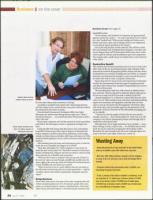
Nathan Zack and his
mother, Karen, at work.
Great Lakes recycled more
than 31 million pounds of
electronics last year.
his twin sister, Marni, now an attorney in Chicago.
According to Grushoff, Zack started with a landscaping business
and then worked at his cousin's Florida scrap yards, where he realized
the potential for electronics recycling.
From the family basement in Farmington Hills, Great Lakes
Electronics has mushroomed during the past eight years. "When I
started this business ... we recycled only about 200 pounds of stuff a
week;' Zack said.
He tore apart computers and sold the material to local scrap dealers
and refiners. He then began to invest in equipment and larger loca-
tions.
Companies like DTE Energy, Best Buy, Kmart, Sears and Quicken
Loans/Rock Financial pay Great Lakes to dispose of unwanted and
broken computers, monitors, hard drives, keyboards, circuit boards,
cathode ray tubes, fluorescent bulbs, cable boxes, television sets, VCRs,
small household appliances, ferrous and non-ferrous metals and other
products.
After breaking down the items and removing any parts of value for
resale, the rest is shredded and shipped to be melted.
"More than 500 million PCs will be relegated to scrap in the U.S.
alone this year',' Zack pointed out. "Hazardous amounts of toxic heavy
metals, including lead, cadmium and mercury, make it critical to keep
these materials out of landfills and incinerators.
"When you throw away a computer with nine pounds of lead in it,
the mercury vapor can seep through a landfill and possibly enter the
water supply. A few years ago, about 150 million PCs had been buried
in those landfills; not very many were recycled.
"What we do here is not too much different than the operation of
the old Jewish-owned scrap yards of an earlier generation — only it's
a modern version with modern requirements, equipment and tech-
niques."
Doing Business
Great Lakes' main source of revenue is the major companies that sell
it their unwanted products for 35 to 50 cents per pound. These com-
panies are contacted daily by a battery of telemarketers. Three Great
Lakes trucks, and rented vehicles as needed, bring the material to the
20
C .?
With identity theft the fastest-growing crime in America, Great Lakes
offers "state-of-the-art security destruction',' Zack explained. When
materials are received, all proprietary labels, stickers and other forms
of identification are removed, including any asset labels. As computer
hard drives are destroyed, for example, a camera records the process
for clients who wish to verify a computer's destruction.
"Agents from the U.S. Secret Service, the Department of Homeland
Security, the Environmental Protection Agency, hospital personnel
and others often witness their machines being shredded and receive a
certificate of destruction.
"We even destroyed a tank once, with a bunch of officials observ-
ing," said Zack. "There's a big need to eliminate identity theft, and we
do our best to help. And all of our work is audited by the EPA."
Lakeside Equipment Co. of Detroit is a typical firm that uses Great
Lakes' services. When machine shops and other small industrial firms
acquire new machinery and equipment, Lakeside relies on Great
Lakes to pick up and destroy the old equipment. "We interact often
with Great Lakes, and I personally supervise the destruction of the
equipment," said Larry Horowitz of West Bloomfield, managing part-
ner at Lakeside.
"I like the fact that the people at Great Lakes are very environ-
mentally conscious — their attitude spills over on the rest of us. The
company is very ethical, professional, prompt and thorough; they're
wonderful to do business with."
Although Zack, who is single, maintains a busy schedule — some-
times working 18 hours a day, he says — he still finds time to study
Torah. He was bar mitzvah at Congregation B'nai Moshe in West
Bloomfield. He and Grushoff study with a few Lubavitch rabbis who
come to the Great Lakes office at least once a week.
Wasting Away
•About 80 percent of all trash and waste in the United States
ends up in landfills, nearly 200 million tons each year.
•More than 500 million personal computers will be relegated
to scrap in the U.S. this year; only a small percentage will be
recycled.
•Computer-related scrap decomposes daily in landfills, con-
taminating the ground and water.
•If only 1 percent of the waste in landfills is electronics, it will
be comprised of 1.1 million tons of ferrous metals, 472,000
tons of non-ferrous metals, 160,000 tons of leaded glass,
120,000 tons of precious metals, 88,000 tons of mixed plas-
tic, and 6,000 tons of hazardous waste.