

hid i/ PPOM PH Im a
World
I
cc
E
0
0
0
v
44" "! e:7•.
.44%
.1G
1:
r" •
.
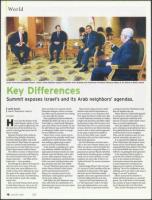
Israeli Prime Minister Ehud Olmert, Jordan's King Abdullah, Egyptian President Hosni Mubarak and Palestinian President Mahmoud Abbas at the Sharm el-Sheik summit.
Key Differences
Summit exposes Israel's and its Arab neighbors' agendas.
Leslie Susser
Jewish Telegraphic Agency
Jerusalem
H
ow to turn the disaster of the
radical Hamas' capture of Gaza
into a political opportunity was
the main focus of this week's four-way
summit in the Egyptian resort town of
Sharm el-Sheik.
Egyptian President Hosni Mubarak,
Jordanian King Abdullah, Palestinian
President Mahmoud Abbas and Israeli
Prime Minister Ehud Olmert all expressed
hope for a renewed Israeli-Palestinian
peace process now that Abbas has set up a
Fatah-led government without Hamas.
The subtext was clear: A vibrant Israeli-
Palestinian peace process could help stop
the radical, Iranian-backed power that
Hamas represents — and which all four
leaders fear — from spreading.
But although they agreed on the general
direction and even on some of the spe-
cifics, there were major differences on a
number of key issues. Mubarak, for exam-
ple, spoke of the urgent need for Fatah
and Hamas to reconcile. The Palestinians,
he said, needed to speak with a single,
united voice.
But a new Fatah-Hamas deal is precise-
ly what Olmert does not want to see. He
fears the return of Hamas would under-
16
June 28 • 2007
mine any chance for a genuine Israeli-
Palestinian dialogue. And he is worried
that Abbas may be pressured into striking
a new deal with the radicals.
More significantly, whereas Mubarak,
Abdullah and Abbas all want to see accel-
erated talks on a final Israeli-Palestinian
peace deal, Olmert has his doubts. He sees
the split between Gaza and the West Bank
as making the conflict easier to manage
but more difficult to resolve.
Olmert favors a more careful, step-by-
step approach that gradually would create
conditions for a final settlement rather
than making a gigantic leap toward a
peace accord that would likely fail.
In the summit's concluding news confer-
ence, Mubarak, Abdullah and Abbas all
urged quick movement toward a two-state
solution, Israel and Palestine, side by side,
at peace. Abbas proposed setting a clear
timetable for negotiations and insisted that
all the core issues, including borders, refu-
gees, Jerusalem and water, were soluble.
The new Palestinian government under
former Finance Minister Salam Fayyad
and the international community's
lifting of its economic boycott on the
Palestinians created genuine opportuni-
ties for peace, Abbas said.
Saeb Erekat, the chief Palestinian nego-
tiator, added that the establishment of a
Palestinian state was now the most urgent
issue on Abbas' agenda.
Many Israeli analysts, however, doubt
whether Israel and the Palestinians are
yet in a position to cut a final peace deal.
They argue that Olmert would not be able
to satisfy Palestinian demands on borders,
refugees and Jerusalem, and Abbas will be
hard pressed to keep a lid on terror in the
West Bank where he is in control, let alone
in Gaza, where he is not. Olmert, therefore,
seems to favor a slower, interim approach
to take steps to improve the quality of
life on the West Bank, create a model
Palestinian polity and then build toward a
final-status agreement.
But the Palestinians want final-status
talks to start now. Nimmer Hamad, one of
Abbas' top advisers, told Israel Radio that
it was time Olmert recognized Abbas as a
genuine peace partner. Hamad said Abbas
would disarm all militia groups, including
Fatah's own Al-Aksa battalions, to create
conditions for peace talks. If there is no
"political horizon;' he warned, extremism
will grow.
Israeli Foreign Minister Tzipi Livni and
U.S. Secretary of State Condoleezza Rice are
sympathetic to that position. They agree
that Israel and the Palestinians should
negotiate a final-status agreement even if it
cannot be implemented for some time.
American and Israeli diplomats call
it a "shelf agreement" ready to be taken
down and implemented as soon condi-
tions allow. Such an agreement would be
a strong incentive for Palestinians to get
their act together, they say.
Olmert, however, is adamantly opposed
to cutting such a deal. He argues that a
deferred agreement would only invite
pressure on Israel to make further conces-
sions so it can be implemented.
Given the readiness on the Arab side to
go for a final peace deal and the fact that a
true political horizon for the Palestinians
would be the best way to strengthen
Abbas and the moderate cause, the inter-
national community may press for it.
If, as expected, the diplomatic Quartet
of the United States, the European Union,
Russia and the United Nations appoints
outgoing British Prime Minister Tony Blair
as its special Middle East envoy, he may
well focus on getting this shelf agreement.
In the meantime, Olmert intends to
go ahead with confidence-building mea-
sures. At the summit, he did what no
Israeli prime minister has done before
in such strong terms: He delivered an
impassioned recognition of Palestinian
suffering. "We are not indifferent to your
suffering, and we are ready to take steps to
bring it to an end;' he declared.
Olmert announced his intention to
release 250 Fatah prisoners as a goodwill
gesture. The Israeli leader is also consider-
ing a number of steps to improve the qual-
ity of Palestinian life in the West Bank.
These include releasing more than $500