
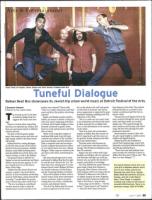

Tomer Yosef, Ori Kaplan, Itamar Ziegler and Tamir Muskat of Balkan Beat Box
Tuneful Dialogue
Balkan Beat Box showcases its Jewish hip urban world music at Detroit Festival of the Arts.
Suzanne Chessler
Special to the Jewish News
T
he artwork on the CD Nu Med,
recorded by Balkan Beat Box,
suggests the band's main mes-
sage.
There's a red and yellow striped flag
that does not represent any country, and
there are instruments linked to different
cultures and eras.
The idea is that the group merges
music from many sources and turns out
high-energy numbers that deny territo-
rial borders.
Balkan Beat Box, visiting Michigan
for the first time as part of the Detroit
Festival of the Arts, presents a definite
klezmer sound while including music
from the Middle East, North Africa and
Eastern Europe, as well as the Balkans.
The group, formed in 2004 by Ori
Kaplan on sax and woodwinds and Tamir
Muskat on percussions, appears at 5:30
p.m. Sunday, June 10, on the Masco/
Metro Times Stage.
"Balkan Beat Box doesn't fit into any
category or genre says Jacob Harris,
director of artist incubation and develop-
ment for JDub Music, which released the
recording. "I would define the group's
style as 'Jewish hip urban world music!"
"The new recording is a shorthand
for their musical vision of what the
Mediterranean would sound like if the
borders were remover Harris adds.
"They try to make connections with their
music and lyrics that politics often keeps
separate!'
Kaplan and Muskat, Israelis and New
Yorkers, are known to deliver a wild party
with each concert. Appearing with them
in Detroit will be Itamar Ziegler on bass,
Jeremiah Lockwood on guitar, Tomer
Yosef on vocals and percussion and Peter
Hess on horns.
"Many of the songs have origins as
traditional folk music from the home
countries and cultures of the vocalists,"
says Aaron Bisman, executive director of
JDub, a nonprofit event and record pro-
duction company that promotes authen-
tic new Jewish music and cross-cultural
dialogue. "Other songs are written by Ori
and Tamir, with Tomer contributing the
lyrics."
The international approach to music
performed by Balkan Beat Box fits right
in with this year's festival, the 21st. The
three-day event, running June 8-10, also
features Sierra Leone's Refugee All Stars,
the Ukulele Orchestra of Great Britain
and the Screaming Orphans of Ireland.
There will be plenty of ethnic food as
festival visitors enjoy street entertainers
who do acrobatics, authors and poets
reading their own works, a multimedia
art show and children's theater.
"Not all of the Balkan Beat Box music
is easily recognized as Jewish music
but, on the whole, it fits well and speaks
to what JDub is all about;' says Harris,
whose organization is supported by grant
foundation funding, including from UJA
Federation of New York.
"We try to make sure our music exists
in the mainstream and that Jewish music
is taken seriously. For us, Balkan Beat
Box is a real embodiment of our mission
on the whole.
"Even if we don't sell a tremendous
number of Balkan Beat Box records, we
feel it's important to get this music out.
It's good for Jewish continuity and iden-
tity in the United States."
The band works with between six
and 13 performers when they perform
onstage. The Nu Med recording has more
than 20 musicians.
Kaplan, who has worked with Gogol
Bordello, and Muskat, who has appeared
with Firewater and Big Lazy, scout per-
formers who can add to the diversity of
sounds, particularly on recordings.
The song "Habibi min zaman" features
guest singer Dunia from Damascus
doing rap. Gilber Gilmore, discovered
while singing a Moroccan song, performs
"Pachima" in Moroccan style with lyr-
ics helped along by his mom. Bulgarian
singer Dessislava Stefanova doubles her
voice in "Joro Boro," a song for kids.
Three songs on the album — "$20 for
Boban,""Gypsy Queens" and "Pachima"
— showcase three Gypsy musicians
from Queens in New York. They include
Michael Nicolich on accordion, Lance
Lunken on keyboard and Vini Sow on
electric violin.
"Because Jews and Gypsies lived in the
same countries through the years, Jewish
music and Gypsy music are cousins;'
Kaplan says. "We roamed through the
same countries, and we play each other's
songs. We have been through the same
persecution and pain."
Band members, mostly in their mid-
20s, give equal weight to soulful acoustic
timbres and digital rhythms.
Balkan Beat Box has headlined at
Central Park Summerstage, toured with
Matisyahu and played Montreal JazzFest
and Chicago SummerDance.
"There aren't any hard political state-
ments besides the statement of peace in
Balkan Beat Box music," Harris says. "The
idea is to start dialogue." O
The Detroit Festival of the Arts runs
June 8-10 in Midtown Detroit. Hours
are 4-11 p.m. Friday, noon-11 p.m.
Saturday and noon-9 p.m. Sunday.
Balkan Beat Box performs 5:30 p.m.
Sunday, June 10, on the Masco/
Metro Times Stage. A complete
schedule and a map can be found at
www.detroitfestival.com . There is no
admission charge. (313) 577-5088.
June 7 • 2007
35