

Bittersweet Legacy
40 years later, Israel struggles in the
peacemaking process.
Leslie Susser
Jewish Telegraphic Agency
Jerusalem
W
as the Six-Day War a blessing or
a curse for Israel's place in the
Middle East and its long-term
survival? Forty years on, the jury is still out.
In the war's immediate aftermath, it
seemed Israel's sweeping victory would
guarantee the Jewish state's future and set
the stage for a grand regional peace. But the
war also unleashed powerful new forces that
militated against a settlement of the core
Israeli-Palestinian conflict and left simmer-
ing the overarching Israeli-Arab dispute.
Today, the parameters of the struggle have
shifted, but comprehensive Israeli-Arab
peace remains as elusive as ever and threats
to Israel's existence still give rise to concern.
In the new equation, the Arab world is
split. As Israel seeks accommodation with
the moderates, radicals in the Palestinian
and wider Islamist camps conspire to quick-
ly abort peace efforts.
In June 1967, Israel emerged from six
days of lightning strikes on three fronts as a
regional superpower that the Arab side no
longer could realistically expect to destroy.
The war also left Israel with large swaths of
territory it could try to exchange for peace.
Thus it seemed that the argument no longer
would be about Israel's existence but over the
terms of accommodation.
Israel's Cabinet met shortly after the war
and agreed to return territory in exchange
for peace. The Arab League thought differ-
ently, however, meeting in Khartoum for its
famous summit of the "Three No's" — no
recognition of Israel, no negotiations with
Israel and no peace with Israel.
Israel's offer to return conquered territory,
before the occupation had been established
and before there were any settlements, was
rejected.
Still, "land for peace" quickly gained cur-
rency as the new international panacea. U.N.
Security Council Resolution 242, passed five
months after the fighting stopped, reflected
the new approach. But that's not how things
worked out.
Settler Movement
The magnitude of Israel's victory rekindled
dormant messianic notions among religious
Zionists. Before 1967, Israelis felt stifled by
the weight of surrounding, hostile Arab
On The Front Lines
Uri Segal of West Bloomfield was 25
years old and lived on Kibbutz Kfar Aza,
just outside the Gaza Strip, when Egypt
began to beat the drums of war in 1967.
A paratrooper during his army service
and in the reserves, he fought with the
Southern Command to help protect his
kibbutz during the war.
On the kibbutz, about 100 men and
Uri Segal
women started to dig in and get ready
for an assault.
"It was one of the worst places to be," Segal said. The kib-
butz was situated on the front lines and the Egyptian and
Palestinian forces massed right near them. "Gamal Abdul
Nasser decided to take the U.N. out the Sinai, and they said
they were going to destroy us.
"Day and night and day and night we were on full alert,"
he recalled. "On June 5, we got a command that we could
go to sleep. As soon as we left the trenches, they started to
bombard us. We saw the Israeli jets fly over Gaza. We had
very few guns and one cannon that was very old. There were
100,000 Egyptians on the other side.
"There was big confusion," Segal said. The Israeli radio
stations didn't issue reports but only played patriotic music.
So, to get news, they listened to Radio Cairo, which broad-
cast that both Haifa and Tel Aviv were on fire. "Then we
heard them report that the people of Kfar Aza were very
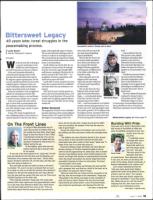
Jerusalem's western Temple wall at dawn.
hood.
states, and in the run-up to the
Concurrently, the Six-Day
war many feared impending
War spurred a new, militant
physical annihilation.
Palestinian nationalism deter-
The fact that the victory was
mined to wrest control of
so decisive fueled speculation
Palestinian decision-making
about divine intervention and
from Arab states like Egypt and
the coming of the Messiah.
Jordan and opposed to any rec-
Religious Zionists argued that
ognition or accommodation with
returning parts of biblical Israel
Israel.
to the Arabs would delay the
Yasser Arafat
Founded several years before
Messiah's coming.
the war, in 1964, the Palestine
These ideas gave rise to the
Liberation Organization under
religious settler movement,
Yasser Arafat embarked on a
which advocated the settlement
campaign of terror against Israel,
of "Greater Israel': especially in
advocating the establishment of
the West Bank.
a "secular democratic" state in
The war also led to the reha-
Israel's stead.
bilitation of the secular Israeli
The twice-defeated Palestinians
right. Herut leader Menachem
continued to demand control
Begin — a virtual pariah during
Menachem Begin
of Jerusalem and the "right" of
David Ben-Gurion's Labor-led
Palestinian refugees to return
administrations from 1948 to
to Israel proper. Accommodation between
1963 — had been included in Levi Eshkol's
these powerful new forces of Israeli and
wartime national unity government. It was
Palestinian nationalism seemed impossible.
the first step on the path that Begin's Likud
Party took to power in 1977 in alliance with
the religious Zionist movement. Both were
dedicated to the integrity of the entire land
Bittersweet Legacy on from page 17
of Israel and opposed to Palestinian state-
brave, but are all dead. But, I looked around and we didn't
have any casualties. We realized if that was the news we
were in good shape."
Though the wheat fields of the kibbutz were on fire from
the shelling and there was heavy smoke, the onslaught never
came.
"The soldiers who were attacking started to turn around
and run back. If they had known how few we were, they
would have come with a smile on their faces," Segal said. "It
began to be clear to us what was going on."
During the fighting, Segal remembers his friend Michael
Demsky driving a D-6 tractor toward the fields to dig up
earth to halt the approaching fire. Raful Eitan, then a colonel
and later Israel Defense Forces chief of staff, jumped on the
tractor and fought with Demsky to instead protect the forest
where the Israeli ammunition was stored. Segal knew Eitan
and yelled to Demsky to follow his instructions. The forest
and ammunition were saved.
Later, Eitan was wounded, and Demsky, who was married
with a pregnant wife, was killed by a bullet in the heart as he
was riding in the jeep just ahead of Segal.
"When we heard that our friends got into Jerusalem in the
Old City, that was the height of the celebration," Segal said.
"We jumped in the ditches and began to sing Jerusalem of
Gold, the song by Naomi Shemer that had won the Israeli
Song Festival just weeks before." Some of his best friends
were among the paratroopers who liberated the Old City.
- Don Cohen, JN special writer
Bursting With Pride
Carol and Jerry Israel of Bloomfield Hills
had moved to Southfield in 1966 and
were still getting connected to the com-
munity when the war
occurred.
"I remember going
to temple with every-
one and biting our
fingernails waiting to
see how things would
turn out," she said.
"We were glued to the
Carol Israel
television and were
on tenterhooks. Then afterward, when
it was over, we were just bursting with
pride. To the whole Jewish community, it
became fashionable to be Jewish now."
Jerry Israel remembered that the
"talk was really about being flabber-
gasted that Israel could defeat all those
armies in just six days." The reaction
from non-Jews was mostly supportive,
though he remembers "you'd hear jokes
like, 'What did you do, rent the tanks?"
implying that the Jews must have won
quickly to save themselves money.
- Don Cohen, JN special writer
June 2007 15