

Arts & Entertainment
Novel offers dramatic new perspective on an ancient tale.
Suzanne Chessler
Special to the Jewish News
I
sraeli author Eva Etzioni-Halevy, like
Jews around the world, turns to the
biblical Book of Ruth on Shavuot,
but she hopes she can entice readers to
take the story even further with her help.
Etzioni-Halevy has used her imagina-
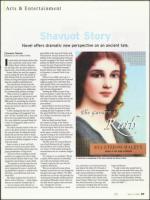
tion in writing the novel The Garden of
Ruth (Plume; $14), her second work of
fiction, to bring some logical endings to
what she considers unfinished text.
"My novel doesn't deviate from the
Bible at all:' says Etzioni-Halevy, 73, the
author of 14 academic texts addressing
her scholarly field, political sociology.
"What I write is in addition to the
Bible, not instead of it. My mystery novel
comes from the mystery that is in the
Bible itself. I'm unraveling the solution:"
While Etzioni-Halevy labels her book
fiction, her instincts take her in a differ-
ent direction.
"I have a feeling that the way I write
is the way things really happened:' she
says. "It's like I traveled back in time, and
this is the way people lived and talked.
It's a very subjective, personal thing; but
I think I'm bringing the Bible closer to
modern readers."
The author reminds readers of the nar-
rative in the Book of Ruth as she injects
her own plot lines. Recalling the Jewish
family that moved from Israel to Moab,
she tells about Naomi, who is left a widow,
as are her two Moabite daughters-in-law,
Ruth and Orpah.
Naomi returns to Israel with Ruth,
and the two women face poverty. Ruth
ultimately marries Boaz and becomes the
great-grandmother of King David.
"The next of kin, according to Jewish
tradition, was supposed to marry Ruth;
but he refused," Etzioni-Halevy says. "This
opened the way for Boaz to marry Ruth.
"The mystery is that the man who was
supposed to become Ruth's husband is
never mentioned by name. I started ask-
ing myself how a person so central to the
story has a concealed name and wrote
about that."
The author explains that the Book of
Ruth is read on Shavuot — which begins
this year at sundown Tuesday, May 22
— for two reasons. First, Shavuot is a
harvest festival; and Ruth met Boaz in the
grain fields at the time of the barley and
wheat harvest. Second, Shavuot also is the
holiday of the commemoration of the giv-
ing and accepting of the Torah; and Ruth,
perhaps the Bible's most famous convert,
accepts the God of Israel and the Torah.
"I myself followed Ruth's example
Etzioni-Halevy says. "After many years
of alienation, I accepted Torah in my
own life.
"When I was a child, I grew up in a
religious boarding school; and I expected
religious people to be a lot better than
other people. What I saw around me was
that they were just like everybody else,
and I became disappointed.
"Reading the Bible was part of my
return to Judaism. I didn't discover the
Bible until late in life, when I realized
that what I learned in school was not the
real Bible. I was fascinated by the rich
personalities:"
Etzioni-Halevy was born in Vienna,
where she and her parents lived until
escaping the Nazi occupation in 1939.
She spent World War II in Italy, early on
in an Italian concentration camp and
later in hiding.
After her family reached Israel,
she studied sociology at the Hebrew
University in Jerusalem and received her
doctorate degree from Tel Aviv University.
Married for the second time, the
author spent a number of years study-
ing and working in the United States and
Australia. She has three grown children
and six grandchildren.
"My first novel, The Song of Hannah,
was a Rosh Hashanah book;' explains
Etzioni-Halevy, who turned to fiction
as a chance to find readers looking for
entertainment and not academic enlight-
enment.
"In writing it, I was troubled. I felt the
scripture did an injustice to [Peninah],
one of the true heroines of the story.
I wanted to give her the voice that the
scriptures denied her.
"She was an unloved woman whose
husband scorned her love even though she
had given him many children. The Bible
describes her as the one who provokes her
rival Hannah (Peninah's childhood friend
and husband Elkanah's second wife), but
the Bible doesn't explain what motivated
her. I attempted to do that."
Etzioni-Halevy, currently on a book
L11...1 1 41
C
•
0
7.' ,2,- .)000
0 0 0
(.3 0
0
0 0 C)
■-■
1.0 Li %I A.,
0 0 0 0 0 0 0 0 0 0 0 0 0 0
0 0 0 0 0 0 0 0 0 0 0 0 0 0
0 0 0 0 0 0 0 0 0 0 0 0 0
0 0 0 0 0 0 0 0 0 0 0 0 0
0 0 0 0 0 0 0 0 0 0 0 0
0 0 0 0 0 0 0 0 0 0 0 0
0 0 0 0 0 0 0 0 0
0 0 0 0 0 0 0 0 0
b.,
a I' a
E 11
ETzioNI- H A
Author of The Song of Hannah
A historical re-imagining of the story behind the Book of
tour, will release a new historical work
next March. She offers The Triumph of
Deborah as a story of the woman she con-
siders most prominent in the Bible.
"I have been totally fascinated by the
women of the Bible, and I identify with
them," Etzioni-Halevy says. "Even though
they lived thousands of years ago and
so much has changed, they still are close
and similar to us in their fears, anxieties,
Ruth
hopes and desires.
"I want to take other people back in
time with me and make them enjoy this
world. I also want them to read novels
that have twisting plots and stories of
love, betrayal and friendship. Nothing
excites my imagination more than stories
about the Bible."
2 07
37