

Arts & Entertainment
Hail To The Scripter
Theater honoring America's foremost Jewish playwright opens on U-M campus.
Suzanne Chessler
Special to the Jewish News
Ann Arbor
T
wo productions about the
Holocaust are at the center of
events planned for the grand
opening of the Arthur Miller Theatre on
the campus of the University of Michigan.
Playing for Time, written by Miller, is
adapted from a biographical account by a
part-Jewish French cabaret singer forced
by the infamous Dr. Josef Mengele and the
Nazis to perform in a women's orchestra at
Auschwitz.
The Charlotte Salomon Project, con-
ceived and adapted by Jessica Brater and
Miriam Felton-Dansky, examines the life
of a Jewish artist whose work depicts her
family's experiences during the rise of the
Nazis.
The opening programs, scheduled
March 29-April 16, also include the Global
Miller Symposium, which features pre-
sentations by members of the playwright's
Birth Of
A Theater
Attention is paid to
Holocaust during
opening events.
Suzanne Chessler
Special to the Jewish News
essica Brater was browsing
the Jewish Museum in New
York City when she first saw
the paintings by Charlotte Salomon.
The images capture European life as
the Nazis were coming to power.
Impressed by the expressiveness of
the renderings and the vast number of
them, Brater bought the catalog and
frequently would look through it.
Artistic director of the experimen-
tal theater company Polybe + Seats,
Brater showed the catalog to company
members and they came up with the
play The Charlotte Salomon Project,
which joins the series of events mark-
ing the opening of the Arthur Miller
j
58
March 29 2007
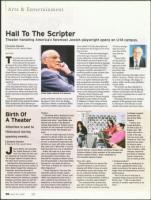
Arthur Miller: Beloved U-M alumnus.
family and theater scholars; scenes from
the opera A View From the Bridge,
which has a libretto co-written by Miller;
and distinct exhibits, which showcase
Theatre.
"l like being able to familiarize more
people with Charlotte Salomon, her
artwork and story," says Brater, who
teaches and works in the Barnard
College Department of Theatre and is
studying for her doctorate in the City
University of New York theater pro-
gram.
"I think it's really important to bring
attention to female artists who some-
times have been forgotten. Her body
of work is absolutely remarkable and
certainly on a par with other artwork
that came out of World War II and the
Holocaust and had a lot of attention."
Brater, 28, grew up in Ann Arbor
and is the daughter of Miller friend
and biographer Enoch Brater. She
directed her company's theater piece
and will participate in the Global Miller
Symposium. Her panel will discuss
"The Place of Playing for Time in the
Miller Repertory."
"I think Playing for Time and The
Charlotte Salomon Project clearly
complement each other," Brater says.
"Miller had adapted his play from a
story related to the Holocaust. Our
adaptation of the Salomon paintings
and story follow in the tradition of
what Miller was doing by turning a
items related to the late playwright and
the architecture and design process of the
new structure.
"When the idea for this theater began
seven years ago, it was part of the uni-
versity celebration to honor Miller on his
85th birthday:' says Enoch Brater, U-M
Department of English professor planning
and moderating the symposium. "Miller
had been asked many times by theater
companies and other universities if it
would be possible to name a theater after
him, and he always had declined.
"When he was asked by his alma mater
to do so, he agreed enthusiastically. The
long and generous association that Miller
had with the university is key to all of this.
He made many trips to Ann Arbor and
was the central speaker for the 50th anni-
versary of the Hopwood [writing] Awards:'
Kuwabara Payne McKenna and
Blumberg Associates of Toronto designed
the theater, located within the Charles
R. Walgreen Jr. Drama Center on North
Campus. It seats 270 in straight prosce-
nium configuration with the option of a
3/4-thrust arrange-
ment. No seat is
more than 25 feet
away from the
stage.
"Arthur Miller
saw the plans for
the theater and
approved of what
we were doing,"
Enoch Brater
says Brater, who
has completed
three books about the playwright: Arthur
Miller's America: Theater and Culture
in a Time of Change, The Stages of
Arthur Miller and the newly published
Global Miller.
"His priority was that it should be a
space with the primary aim of allowing
students to learn their craft. He did not
want it to be a booking house or a place to
bring celebrities:'
In keeping with the focus on students,
planners of the opening events turned
to Playing for Time because it could
include many theater and music majors.
Photo courtesy of Jessica Brater
to theater projects
connected with
IR
NM iFty
the Arthur Miller
---1-
Tr so —
ar
ire f Itifd
I
Theatre.
a i4 tri_m_mt
"I hold a very
broad definition
of what a play is,"
fig
Brater says. "We
didn't start with a
script in the way
that was done with
Playing for Time. Our
approach has been
to bring in mate-
rial, work with it in a
room of actors, make
Artistic Director Jessica Brater and Katya Schapiro and
changes, improvise
Catherine Wallach, fellow members of the experimental
and bring in material
theater company Polybe + Seats, collaborate on
found
in improvisa-
The Charlotte Salomon Project.
tion to come up with
story into a play.
a finished product."
"Paying attention to a person like
As Brater brings her production to
Charlotte Salomon is very much in
Ann Arbor, adjustments have to be
keeping with Miller's focus on social
made according to the space, which is
and political issues and change. For
bigger than she experienced in earlier
me, as a feminist theater director,
performances.
bringing attention to a [talented]
"Part of the fun of directing is
woman is my interpretation of Miller's
changing things around all the time,"
tradition of socially aware theater."
Brater says. "I like to experiment,
The complementary productions
and this is another opportunity to do
also offer contrast to showcase the
that." I I
diversity that the university can bring
fkr; kw3
`1 11
farcarrit
;t•