

To Life!
HOLIDAY/PESACH
101
Passover Basics
Meaningful holiday recalls freedom and our connection to God.
p
because slaves ate hurriedly; the affluent and free were able to recline on cushions. On
assover is one of the most important Jewish festivals of the year, and its high
erev Pesach (Passover eve), rich and poor are indistinguishable and all are free and thus
point is the seder. Experiencing this wonderful Jewish meal and interactive
privileged to recline. Many families have the tradition of placing pillows on each chair or
"happening" is to live through all the varied themes of the Passover festival.
at least having the seder leader follow this practice of reclining.
The most obvious theme of the eight-day festival is redemption. In the exodus story,
which Jews are commanded to tell their children every year on Passover, the Jews were
redeemed physically from slavery. While Pesach is z'man heyruteinu, the season of our
To tell the story, Jews have created an ingenious work of pedagogy. The "script" for this
freedom, it is also a festival that speaks of spiritual redemption. Jews were freed from
central ritual of Passover is the Haggadah (literally,"telling"). It contains questions and
mental as well as physical slavery. It was as a physically and spiritually free people that
answers, stories, show-and-tell, song, food as reward and symbol, pathos and suspense.
the Jewish nation prepared to receive the Torah on Mt. Sinai.
The creation of this script took place
The notion of spiritual redemption is,
;
,)•
over hundreds of years at the beginning
in part, demonstrated by the fundamental
441 .0111MILVI IIPAILW111 4Whilla rr4114 •11111, 0111■ 144Mktgidieir
of the Common Era. There is evidence
Jewish idea that in every generation every
4
go
spa a *a4 a a dolt 114:11
* Alt * • a- *
that parts of the seder were in a fixed format
individual is obliged to view him or herself as
by the time of the Mishnah (second to third century
though he or she had actually gone forth from Egypt.
C.E.).
Egypt is Mitzraim in Hebrew. It stems from the root tzar,
There are a number of symbols that occur throughout
which means narrow or constrained. To leave Egypt, each indi-
the seder, but perhaps the focal point of the whole event is the
vidual must break out of personal narrowness, becoming free to
seder plate. It contains a roasted shankbone, symbolizing the
achieve his full spiritual potential.
Pesach sacrifice in the Temple; a roasted egg, symbolizing either the
Another explanation of the root tzar is calamity. In this view,
spring season or mourning (for the destruction of Jerusalem); maror
Mitzraim represents the country of calamities that befall the Jews.
(bitter herbs), to represent the bitter experience of the Hebrew slaves;
The seder includes many allusions to a future messianic redemption.
haroset (a mixture of apples, nuts, raisins, spices, wine), symbolizing
One of the clearest symbols of the presence and hope of future redemp-
the mortar the Hebrew slaves used to build for the Egyptians; and kar-
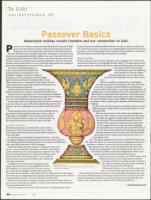
tion is the Cup of Elijah that is placed on every seder table.
pas (parsley, celery, or another green vegetable), symbolizing the green
Passover also contains a strong connection to the theme of creation. It
of spring.
is one of the four new years of the Jewish calendar. Nisan, the time the
The table must also have three pieces of matzah, each piece used for
festival occurs, was traditionally seen as the first month of the Jewish
a different purpose, usually held in a special pouch made to be used
year.
during the seder.
Pesach celebrates spring, rebirth and renewal, symbolized by the
There are many instances of the number four throughout the
green karpas and the egg on the seder plate. It is also a time of
seder: four cups of wine, four sons, four matriarchs, four names
"beginning," as exemplified by the first grain harvest and the
for Pesach, four Aggadot, four blessings, four types of food on
birth or creation of Israel as a nation. As a newborn nation, the
the seder plate. The most well-known example is the Arba
Jews began their journey to receive the Torah on Mt. Sinai.
Kushiyot, or four questions. These questions, usually recited
by the youngest person at the table, are meant to highlight
Spiritual Cleaning
the main differences between this meal and all other meals of
Meticulous preparation is the theme of the weeks and days
the year. They are also a brilliant way of keeping young people
leading up to Pesach. Every speck of hametz (yeast or leaven)
interested and involved in the events of the seder. They include
must be removed from the house in the days before sitting down
queries about why we recline, why we dip food and why we eat
to the seder table.
certain types of food.
On Passover, we also rid ourselves of spiritual hametz — any type
One of the ethical components of Passover is called Ma'ot Chittim, liter-
of arrogance, indulgence or self-assertion. As slaves, Jews had no choice but
ally "money for wheat." It is a tax imposed on the congregation in the period
to be self-denying. After liberation, they had to freely choose to humble them-
leading up to Passover to raise money so that the poor can buy wheat to
selves and subject themselves to God's sovereignty.
bake matzah and buy other special foods required for the festival. Even
Traditional Judaism interprets hametz as a metaphor for the yetzer
though most congregations would not formally impose such a tax, it is
ha-rah — the evil inclination. The absence of leaven is epitomized by
very common in Jewish communities throughout the world to raise
matzah, the flat bread Jews eat during Passover. Matzah is also a link
money or send out Passover food baskets for the poor.
between exile and redemption. It is the bread of affliction, eaten
The first and last days of Passover are full festival days, when
by slaves who did not have decent food. It is also a symbol of
traditional Jews do not work. Traditional Jews outside of
freedom because when the Jews left Egypt, they rushed away
ivig/7447
Z'T,V.:
47.7/17.17/
Israel observe the first two and last two days as full festi-
111 Tk!k 7\71V.N .,407\r:,
with unleavened bread.
vals, while in Israel and among liberal Jews worldwide, it
In telling the story of the escape from Egypt and the
Elijah's Cup. Lodz, 1935.
is just one day at each end of the festival.
plagues that preceded it, Jews also highlight God's role in
Reproduced with the cooperation of Historicana, publisher of the New Edition of The Szyk
Haggadah,
www.szykhaggadah.com
The last day of Passover is one of the four times of the
the redemption. It is made clear that it was not a messen-
year
we recite Yizkor, the memorial service for the dead.
ger or angel, but the almighty God who redeemed the Jews.
The
counting
of
the
Omer
commences
on the second night of the holiday. Omer was
The events and circumstances of the Exodus, from the calling of Moses at the burning
the
measure
of
barley
brought
to
the
Temple
on the second day of Passover as an offer-
bush to the plagues brought against the Egyptians, proved beyond any doubt to Pharaoh
ing
for
the
beginning
of
the
harvest.
The
days
will then be counted publicly for seven
and all humankind that the one God is sovereign over all the earth.
weeks
(a
week
of
weeks),
which
culminates
on
the 50th day with Shavuot.
Beyond that, the Exodus is a formative experience for the Jewish people. What was
once a group of slaves gains an identity as a nation. This event lays the foundation for a
— myjewishlearning.com
covenantal relationship with God.
The seder is supposed to take place with everyone in a reclining position. This is
40
March 29
4
2007