

Business & Professional
ON THE COVER
Cellular Success from page 34
0. ;
ReCellular has partnerships with dozens of national companies.
a point where about 125 million phones
are 'retired' yearly, and most of them are
thrown out. We have recycled about 15
million phones since 1999, and we now
recycle more than 300,000 phones a
month."
In November, ReCellular was named to
Inc. magazine's "Green 50" list, companies
recognized for achieving success in the
34
March 22 • 2007
environmental industry. A 2005 report
by D.F. Blumberg & Associates, a national
management consulting firm, named
ReCellular the top collector of used cell
phones in the country, with more than
half of the market share.
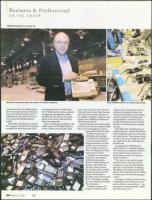
There are cell phones everywhere in the
56,000-square-foot ReCellular facility in
Dexter, a former auto parts plant. They
Some 300,000 phone are recycled each month.
are in boxes, barrels and tubs. "Two tons
of the stuff comes in here daily;' Newman
said. There also are plenty of phone cov-
ers, chargers, wrappings, wiring, and even
compact discs explaining cell phone use.
All of this gets recycled.
Newman, who grew up in Wayne where
his father, Louis, owned a junkyard, fondly
refers to the arriving phones as "just a
better grade of junk." He adds,
"The main thing is that, by
refurbishing and recycling
everything, we're keeping tons
of material, mostly made of
cadmium and lead, out of the
landfills. And in the process,
we're creating new jobs. Our
efforts are helping the environ-
ment and the economy."
ReCellular has partnerships
with dozens of companies,
including wireless giants
Verizon, T-Mobile, Sprint and
Motorola, and retailers like
Wal-Mart, Costco and Best
Buy. Through collection drives,
the partners gather used cell
phones and send them to
ReCellular, which either recycles
them or refurbishes, reconfig-
ures and resells them, for about
$16 to $18 apiece.
ReCellular engineers "de-
program" the many models
of phones, first identifying the phone's
software, then testing the phone and
removing such things as personal phone
numbers and photos. The phones are
reprogrammed to customers' needs, if
possible. Some phones are so "beat-up"
that they are taken apart just to salvage
the parts.
About half of the rebuilt phones go to
resellers in the U.S., and the other half are
sold to developing countries in Asia, Africa
and South America. Those phones, in turn,
are sold at discounts to people who other-
wise might not be able to afford phones,
Newman said.
Accompanying ReCellular's green
industry efforts is a charitable program.
The company buys cell phones collected
by the partners from customers and
donates the net profits to the partners'
choice of charities.
"The carriers come up with unique
collection drives, which they and the
customers can turn into local fundrais-
ing drives:' said Newman. "In Chicago,
they filled an old whiskey barrel full of
phones. We've donated nearly $15 million
to charity since we started this program
in 1999.
"Our biggest challenge in this business
is building consumer awareness in con-
nection with our carrier partners — get-
ting people to donate the phones, rather
than throw them out." 1