

M etro
Detroit Incidents Up
But the ADL audit reports national anti-Semitic events are down.
Keri Guten Cohen
Story Development Editor
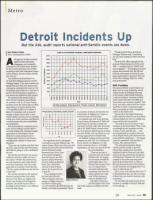
Audit of Anti Semitic Incidents, 1986 2006 (National)
2200
A
2000
all
Alklkil 1.
Al
1800
1600
c 1400
r,
cif
1200
1000
800
z
600
A
A
1111
Alan.'
Alia
AIM
11111rAIIMIIII.
\ '
lthou anti-Semitic incidents
against Jewish individuals,
synagogues and community
institutions in the United States declined
for the second consecutive year in 2006,
according to new Anti-Defamation League
(ADL) statistics, the rate in Metro Detroit
was "way up:'
"Our numbers increased from 9 to
14," said Betsy Kellman, director of ADL's
Michigan Region. "Even these numbers are
lopsided because they don't represent dis-
crimination complaints that come in. Only
14 incidents may sound not so bad, but we
get 50 to 60 discrimination complaints a
year that are not reflected in this number."
The national ADL's annual Audit of
Anti Semitic Incidents, issued March
14, counted a total of 1,554 anti-Semitic
incidents across the United States in 2006,
representing a 12 percent decline from
1,757 reported in 2005. An "incident" is
limited to vandalism, such as property
damage, cemetery desecration or anti-
Semitic graffiti, and harassment, including
violent acts of anti-Semitism, and physical
or verbal assaults directed at individuals
and institutions.
Still, discrimination complaints can be
quite serious. Kellman says her office is
currently dealing with complaints regard-
ing teachers in a Huntington Woods
elementary school, among faculty at
Michigan State University and between
undergraduate students at Wayne State
University.
"These are not incidents and don't show
up in the audit, but they show the pattern
and behavior going on in the community:'
she said.
She explains that Detroit is an unusual
confluence of factors unlike any city in
the country. "We have the country's larg-
est Arab population and a large African-
American community; we're very segre-
gated and our economy is bad',' she said.
"We have unique problems no one else has
to deal with:"
She recently attended an ADL regional
directors meeting in New York, where
directors from Texas, Los Angeles and
Miami were dealing with immigration
problems. She found what her office is
handling in Metro Detroit is very different
from any other region.
-
-
400
MI
lilrd
200
0
o IJA
(7% ET,
cAch a, a,a,a‘ 0,
‘I)
cr‘
m a ,
CO CO CO CO ON
cA
-
U
moN0,00000
o. 0, 0
0 0 0 0 0
MI"C ■ iC\INNN
Year
*Total Incidents *Harassments, Threats, Assaults •Vandalism
Reported Incidents of Anti-Semitism In Michigan 1999-2006
40
an escalation of rhetoric between the two
communities. It frightens me. I wish we
would tone down on both sides."
30
As examples, she cited recent speeches
25
by local imams Mohammad Ali Elahi and
20
Sayid Hassan al-Qaswini as being very
15
anti-Israel; and last week's ZOA-sponsored
10
.--•-•
talk by Dr. Tawfik Hamid, a former mem-
5
0
ber of an Egyptian Islamist group, as being
very anti-Muslim. ADL was listed as a sup-
J
porting organization for Hamid's talk.
Year
She delined comment on this particular
program, but said, `ADL is in a funny posi-
One significant factor is Michigan's
tion in Detroit. Our allegiance is to the
"horrendous economy:' Kellman said. "We
suspect things will get worse this year, with Jewish community but, as a civil rights
organization, our doors are open to all who
increased activity from the Ku Klux Klan
face discrimination.
and the National Socialist
"There are no wars or
Movement [neo-Nazis]. Most
incursions now [for Israel],"
of the people belonging to
Kellman said. "I'm hoping
these hate groups are work-
we can start to rebuild the
ing class people. When they
relationships [here] that
lose jobs and get in financial
blistered last summer. There
binds, they usually find
are a lot of good hearts
someone to hate or blame,
and souls working in this
and we [Jews] go to the top
community who have kept
of their list.
things
together for a long
"We are girding ourselves
time.
If
they continue to
,
'
she
said.
for a bad year'
work, we should be OK."
"We're seeing lots more hap- Betsy Kellm an
Still, Metro Detroit has
pening on college campuses,
the third highest hate crime
and there's a frenzy going
rate in the country, according to the ADL
on in Detroit back and forth between the
audit.
Muslim and Jewish communities. There's
Num ber If In c idents
35
\
,
,
0
0
0
0
0
0
0
0
N
tn
0
0
r■
0
0
"People just don't know that about
Michigan:' Kellman said. "Considering
our size, that's unheard of. We're very busy
here."
The local ADL office responded to the
increase of discriminatory activity in late
2006 — including reports of thefts from
area synagogues — by bringing in security
experts from national ADL, the FBI and
local law enforcement to brief local syna-
gogue representatives about how they can
secure their buildings. Fifty-five institu-
tions participated.
Still Troubling
The national decline in anti-Semitic inci-
dents came in a year marked by several
violent attacks, including the shooting
at the Greater Seattle Jewish Federation
in July by an Islamic extremist, in which
staffer Pamela Waechter was killed and
three others were seriously wounded. That
attack and others underscored the continu-
ing threat to Jewish community institu-
tions, particularly at a time of heightened
conflict in the Middle East.
Tensions from the Israeli-Palestinian
conflict and last summer's war in southern
Lebanon boiled over onto U.S. college cam-
puses and into anti-war protests.
"The audit is just one measure of anti-
Semitism in the United States. There is also
an onslaught of anti-Semitism out there
in blogs, e-mails and Web sites — and
most significantly in conspiracy theories
about alleged Jewish power that have even
penetrated the mainstream — that simply
cannot be quantified," said Abraham H.
Foxman, ADL national director.
"The national immigration debate
caused extremist groups to partially
refocus their energies away from their
traditional objects of hate and onto other
minority groups, particularly immigrants
and Hispanics," Foxman said. "One recent
example of this is the surprising resur-
gence of the Ku Klux Klan. So while we
find any downward trend in the numbers
on anti-Semitism encouraging, there is no
cause to celebrate just yet."
Glen S. Lewy, ADL national chair, said, "It
is disturbing that there are still an average
of about four anti-Semitic attacks per day
in America."
The full 2006 ADL Audit of Anti Semitic
Incidents is available on the ADL Web site
at www.adl.org .
-
March 22 2007
13