

Purim At A Glance
Elizabeth Applebaum
Special to the Jewish News
•When It Happens: The 14th of Adar,
which this year corresponds to sundown,
Saturday, March 3, until sundown, Sunday,
March 4.
•What It Commemorates: In the 4th
century B.C.E., Esther, the Jewish queen of
Persia, and her cousin, Mordechai, thwarted
the plans of the evil Haman, the top offi-
cial in the court of Esther's husband, King
Ahasuerus, to kill all the Jews in the Persian
empire.
• What Purim Means: Purim means
"lots" (objects used in making a choice by
chance, such as dice). It refers to the lots
cast by the superstitious Haman to deter-
mine the month in which to exterminate
the Jews (Esther 3:7; 9:26).
• Ceremonies And Rituals: The main
event of Purim is the public reading of
Megillat Esther, the Book of Esther (or
Scroll of Esther), commonly known as the
megillah (which in Hebrew means "scroll").
The day before Purim is a fast day,
Taanit Esther (Fast of Esther). We fast
because Esther also fasted when confronted
with the news of her people's impending
doom and to give her the spiritual strength
to reveal her true identity to her husband,
the king, and thus appeal for his help in
defeating Haman.
This year, the day before Purim is
Shabbat, but with the exception of Yom
Kippur, we do not fast on Shabbat. Thus, the
Fast of Esther is deferred to the Thursday
before Purim, which is March 1 (we also do
not fast on Friday because of the inherent
conflict with Shabbat). The fast begins at
5:56 a.m. and ends at 6:57 p.m.
Then, at sundown on Saturday, March
3, Purim begins with Maariv, the evening
prayer service. In most congregations, the
megillah is read during this service. Some
synagogues and temples hold additional
readings after Maariv. The next morning,
during the Shacharit service, the megillah
is read again. Some synagogues hold fur-
ther readings later in the morning.
• How To Celebrate: Attend both the
evening and morning readings of the megil-
lah. Drown out with sound every mention
of Haman's name. You can boo and hiss, or
use any type of noisemaker. The traditional
type that spins and makes a clicking noise
is known in Yiddish as a grogger.
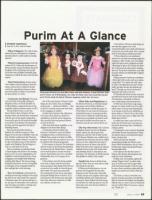
Three-year-old twins Lily and Abby Foltyn with their brothers, 2-year-old twins Evan
and Eli Foltyn, all of Birmingham, are ready for Purim. (See more local kids dressed
up for Purim inside the March Platinum magazine, within this JN issue.)
One of the main themes of Purim is that
things are not as they seem. Accordingly,
many people — adults and children — like
to dress in costume (some even wear them
to the synagogue or temple).
Another Purim theme is the celebration
of survival. Thus, Purim is a festival of
unbridled joy with lots of fun. Humorous
skits, practical jokes and general silliness
are part of the day.
Aside from hearing the megillah, we are
obligated to do three other things:
1)Send gifts of food to fellow Jews.
Known as mishloach manot in Hebrew
(sending portions), or shlachmoness in
Yiddish, these consist of at least two differ-
ent types of food that are ready to eat or can
be enjoyed with minimal preparation.
2) Give money to the poor. The minimum
amount we give is the lowest denomination
of currency (in the United States, 1 penny),
and it must be given to at least two poor
persons. Fortunately, most of us can afford
substantially more, so it is proper to be
generous.
3)Eat a festive meal. On Purim, include
more wine or liquor with the meal than
usual, enough to make things lively (but not
so much as to be unable to recite the grace
after meals). The meal may extend into
the evening after Purim, but it must begin
during the daylight hours of Purim. Try to
invite guests to the Purim meal, especially
those who otherwise would not, or could
not, celebrate on their own.
• Other Rules And Regulations: In
the Sheinonah Esrei, or Amidah (stand-
ing) prayer, and in Birkat HaMazon
(grace after meals), include the prayer of
Al Ha-Nisim. Do not recite the Tachanun
(penitential) prayer at morning and after-
noon services. Unlike the major holy days,
Purim does not prohibit any kind of work:
fires may be kindled, electricity may be
turned on and off, cars may be driven, etc.
• The Day After Purim: This is known
as Shushan Purim. The Jews of Shushan,
Persia's capital city, did not gain their
deliverance until the 15th of Adar (Esther
9:18). Because Shushan was a walled city, it
became the law that Jews who live in walled
cities or in cities walled from the time of
Joshua (successor of Moses, who led the
tribes of Israel in their conquest of Canaan)
celebrate Purim on the 15th of Adar (this
year, Monday, March 5). Jerusalem is one
such place. The only place in North America
that qualifies is Quebec City, Canada.
• Family Fun: Purim is all about hav-
ing a lot of fun. Here are some ideas to help
your family do just that:
1) Photocopy family photos or cut out
pictures from magazines for the main
characters in the Purim story. Then affix
to sticks and put your puppets center stage
and tell the holiday story. Little girls may
yearn to be Queen Esther, but even teenag-
ers will have fun with this project if you let
them select their least favorite celebrity to
serve as Haman.
2) One theme of Purim is that things are
not what they appear to be. Visit
www.puzzlemaker.com, which will help you
create your own word search. This is a great
treat to send along in mishloach manot.
3)Pick a theme for your mishloach
manot. You can make everything purple, for
example, or offer a make-your-own Italian
night with pizza sauce, spaghetti and indi-
vidual bags of spices. Or consider the favor-
ites of the person to whom you're sending
the treat. If your best friend loves cars, look
for pasta wheels and individually wrapped
chocolate cars.
Feeling romantic? Send your sweetheart
a Purim gift with a code, such as an onion,
a large letter "U," a plastic key with some
lox and a chocolate heart, because "Onion
[only] you have the key that unlocks my
heart" (Terrible, yes, but it's the kind of
thing that will work on Purim).
4) If family and friends are far away, you
can still send a Purim card via the Internet.
The best place, with plenty of choices:
www.123greetings.com/events/purim/.
5)Write your own Purim song using a
favorite (or utterly awful) tune. You could
tell the story of a man named Mordechai
to the theme of the Beverly Hillbillies or
Queen Esther to "Maria" (from West Side
Story) or the entire story to Billy Joel's "We
Didn't Start the Fire."
6)Adults may want to pass on the cos-
tumes, but it's pretty easy to just put on a
hat and be dressed up. Have a family hat-
making contest.
7)Looking for a new recipe for the peren-
nial holiday favorite, hamantashen? Check
out judaism.about.com/od/purimrecipes/
Purim_Recipes.htm.
There's one here for chocolate
hamantashen dough and Tofutti cream
cheese-filled hamantashen. Also try www.
jewishrecipes.org/recipes/purim/haman-
taschen/index.html.
8)We all know the fate that came to
Haman. After dinner, play hangman, but
make the words backwards.
9)Make your own holiday napkins by
writing "Happy Purim!" on plain white
ones, or do the same with a paper table-
cloth. Permanent markers work best; just
be sure to have something underneath the
napkins (to absorb extra color) while you
work.
10)Purim is a time to remember our
fortune in being saved from a terrible fate.
Who is someone who helped you through a
difficult time, or came to your aid when you
were in trouble? Write that person a note to
say, "Thank you." LI
March 1 • 2007
29