

Richard
Bernstein
A Passion For Making A Difference
His days start at the health club around
5 a.m., where he runs 13 miles a day. He
Karen Schwartz
Special to the Jewish News
A
sk Richard Bernstein to talk
about himself and he'll likely
change the topic. He would rath-
er talk about the causes he's fighting for,
the communities he wants to build and
the people he wants to connect.
But Bernstein, 33, who grew up in West
Bloomfield and lives in Birmingham, has
no shortage of awards and accomplish-
ments. He was honored recently by CNN's
Anderson Cooper, is training for his fifth
marathon and has been recognized for
his community service efforts by groups
around the state. He is scheduled to
run in his sixth marathon in March in
Los Angeles and hopes to participate in
August in an Iron Man competition in
Oahu, which entails swimming 2.5 miles
in the ocean, biking 110 miles and then
running a 26.2-mile marathon.
"Because it's the next challenge said
Bernstein, who is blind.
His friends talk about him as a person
who inspires others and makes people feel
comfortable, a person who takes on chal-
lenges and steps up to the plate without a
second thought when it comes to leader-
ship.
To him, though, it's not about being a
leader.
"I just think you go out and do things,"
he said.
goes to work, meetings, events and holds
class, then is not surprised to find himself
heading home at 11 p.m.
Currently, he's working to start a Detroit
chapter of the Achilles Track Club, which
brings people with disabilities together to
participate in mainstream athletics, and
he's preparing to file a complaint against
the University of Michigan regarding mak-
ing the football stadium more accessible
to disabled students.
Even on weekends, when he travels to
New York to run in the freezing cold with
the Achilles Track Club in Central Park,
he's thinking about ways to bring people
together: Last weekend he was busy dis-
cussing ways young Jews from Detroit
who come to New York can get involved
with Manhattan Jewish Experience, a
Manhattan-based group for young Jewish
professionals.
He also wants to urge the Jewish corn-
munity to use its influence and resources
to get government to work better for
everybody. "This is my passion; you focus
on issues that are going to make a differ-
ence for people in a very empowering,
very constructive and essential way," he
said. "That's the key."
It is a passion that runs through his
work and activities. He heads up the pro
bono division of the Law Offices of Samuel
I. Bernstein, his father's Famrington Hills
law firm, putting in 15-hour days to rep-
resent people who would otherwise not
be able to afford representation on issues
with large-scale policy implications.
Bernstein has gone up against the
airport authority to fight a ban that
would have kept commercial drivers
from coming into the terminal at Detroit
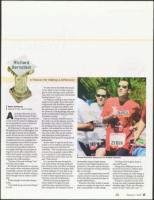
Richard Bernstein running the Los Angeles marathon.
Metropolitan Airport, fought against
former Gov. John Engler's proposed reor-
ganization of the state's special education
system and fought for working wheelchair
lifts on city buses.
Issues of public transportation are still
of great concern to him, he said, because
of the role public transportation plays in
people's independence.
Bernstein, who relies heavily on memo-
rization to complete his legal work, said he
feels a responsibility to make change.
"To whom much is given, much is
expected:' he said.
Among other affiliations, he sits on
the Board of Governors at Wayne State
University in Detroit and teaches a
senior-level seminar on social change at
the University of Michigan. He attended
Northwestern University for law school.
He hopes to continue to do the work
he does now and to continue fighting for
disability rights. "That's why I became a
lawyer," he said. "That's who I are
February 1 • 2007
17