
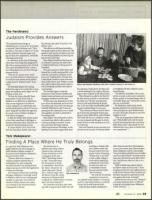

The Herdmans:
Judaism Provides Answers
"We questioned many things in
Christianity, but no one in the church gave
us answers," Batya Herdman said. "They
just told us, 'You have to believe it.'" So she
and her husband, Netanel, began look-
ing for their own explanations, eventually
searching Jewish texts.
At a bookstore in the state of Wyoming
where they were living, Batya happened to
talk with a woman wearing a Star of David.
Their quick friendship became a connec-
tion with Judaism on a new level: through
someone Jewish.
"What are the chances that I would
meet one of the 400 Jews in Wyoming and
we would become friends and be invited
to their home for Shabbat meals?" Batya
asked.
The friendship helped, but studying
without the support of a real teacher or syna-
gogue, the Herdmans had to figure out a lot
of things on their own.
"We took the Torah so literally,' Batya
remembered."It said,`Don't work on
Shabbos: so we didn't. But we didn't know
what we were supposed to do while we
weren't working. So, we stayed home and
read the Torah portion, with no TV, no com-
puter" Along the way, Batya also signed up
for a crash course in Hebrew reading at a
local Reform synagogue.
In 2003, the family, which by then includ-
ed son Calev, moved back to Michigan so
Netanel could attend school. They also con-
tinued their Jewish learning at home.
At Unique Kosher Carry Out in Oak
Park one day, Batya chatted with owner
Rita Jerome, and asked if she knew of a
Hebrew tutor.
"She told me to call Chana Greenfield, a
first-grade teacher at Akiva," Batya said."She
agreed to teach me, but was blown away that
we were keeping Shabbos and learning, but
that we were not Jewish."
After telling Greenfield of their hope for
an Orthodox conversion, she referred her
to Rabbi Yechiel Morris of Young Israel of
Southfield.
From past experience, Rabbi Morris had
learned that to really understand life in the
Orthodox community, candidates should
live in one. "Frankly, after I told them that,
I didn't think I would ever hear back from
them': Rabbi Morris said. "Within a month,
they called to tell me they found a home to
rent in Southfield, and they were ready to
start learning:'
The Morrises began to invite the
Herdmans to their home for Shabbat and
holiday rituals and meals, and encouraged
synagogue members to do the same.
`At first some were skeptical, but as they
got to know the Herdmans and to see how
committed and serious they were, they got
involved': Rabbi Morris said. "It was eye-
opening for the community to see a couple
who, together, were both so interested in
becoming Jewish."
Batya added, "They embraced us. When
we moved, they called to offer a couch or
a dresser, anything we needed:' In time,
the connections that began with the
rabbi's request became friendships. As the
Herdmans' conversions approached, mem-
Batya and Netanel Herdman with their children Chana, 2, and Calev, 4.
bers planned a bridal shower for Batya and
a Jewish wedding for the couple at the syna-
gogue, with a reception in the Morris' home.
When Netanel was called to the Torah for
the first time for an aliyah as a Jewish man,
the rabbi said,"The men spontaneously
stood up and started dancing all around
him. It was one of the most beautiful, uplift-
ing and profound things I've ever seen.
"They understood what it took for him to
get to that point, learning the brachot, jug-
gling his time;' Rabbi Morris said of Netanel,
who works full time as a warehouse worker
at a steel company and also goes to school,
nearly 40 hours a week, studying to be an X-
ray technician.
Batya and Netanel's actual conversion was
overseen by the Council of Orthodox Rabbis
in Southfield, with their children's conver-
sions following.
"We still have our families, who are sup-
portive, as much as they can be, looking for
kosher symbols on food and being aware of
our beliefs': Batya said. "The Jewish commu-
nity, too, is our family"
The Herdmans continue their Jewish
learning, attend services and Netanel and
Calev participate in a post-Shabbat father-
son class. They hope someday to raise their
children in Israel.
"They are an inspiration': Rabbi Morris
said. While thrilled with what the family
received and learned from the community,
Rabbi Morris said,"I also already see how
influential they are to others to further their
own commitment" 11
Yoni Makepeace:
Finding A Place Where He Truly Belongs
As a gay man, Yoni Makepeace was
highly influenced by the teachings of
Rabbi Mordecai Kaplan, founder of
Reconstructionist Judaism. Makepeace
became Jewish in 1992.
"Judaism offered me a home in a
religious tradition relatively free of
homophobia:' he said, noting that
Reconstructionism was among the first
religious groups to call for the legalization
of same-sex marriage.
After living in several states including
Michigan, Makepeace eventually moved
to Windsor, where he was "seeking legal
equality as a gay man:' In October, he
moved to Ottawa, Ontario, but contin-
ues to belong to the Reconstructionist
Congregation of Detroit.
His introduction to
Judaism came when a fellow
American also studying in
Vienna invited him to visit
a synagogue in the mid-
1980s. "Something clicked':
he said. "It may have been
the strong sense of family
or community, I don't know,
but when I returned to my
church afterward, I found
that I could no longer recite
the Nicene Creed, the central
statement of Christian belief.
I realized that I didn't believe it, indeed,
that I had never believed it"
His conversion took place after meet-
ing with "a long string of rabbis': he said,
including a Chabad rabbi
and a Reform rabbi who
became Conservative dur-
ing the course of learning.
"At that time, it was hard
to find a rabbi willing to
work with an openly gay
candidate for conversion:'
he said, but found one
in Philadelphia-based
Reconstructionist Rabbi
Julie Greenberg.
"My mikvah (ritual bath
required for conversion)
was [Rabbi] Arthur Waskow's swimming
pool," he said. Rabbi Waskow is a political
activist and Jewish Renewal leader.
Raised Roman Catholic, Makepeace's
father had converted from Protestantism
to marry his mother. Born Warren Eugene
Taylor, Makepeace said his name change
"was particularly painful because my father
named me after himself. I love him and his
name, but I felt that the name didn't reflect
who I had become, either as a Jew or as a
gay man:'
While he prefers Jews address him by
his Hebrew name of Yoni, he said, "I chose
Jonathan and David for my English names to
recall the love between Prince Jonathan and
the future King David, expressed over and
over again in the books of Samuel:'
And for his last name, he said, "I dropped
a surname dictionary onto to a table and
it opened to the perfect name: Makepeace
(Oseh Shalom)."
iN
December 21 • 2006
33