
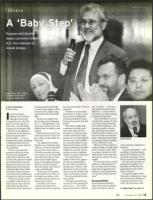

Program with Musli
leaders promotes lis
first, then dialogue to
rebuild bridges.
Najah Bazzy, Victor Begq
(standing), Rabbi David
Rosen and Saeed Kahn
Harry Kirsbaum
Staff Writer
I
n Our Own Words ...
Muslim Voices in Detroit:
Messages to the Jewish
Community" was not the "dia-
logue" that many expected to
hear on Dec. 7 at Adat Shalom
Synagogue in Farmington Hills.
But to the event organizers —
Adat Shalom and the American
Jewish Committee's Metro
Detroit chapter — it was an
important first step in rebuilding
a bridge that had all but been
destroyed last summer after the
war in Lebanon.
"This is a very important
moment in the history of our
Detroit Jewish community:'
Rabbi Herbert Yoskowitz told a
crowd of 200, before four Detroit-
area Muslim leaders answered
prepared questions and tried to
dispel notions the Jewish com-
munity had about their beliefs
and politics. The answers, how-
ever, reinforced more differences
in perspective than they resolved.
"These four agreed to speak
out publicly to the Jewish corn-
munity because they value the
relationships that have been
built and nurtured," said Brenda
Rosenberg of Bloomfield Hills,
co-chair of inter-religious affairs
for the local AJC chapter, along
with Sheldon Toll of Bloomfield
Hills.
"My hope for tonight is that
this evening is just a beginning
for us — the beginning of creat-
ing a larger network of Jews and
Muslims who are willing to come
together."
Rabbi David Rosen, AJC's New
York-based director of inter-reli-
gious affairs, moderated the two-
hour event.
"The tragedy of the relation-
ship that we are looking at today
is that we can look at a period in
the past when we knew how to
live with one another with much
more respect:' he said. "Especially
if we look back to the era under
Islam and the Golden Age of
Spain, when Muslims, Christians
and Jews were able to benefit
from one another in the areas of
science and philosophy.
"We have one of two options
in this world;' he said. "One is to
live despite one another, or live
in relation with one another. It is
obvious what is better."
Saeed Khan, who teaches
in Wayne State University's
Department of History and Near
East and Asian Studies in Detroit,
spoke first.
"Whether or not you realize
this, the four of us here, accord-
ing to most loose definitions,
are militant Muslims',' he said,
because they pray, fast and don't
gamble.
"The ability to define what
is moderate and what is mili-
tant cannot simply be left to
the caprices of what the media
or what somebody else might
decide. And so it's quite plausible
that the scope of who qualifies
as a moderate Muslim is much
larger than the litmus test that
seems to arbitrarily be provided.
If that's the case, then, we have
already overcome a significant
obstacle as a partner in dialogue."
The movie Obsession:
Radical Islam's War Against
the West is overgeneralized,
he said. "If this were shown in
my class, there would be a real
disjuncture in what was being
shown in the documentary and
what is the historical accuracy"
Khan also spoke of the situa-
tion in Darfur.
"Although some will look at
the issue in Darfur through the
prism of race ... this is noth-
ing more than Cain vs. Aber he
said. "Vocations — one being a
agriculturalist and one being a
shepherd — it comes down to
the jealousy over whose offering
is accepted by the Divine.
"The Arab Sudanese were the
nomadic tribes-people who had
a very long-lasting relationship
with the Black Sudanese, a very
interesting symbiotic relation-
ship. Their migration patterns
would take them to Darfur at cer-
tain times of the year, and their
herds would help the agriculture
by grazing the land and making
it more cultivable:' he said.
When the civil war erupted in
southern Sudan, the Arabs stayed
put for survival, he said. "When
two groups of people are in the
midst and have overstayed their
welcome, the conflict of the war
erupted.
"The fact that they are racially
different is really incidental to
the core issue. There has been a
tragic lack of engagement and
initiative by Arab organizations
as well as the American govern-
ment."
Responsibilities
Imam Mohammad Mardini,
leader of the American Muslim
Center in Dearborn, said the
Imam Mardini
Arab community condemns ter-
rorist acts.
"We stood tall together — that
any killing of a human being is
against the holy Koran',' he said.
According to the Koran, "If you
kill one, you kill all of humanity."
The imam also said there are
people who sympathize with
Hezbollah, but "they know it's
against the law of the United
States of America"
He made this appeal: "We've
been in the community for a long
time. We've been in dialogue for
a long time, but don't see any
result. The bottom line is that
A 'Baby Step' on page 14
December 21 2006
13