

I
I
World
Life As Usual
Almost
Hadassah mission revisits Israelis
targeted by rockets.
Keri Guten Cohen
Story Development Editor
hings looked like they were back
to normal in Israel after this
summer's war with the Lebanese
terrorist group Hezbollah, said Annette
Meskin of Sylvan Lake, who was a leader
of the national Hadassah Unity II Mission
Oct. 24-30.
But looks can be deceiving-.
For this mission, a group of 60 from
across the country revisited areas Unity .
Mission I had visited in early August,
while the war with Hezbollah still was
raging.
"We found a woman who had been
hysterical at an apartment building bomb
shelter one of our buses was stopped at
when a siren sounded in Haifa;' Meskin
said, recalling the August mission. "This
time her hair was made up and she had on
makeup; she wanted to show us that her
life had returned to normalcy. But she also
said her life wouldn't be the same again,
that she'd always be waiting to hear sirens
again and that she hadn't seen the last of
being in that shelter."
Still, Meskin said, Haifa was bustling,
the streets were filled with flowers and
buildings that in August were in ruins
were restored.
"It didn't look like war any more she
said.
Even in Nahariya, a seaside town in
northern Israel hit hard by Katyushas,
people were shopping on the street and it
looked like nothing had happened, Meskin
said.
"We were entertained by school kids
who sang and danced for us — kids who
had been in bunkers during the war;'
Meskin said. "But social workers told us of
the trauma in their lives, about many not
eating and sleeping well, of having prob-
lems with their everyday lives. There was
a thunderstorm the day before we arrived
and some of the kids went crazy because it
reminded them of the bombing!'
,
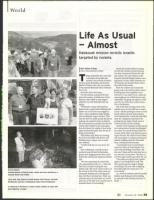
Top to bottom:
Annette Meskin of Sylvan Lake, center, amid tree planting in a
national forest near Sated.
Jerry and Judy Subar of Grand Rapids flank Shlomo and Miki
Goldwasser, parents of kidnapped soldier Ehud Goldwasser.
And in the Israeli tradition of going
on with life, a family invited the group
into their reconstructed home for cake
and cookies. The only evidence of the
Katyusha that had landed (without caus-
ing injury) in their child's bedroom was
the bearings and shrapnel from rockets
they held in their hands.
From the northern tip of Israel, the
group went as far south as Sderot, where
bombing from Gaza regularly occurs
between 6-7 a.m. and 6-7 p.m., when the
most people are out of their houses and
vulnerable. The group was taken to a hill
near the city where they could see Gaza
City in the distance.
One of the most moving events of the
mission was a service held near a memo-
rial in a Ma'alot parking lot where a dozen
Israeli soldiers on leave from Lebanon
were relaxing when a rocket hit and killed
them all. A poignant memorial in the
parking lot was made of bark, parts of
rockets and bits of their clothing.
Another of the mission's moving aspects
was visiting forests burned and damaged
by rockets. At a Jewish National Fund for-
est near Safed, where trees had been grow-
ing for 60 years, the smell of burnt timber
still was pungent. As mission participants
planted seedlings amid the devastated
trees, a family picnicked nearby.
"I had planted trees in Israel before
said Jerry Subar of Grand Rapids, "but
never with the feeling I had when I left
that area." Subar and his wife, Judy, have a
son who lives in Jerusalem. They had vis-
ited him eight months ago, before the war.
"Everything was all put back together
again; it was wonderful;' he said. "But
these people may be acting as though
everything is OK now with no fighting;
but underneath, the trauma has to be
excruciating!'
As a show of solidarity with the Israelis,
Meskin said, Hadassah will be holding
its national board meeting in January in
Israel.
A memorial in Ma'alot to a dozen Israeli soldiers on leave who
were felled by a rocket
November 30 • 2006
25