

Opinion
Editorials are posted and archived on JNonline.us .
Greenberq's View
Editorial
For All Israelis
0
ne of the defin-
ing moments of the
Lebanon war came
July 19 when a Katyusha rocket
slammed into Nazareth and
killed two brothers, ages 3 and
7, who were in the yard playing
soccer.
Nazareth is a predominantly
Arab city, and the slain children
were Israeli Arabs, not Jews.
Those deaths helped Israel make
the case to the world that the
enemy, Hezbollah, practiced a
cult of death and destruction
with a blind rage that did not
distinguish among its targets.
So it came as a shock last
month when a few American
Jewish groups expressed outrage.
that United Jewish Communities
funneled a small portion of its
emergency relief fund to Arab
and Druze citizens of Israel.
UJC, the New York-based
umbrella organization for the
Jewish federations across North
America, raised about $330 mil-
lion during and after the war.
According to the Jewish Week in
New York, of the first $92 million
spent, $9 million went to non-
Jewish Israelis.
Helen Freedman, former
director of Americans for a Safe
Israel, led the charge against
UJC disbursements, declaring to
the Jewish Week: "I am sure that
most people who give to the UJC
have no clue that a percentage of
their money is going to Arabs. I
think they would be horrified."
We would be horrified if the
money didn't go to Arabs.
When Hezbollah launched
nearly 4,000 rockets at northern
Israel, it attacked an incredibly
diverse area. Haifa, for example,
is. a mix of Jews and Arabs, along
with the headquarters of the
Bahai religion and a large Druze
community, including the home
of the Israeli consul general to
the Southeast, Reda Mansour.
They are all Israelis.
The men and women of the
Israel Defense Forces who fought
Hezbollah were not limited to
one religion. Druze soldiers, with
their language skills and their
cultural connection to many
residents of southern Lebanon,
played a crucial role in this war
as in previous fighting; and they
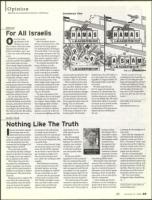
LEADERSHIP)
were wounded and died for their
country alongside their Jewish
comrades. They are all Israelis.
When residents of the north
spent a month huddled in shel-
ters, sent their children to safety
farther south and, in the end,
dealt with the property damage,
the environmental destruction
and the economic devastation,
Jew and Muslim, Christian and
Druze experienced the same suf-
fering. They are all Israelis.
UJC ran its emergency cam-
paign in the name of Israel, not
in the name of Judaism or the
Jewish people. We, therefore,
LEADERSHIP
2006, ddl;
gardi
should expect the relief dollars to
go to the people who need help,
regardless of religious beliefs. All
that should matter is that they
are Israelis.
We often make the case
for U.S. support for Israel not
because it is a Jewish state, but
because it is the one bastion of
freedom, democracy and plural-
ism in the Middle East. We would
shatter those ideals if we turned
our backs on non-Jewish Israelis,
just as Israel would deserve
condemnation if the government
helped only Jews rebuild after
the war.
On the occasion of its just-
concluded General Assembly, we
salute UJC for doing the right
thing and honoring the memory
of Rabia and IvIahmoud Taluzi,
the slain Nazareth brothers, along
with the other 42 Israeli civil-
ians and 119 IDF troops killed
in the war. After all, they were all
Israelis.
hurting and they
feel betrayed. Was it
reasonable to expect
they and their wives
and daughters would
continue to buy
the argument that
Michigan should
give preferential
treatment to favored
minorities? Do these
people feel there is a
level playing field for them?
Most people in this state know
someone who was denied a job
or a promotion or a contract or a
place in a university because of
affirmative action. Wasn't anyone
listening to them? Doesn't their
pain count, or do we only deal in
selective compassion?
I wrote months ago that the
decision to cast the campaign on
gender rather than race was not
going to work. In fact, it revealed
a contempt fOr the intelligence of
state voters.
Notice that the campaign ads
said medical and outreach pro-
grams for women were "put at
risk" or "threatened" when a simi-
lar proposal passed in California.
Those are weasel words. There is
no evidence that any such pro-
grams were discontinued.
The idea of mounting legal
challenges to this outcome strikes
me as a terrible idea. It seems to
confirm that liberals embrace the
democratic process right up until
the time it produces a result they
don't like. Then they want to take
the decision out of the hands of
•
the people and into the courts.
The voters have spoken.
Michigan's leaders should listen
up.
E-mail letters of no more than
150 words to:
letters@thejewishnews.com .
Reality Check
Nothing Like The Truth
I
sent my journalism students
out for some man-on-the-
street interviews last month.
They were assigned to pick five
people at random and ask them
about the governor's race, the
economy and the Michigan Civil
Rights Initiative (MCRI).
They came back puzzled.
They told me that they could get
answers to the first two topics eas-
ily enough, but no one wanted to
give an opinion on the MCRI.
That's when I knew the bal-
lot proposal to end affirmative
action was going to win. Because
people will not speak honestly to
pollsters or journalists in matters
involving race. They know better
than that.
Being perceived as a bigot is the
worst sin in the American rule-
book, and that is how the MCRI
issue was framed: Fair minded
people vs, the racist and misogy-
nist monsters who walk among
us. People can lose friends or
sometimes jobs over such percep-
tions, even if the perceptions are
false. But in the voting booth, they
can speak freely.
In an era when distorted, infan-
tile and nasty political ads are the
norm, the anti-MCRI campaign
was no better or worse than aver-
age. Certainly at a higher level
than the ads for the governor's
race, which were stunning in their
stupidity.
What bothered me, however,
was the repeated assertion that
the ballot initiative was being
pushed on Michigan by individu-
als who "aren't from our state
Isn't that what the good people
of Dixie used to say back in the
'60s? "All this civil rights commo-
tion is the fault of these outside
agitators from up North who
come into Mississippi, don't
understand our way
of life and rile up our
black folks."
How discouraging
that Michigan's estab-
lishment was reduced to
using the same rhetoric
40 years later on anoth-
er issue that touched on
race and equality under
the law.
But the more disturb-
ing question is this: A proposal
that was condemned by nearly
every major media outlet, political
leader and civic organization in the
state was approved easily. How do
you explain it? Are the people of
Michigan hopeless bigots? Or are
their leaders farther out of touch
with them than they should be?
The restructuring of the state's
automotive industry has taken a
tremendous toll of jobs once held
by white males. These people are
George Cantor's e-mail address is
gcantor614@aol.com.
November 16 • 2006
23