

Introducing Rich Cohen
W
hen New York was the
capital of sugar more than
a century ago, it's unlikely
that there were Jews among the
Livingstons, Van Cortlandts, Roosevelts
and other prominent families who
owned refineries. But it was a Jewish
son of the Lower East Side who revo-
lutionized the sugar industry not once,
but twice — by inventing the now ubiq-
uitous sugar packet and then creating
sugar substitute Sweet'N Low.
Benjamin Eisenstadt also invented him-
self.
A rags-to-riches success story, he
trained as a lawyer in the late 1920s,
worked as a short-order cook in a diner
- when his legal practice was slow and
then went on to own several diners
before turning his cafeteria near the
Brooklyn Navy Yard into a factory. At
first he made tea bags, until he had the
brainstorm of packaging sugar in indi-
vidual servings.
Since he didn't know about patents,
he had his idea stolen when he excit-
edly showed it to the folks at Domino.
W
He was more careful
when he came up with
a diet sugar made of
cream of tartar, dex-
trose and saccharine.
Eisenstadt takes
center stage in Rich
Cohen's newest book,
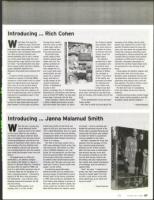
Sweet and Low. The
author, grandson of
the sweetener pio-
neer, speaks at a 12
p.m. Lunch and Learn
(reservations are nec-
essary for a catered
lunch, and there is
an $8 charge) at the
Jewish Community
Center of Washtenaw
County in Ann
Arbor on Tuesday, Nov. 7. Call Rachel
Rosenthal for information and reserva-
tions at (734) 971-0990. You may also
brown-bag it and hear him for free.
Cohen narrates a family story that's
a finely crafted period piece, an epic
tale more bitter than sweet. As narra-
tor, Cohen is insider
and outsider, often
very funny even as
he writes of a fam-
ily fortune that ulti-
mately drove the
family apart.
The author's
perspective is that
of a grandson who
will inherit none
of the hundreds of
millions of dollars
the company is
worth — his branch
of the family was
purposely excluded
for unknown rea-
sons Cohen tries
to figure out. But
he knows that he has been left with a
great story and that he can tell it any
way he chooses, with loyalty only to the
truth.
"To be disinherited is to be set free,"
Cohen writes.
He's free to write not only about the
members of his family, like his Aunt
Gladys who stayed in her room in her
parents' Brooklyn home for some 30
years, but also about the scandal that
rocked the company, when they were
investigated by federal authorities and
charged with tax evasion and criminal
conspiracy in 1993 and his mother's
attempts, ultimately abandoned, to
contest the will that stated there were
no provisions for her and any of her
issue.
Cohen opens his family's closets, and
he also links New York's early days,
Brooklyn color, immigrant energy, diet-
ing obsessions, mob presence, corrupt
politicians and sibling rivalry with the
pink packets. The book is history, mem-
oir and investigative reporting.
His tone isn't one of complaining
of his lot; rather, he has fun with the
material.
Cohen's previous books include Tough
Jews, about Jewish gangsters, and The
Avengers, about partisan fighters. ii
- Sandee Brawarsky
ng Janna Malamud Smith
hen she was a young girl,
Janna Malamud Smith
would sit next to her father
on the couch when''he was reading,
and they'd talk about whatever book
was in his hands. From the great novel-
ist Bernard Malamud, she learned the
names of important writers before they
had meaning. His own childhood had
been bookless, and he took particular
joy in buying books for her and looking
over those she brought home from the
library.
"He gulped down my little-girl
admiration; I, his fatherly delight,"
she writes in My Father is a Book: A .
Memoir of Bernard Malamud. Published
20 years after his death in 1986, the
book is a well-written personal view of
a famous father by his daughter; it's
also a revealing memoir — chronicling
aspects of life like a long extramari-
tal relationship — and a literary work,
drawing connections between his life
and his writing.
Malamud Smith speaks 1 p.m.
Tuesday, Nov. 7, at the Jewish
Community Center in Oak Park and
again at 6:30 p.m. the same day at the
JCC in West Bloomfield. She is co-spon-
sored by the Jewish Historical Society,
Congregation Beth Ahm Sisterhood and
Congregation Beth Shalom Sisterhood.
There is no charge.
The title of her book comes from a
2001 essay Malamud Smith wrote. She
was inspired by "My mother is a fish,"
a line in William Faulkner's As I Lay
Dying. For the memoirist, the title cap-
tures the pull her father felt between
his everyday world and creating art,
his belief in the transformative power
of books, and "the way some ever ani-
mate part of him is stored within their
pages," as she writes.
A practicing psychotherapist,
Malamud Smith, 54, has written two
previous books, Private Matters and A
Potent Spell. In the former, published
in 1997, she provides an anecdotal cul-
tural history and defense of privacy. A
few years after her father's death, she
wrote a piece for the New York Times
Book Review about her father's sense
of privacy — how he carefully pro-
tected the personal sources of his
fiction. She concluded the piece by
saying that her family was unlikely
to make her father's unpublished
writing available to the public.
But she's changed her mind. She
explains that the passage of time
has created enough emotional
distance for her to feel comfort-
able. She has come to understand
that privacy has less to do with
the question of telling or not tell-
ing, but with having control over-
the telling. She also realized that
her mother had a great storehouse
of knowledge, and she wanted to
capture that.
"And," she says, "I needed to be
pretty sure that I had established
enough of myself apart from him,
so that I could return to him with
some objectivity, as an adult look-
ing at an adult."
A MEMOAR OF BERNARD MALAMUO
- Sandee Brawarsky
October 26 200$
67