

Clea nes and minima or namentatio
natbre and its na vest — sin
stars
et tne true
tnrougn,
STYLED AND WRITTEN BY ANNABEL COHEN
PHOTOGRAPHY BY ANGIE BAAN
y sukkah is an expression of
what I love: It is homey in its
own rustic way, warm in spirit (if
not temperature) and intrinsi-
cally agricultural. When it was
first constructed a few years ago, we placed our
family sukkah directly under an enormous sil-
ver maple tree dripping with long untrimmed
branches. With just four posts and topped by
wooden beams, it is entirely sans roof except for
those drooping tree branches. The lattice I had
intended was not necessary, as the branches form
an umbrella over the top and dip into the suk-
kah itself. Even a light rain won't penetrate when
the foliage is at its thickest, and to this spot it
returns every year.
Generous lengths of burlap are attached (with
a staple gun) to the posts to form walls all the
way around the sukkah. The entrance of the but
is swathed in a saffron-hued woven cloth that
ties back with raffia when needed. A carpet of
leaves collected from surrounding trees cushions
underfoot, and lots of pumpkins, gourds and
potted mums are scattered in every corner.
Votive candles provide the only illumina-
V
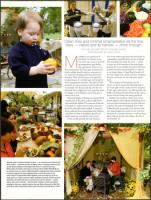
Opposite page: A sculptural element of nature — an enormous gourd textured with
flecks of gold — helps blur the lines of indoors and out. This page, clockwise from
top left. Charlie Hermann of Farmington Hills, then 1 1 /2, examines the etrog.
William Stein of Franklin, left, looks on as Howard Davis of West Bloomfield lays
the sukkah's lulav on a votive-studded chandelier suspended from beams overhead.
A casual arrangement of fresh vegetables (here served with hummous and
spinach dip) is an appropriate Sukkot appetizer; a few go a long way, so fill up
empty spaces in a large vessel with whole vegetables and fruits. Thirteen-year-old
Jacob Stein of Franklin sits down to squash soup. Seasonal splendor — gourds,
grapes, pine cones and etrog — lines the table, creating a colorful centerpiece;
enjoying the feast are, counterclockwise from top, Miriam Konstantin of Oak Park,
Jacob Stein and his mom Deborah Stein, both of Franklin, and Linda Kovan of Novi.
tion in the sukkah, glowing from their perch in
a chandelier suspended from a beam overhead.
The chandelier also holds the lulav — which
is made up of the branches of the lulav (palm
branch), the aravah (willow branches) and hadas
(myrtle branches), all tied together — when it
is not being shaken. A large flag of Israel is all
else that hangs from a beam, and faux evergreen
branches and leaves are the only other adorn-
ment.
When family and friends join me for
dinner, we all sit around the table and bask in
the warm glow of the candles and the company.
At the open "open house," my table becomes the
buffet, brimming with the bounty of the season,
sweets of every variety and more good food.
And for one transitory week a year, we are
Jewish pilgrims, rejoicing and celebrating in our
own way and connecting our city lives with our
ancestors' 40 years of wandering. And at this
Sukkot festival, we partake of an ancient ritual
that acknowledges how lucky we are to be ben-
eficiaries of a summer's harvest — with an abun-
dance of food, friends and wellness. For this I
am thankful. ❑