

To Life!
One-Of-A-Kind Sukkah
Stafi nho:os
4nc,e Baan
Shelli Liebman Dorfman
Staff Writer
let-shell lights and a string of
cacti. "We call it our Western
Judy said.
Little decorating is done each
year because, for the most part,
once something's up it's there to
stay, remaining fastened to the
ceilings and the walls during stor-
age.
Each year, most items are
re-hung by rote, but the lights —
Coke bottles, beer bottles, toy RVs,
moons and suns — are another
story. Hanging them is a precise
art, typically performed by Noah.
"The first year he went away
to school, we had no idea how to
hang them',' Marty said. "So he
drew the plans on a piece of paper,
scanned it and e-mailed it home
so I could do it"
For many years Marty, Noah
and Miriam have slept overnight
in the sukkah in sleeping bags,
with Marty's set atop a camping
mat on the table.
The Liebman's sukkah is almost
constantly filled with guests, often
friends of Noah and Miriam who
have never been in one before.
"I'm pretty used to how it
looks',' Marty said. "But I always
wonder what those who are new
to our sukkah are thinking, and
if they think this is what every-
body's sukkah looks like."
y
ou have to look closely
to find something tra-
ditional in Marty and
Judy Liebman's sukkah.
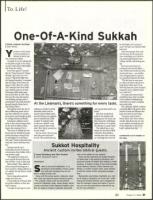
Certainly it's not the talking fish
or the glittery angel or the string
of giant multicolored M&M lights
that drape the ceiling.
Even what appears "normal,"
like the "Chag Samayech" (Happy
Holiday) sign, turns out to be
taped to "Big Mouth Billy Bass:
the Singing Sensation," a mounted
fish that sings "Don't Worry, Be
Happy" with a flick of a switch.
The Liebmans have been build-
ing a sukkah each year at their
Farmington Hills home since
they moved there in 1987. That
first year, the main decorations
were holiday greeting cards, a
preschooler's arm reach from the
ground, hung by Noah, then 3,
and Miriam, then 1.
Through the years, the size of
their sukkah has grown and so
has their collection of eccentric
decorations, most brought as gifts
by visiting friends and family.
Sometimes, additions arrive
early so they can be hung in time
for the start of Sukkot, which
begins the evening of Oct. 6.
"One year, we walked into our
house and our friends had come
inside and hung a string of bul-
let-shell lights in our kitchen:'
Judy said. "I had no idea what they
were, but I knew what they were
for"
During a recent trip to
Guatemala, the pair struck up a
conversation about Sukkot with a
non-Jewish couple.
"We explained to them how
most people decorate their suk-
kah and how we do it," Judy said.
Marty added, "They asked if a
tacky, neon pink flamingo on a
base would be a fitting addition to
our sukkah. We told them it would
be perfect:'
Not too long afterward, the
couple sent them one.
Occasionally, the Liebmans find
the perfect addition to their suk-
kah by chance.
"A couple of years ago we were
•
43
At the Liebman's, there's something for every taste.
walking to tashlich (a Rosh
Hashanah ritual) and we
passed a house where some-
one had thrown out a gigantic
pair of animal horns," Judy
recalled. "I wanted to take
it with us to tashlich. I was
afraid someone else would
take it first. Marty assured me
no one would"
He was correct. "On our way
back, they were still there','
he said. "She picked them up
and carried them all the way
home."
Now they are the focal
poilit of one sukkah wall,
hanging near the maize and
blue University of Michigan
lights. Noah is a U-M gradu-
ate; Miriam is a junior there.
The sukkah has no real
theme, but one side is filled
with items that include a
weathervane with a cowboy
on a bucking horse, the bul-
Candlesticks are lit brightly on
the table.
Sukkot Hospitality
Ancient custom invites biblical guests.
Joyce Eisenberg and Ellen Scolnic
Jewish Telegraphic Agency
Philadelphia
S
ukkot is a harvest celebration. It's a
blessing to invite families, friends, neigh-
bors and even strangers who do not
have a sukkah of their own.
Along with the actual guests, religiously obser-
vant Jews also welcome seven heavenly guests
– the ushpizin. These seven are the biblical
characters Abraham, Isaac, Jacob, Moses, Aaron,
Joseph and David. In the Sephardi tradition, fam-
ilies set aside an ornate or specially decorated
chair in the sukkah for the ushpizin.
Some say the inspiration for Sukkot hospital-
ity dates back to the patriarch Abraham, who
would sit outside his desert tent waiting to invite
travelers. A modern version of the ritual includes
Sarah, Rebecca, Rachel, Esther, Deborah and
Miriam. In another modern twist, some families
invoke the names of their deceased grandpar-
ents.
Maimonides saw holiday hospitality as a mat-
ter of religious obligation. He wrote that "while
eating and drinking himself, one is obligated to
feed the stranger, orphan and widow. If you do
not, you are not performing a mitzvah for joy,
but for your stomach." El
N
October 5 2006
31