
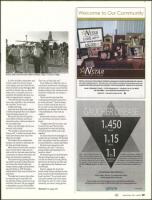

Emery Klein with Detroiter Robert Naftaly, right, in Israel in 1982.
-
In 1956, his father, stepmother and
brother made it to Detroit. Emery
came along a year later when he was
hired at Jewish-owned Michigan Bolt
and Nut in Detroit, first as a book-
keeper, then a controller, then vice
president. His brother, Bernard, was
with an import/export company.
"We both felt that when the right
time came, we'd like to be in business
for ourselves:' Emery said.
It didn't take long.
Later that year, they both chipped
in $250 and opened their own import/
export business, Alaron, Inc.
Bernie quit his job, and opened a
small office in Detroit, and Emery
shared his salary with his brother for
the next eight years.
Emery was still single. Bernie was
married, with a baby.
"We needed an income for him,"
Emery said. "I would come home from
work, have dinner, then stop at the
office for the night."
The brothers knew people from
Europe, who moved to Australia, the
Far East and South America.
When Emery took his first vacation
from work for three weeks, he trav-
eled to the Far East and made the first
connections to import electronics and
home entertainment equipment.
The business kept growing, becom-
ing wildly successful selling electron-
ics all over the United States and
Europe. Emery, single and hardwork-
ing, met Diane in 1965 through a
mutual friend. They were married two
years later.
"He asked me to marry him when
he wanted to go to Israel after the
Six-Day War, and he wanted me to go
with him," she said. "We got engaged
in September, married in November
and went to Israel for our honeymoon.
That was our first joint trip?'
Diane followed a different track to
community involvement. Growing up
in Detroit, she became one of the first
latchkey children. Her mother, heavily
involved in Hadassah, was always at
meetings.
Those were the days that kids
would go home for lunch and return
to school, she said. "I had the house
key on a chain around my neck. I'd
let my sister in and we'd eat the tuna
sandwiches my mother left," she said.
"I hated Hadassah. They took my
mother?"
Resentment turned to volunteer-
ism when Diane and Emery raised a
family.
"I taught school for two years, and
I loved it," she said. "But the idea
of going back to work and leaving
my kids at home didn't seem to go
together?'
As Alaron became increasingly suc-
cessful, she quit teaching. "We decided
that I was going to treat my communi-
ty involvement as a career," said Diane.
She had some interaction with
Federation, she said. "I was just a
young mother participating with a
bunch of others."
Involvement grew in the Federation
Women's Department and in agen-
cies like the Fresh Air Society, Jewish
Apartments & Services and JVS, and
in organizations like Hadassah and
Israel Bonds.
Emery's support for Israel, the
Jewish needy and his political involve-
ment was part of his overall desire for
Jewish survival. "To us, Jewish conti-
nuity, after family, is the most impor-
tant thing," he said. "In order to have
continuity, you need a strong Jewish
Retired? on page
20
COMMUNITY BANK
NSTAR is proud to be a Community Bank, dedicated to developing and maintaining relationships with customers
who value exceptional service. We invite you to call or stop by, and discover how personal service and
exceptional rates define a truly great Community Bank. NSTAR Community Bank - Welcome to Our Community,
NSTAR COMMUNITY BANK • 31780 Telegraph Rd • Bingham Farms, MI 48025
248-645-8888 • www.NSTARcommunitybank.com
MEMBER FDIC 'Rates subject to change at any notice.
Type 1 Gaucher disease (pronounced Go-
Shay) is the most common Jewish genetic
disease, and among the least well known. In fact,
it is much more common than Tay-Sachs disease.
The symptoms of Gaucher disease are progressive
and often debilitating. Symptoms can begin at any
age.
Gt
FortunaWy, Gaucher disease is treatable, and
the earlier the diagnosis the better, because in -
versible problems or premature death can occur if
left untreated. If you or your family members are
experiencing any of the following symptoms, ask
your doctor if a Gaucher blood test is right for you.
lin
Should know
about it.
GAUCHER DISEASE SIGNS & SYMPTOMS
•FATIGUE (ANEMIA) • Bork PAIN • EAsY BRUISING AND/OR BLEEDNG
•ENLARGED ABDOMEN (SPLEEN AND/OR LIVER)
If you are Jewish and of Eastem European ancestry, and would like more information,
call Genzyme Medical Information at 1-800-745-4447 (option 2) or visit www.genzyme.com .
cle.n_r ime
r-GC9, US PZ64. JE, 06
September 28 - 2006
19