

To
i fe
!
SPIRITUALITY
Ritual Bath Overfloweth
Liberal mikvahs create new customs for healing and spiritual growth.
Sue Fishkoff
Jewish Telegraphic Agency
A
Newton, Mass.
vita Diamant, a Jewish
educator and best-
selling author of The
Red Tent, remembers going
to Boston's Orthodox mikvah,
or ritual bath, years ago for her
husband's conversion.
"We sat in a tiny foyer, with
the sound of the washer and
dryer going next door," she
recalls. "After we signed the
check, we were out in the park-
ing lot, surrounded by broken
glass. - We took the rabbi out to
lunch and that was it.
"I thought it should be better
than this. Wouldn't it be nice to
have a place where people could
,, raise a glass and say,' ?'"
Today, Diamant is founder
and board president of
Mayyim Hayyim Living Waters
Community Mikveh and
Education Center, a 2-year-old
facility in this Boston suburb.
Built next-door to a
Conservative synagogue,
Mayyim Hayyim is a transde-
nominational mikvah available
to men, women and children
seeking to mark life transi-
tions, observe the laws of family
purity and create new rituals of
healing and spiritual growth.
In its short life, it has become
wildly popular. More than 500
conversions and 2,000 other
immersions have taken place in
its two ritual pools.
There are fresh flowers, a
light and airy atrium, and a
comfortable waiting area where
friends and family can gather to
celebrate.
The guest books are filled
with descriptions such as "beau-
tiful," "uplifting" and "wonder-
ful," not words that liberal Jews
have often associated with a
ritual they so long rejected.
But along with other Jewish
88
September 21 • 2006
traditions that are being re-
examined and reshaped by
liberal Jews today, mikvah is
experiencing a nationwide
resurgence.
In late June, 200 clergy and
educators gathered at Mayyim
Hayyim for "Reclaiming
Mikveh," a three-day conference
to share ideas, experiences and
technical know-how.
Sponsored by the Union for
Reform Judaism's Outreach
Institute, and funded largely
by the Combined Jewish
Philanthropies of Greater
Boston, this was believed to be
the first national conference
an aesthetically pleasing envi-
ronment and are designed to
handle a steady stream of users.
Mikvahs also have been used by
Orthodox and a growing num-
ber of liberal Jews as part of the
conversion process.
"I was one of the traditional
voices at the conference, provid-
ing enthusiasm and passion
about the rabbinic laws of nid-
dah," Rabbi Berkun said. "For
me, reclaiming the mikvah is
not merely about innovating
new rituals. Rather, it is about
serious study and engagement
with the traditional Jewish
texts."
Orthodox mikvahs, while open
to all Jews for ritual immersion,
have in recent years barred non
Orthodox conversions.
The list of liberal mikvahs is
growing rapidly. Already they
have been built in California,
Illinois, Pennsylvania, Michigan,
Ohio, New York and Ontario,
to name a few, and others are
being planned. Unlike Mayyim
Hayyim, most are associated
with a Reform or Conservative
synagogue. All are open to
the entire Jewish community,
however, and the trend is more
and more toward collaborative,
interdenominational ventures.
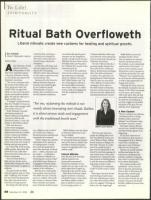
"For me, reclaiming the mikvah is not
merely about innovating new rituals. Rather,
it is about serious study and engagement
with the traditional Jewish texts."
A New Custom
Rabbi Lauren Berkun
on a religious issue in which
the Conservative, Reform,
Reconstructionist and Renewal
movements all partnered.
"When I began my academic
exploration of the mikvah as
an undergraduate, I would
have never dreamed that 13
years later, hundreds of liberal
Jews — rabbis, educators and
lay people — would gather
for a national conference on
reclaiming this ancient ritual:'
said Rabbi Lauren Berkun of
Congregation Shaarey Zedek
in Oakland County, who was a
speaker at the conference.
Mikvahs have traditionally
been used by observant Jews
who follow the laws of family
purity, or niddah, which obli-
gate women to immerse them-
selves monthly. And indeed,
many Orthodox facilities boast
t el
Rabbi Berkun wrote her thesis
at Princeton University on the
laws of niddah.
"The entire research project
of tracing the historical develop-
ment of the laws of niddah from
the Bible to medieval Judaism
became the springboard for my
rabbinic path."
Liberal Mikvahs
Since the first non-Orthodox
mikvah opened at the
Conservative movement's
University of Judaism in Los
Angeles 26 years ago, nearly two
dozen others have popped up,
almost all in the past five years.
Most liberal mikvahs, includ-
ing the University of Judaism,
were built because Conservative
and Reform rabbis needed a
place to perform conversions.
An increasing number of
Rabbi Berkun carries the
metaphor further. "Every
time we immerse in mayyim
hayyim, the living waters of
the mikvah, we are symbolically
embraced by God's womb — a
source of new creation, uncon-
ditional love, mercy, repentance
and divine protection," she said.
"Whatever we are experiencing
in our lives, the mikvah presents
us with a holy opportunity for
change and renewal.
"Entering the warm waters of
the mikvah, we dissolve into our
Source of Life. When we emerge,
we rise up as a new creation
with a new spirit. The soft and
permeable waters teach us that
we need not stay hardened in
our lives, trapped in the habits
and pains of the past. We can
embrace a new beginning."
"All over, more and more
people are talking about mik-
vah," says Norman Cohen, pro-
vost of Hebrew Union College-
Jewish Institute of Religion in
New York. "It's part of a wider
search for people trying to
give concrete expression to the
search for spiritual meaning. In
most urban areas, if they don't
already have a community mik-
vah, someone is thinking about
it. And the return to tradition is
only going to lead to more.
"It's physical; it's emotional;
it talks to all the senses:' Cohen
says.
Referring to the back-in-the-
womb feeling of safety many
first-time mikvah-goers experi-
ence when they immerse them-
selves, he suggests, "It brings us
back to the very beginning!'
"We are creating a new Judaism,
minhag America,' a strong,
healthy, creative American
Judaism," says Diamant, using
the Hebrew word for custom.
She hopes Mayyim Hayyim
can serve as a model for others.
And that already appears to be
happening.
On the first afternoon of
the conference, Neal Linson of
Congregation Eilat in Mission
Viejo, Calif., is busily tak-
ing notes at one of Mayyim
Hayyim's two ritual pools.
Upstairs, he unrolls detailed
architectural plans for the
mikvah he is building at his
southern California congrega-
tion, which is Conservative and
serves about 280 families.
Every aspect is laden with
symbolism: 18 feet from the
door to the pool, representing
chai, or life; 13 feet across, for
the age when a Jewish male
assumes adult responsibili-
ties; one door for both exit and
entrance, "because you should
feel like a different person when
you leave!'