

To Life!
ON THE COVER
A New
Beginning
Congregation revitalizes
Wayne County synagogue.
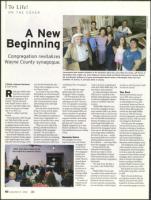
Congregation Beit Kodesh members in the sanctuary: back row: Larry Stein of Livonia, Jeff Kirsch of
Farmington Hills; middle row: Aron Zoldan of Livonia, David and Phyllis Scherman of Livonia, Rachel,
20, and Michelle Hoffman of Livonia and President Martin Diskin of Farmington Hills; front row:
Elizabeth, 16, Evelyn, 11, and Sally Stein of Livonia.
Shelli Liebman Dorfman
Staff Writer
R
abbi Jason Miller often
heard the same skepti-
cal question when he
mentioned Congregation Beit
Kodesh. "They'd come back
with, `Really? There's a shul in
Livonia?" said Rabbi Miller, who
admits driving past and forget-
ting it was there, too.
Then he walked inside Beit
Kodesh.
From September 2005 through
July 2006, Rabbi Miller served
as rabbinic adviser, helping the
synagogue become more notice-
able, not just from the street, but
through its programming and its
new-found vibrancy and youth.
Just as Rosh Hashanah, which
begins at sundown Friday, signals
a new beginning for Jews world-
wide, this year also brings a fresh
start for Beit Kodesh, the only
Conservative synagogue in west-
ern Wayne County.
As recently as the early 1990s,
Beit Kodesh was a flourishing 90-
to 100- family congregation with
an active sisterhood and men's
club, a thriving Sunday school
and standing-room-only High
Holiday services.
But, with fewer Jewish families
living in Livonia and the dept.=
ture of their rabbi in the late
1990s, the progressive, egalitarian
Conservative congregation was -
down to 40 families with a small
Sunday school and no clergy
"There was never talk of dis-
solving," said Martin Diskin of
Farmington Hills, synagogue
president. "We just looked at
our declining membership and
decided we'd better do something.
We knew we needed young fami-
lies and would need to offer them
Rabbi Jason Miller speaks at the
Beit Kodesh 9-11 memorial service.
82
September 21 ® 2006
something if they were going to
join."
So, in late 2004, the congre-
gation began the "Save Our
Synagogue" (SOS) campaign.
The first thing they did was
to renovate the sanctuary and
adjoining social hall. "We knew
if we were going let area families
know we were here, we needed
to update our building," said Jeff
Kirsch of Farmington Hills, reli-
gious committee vice president.
The building includes all the
expected amenities, from offices
and classrooms to a sisterhood
gift shop and "a classy full-
fledged, categorized, up-to-date
library," said Martin's wife, long-
time sisterhood treasurer Dorothy
Diskin.
Heavenly Match
Once changes were under
way, Kirsch went to the United
Synagogue of
Conservative
Judaism to have
the synagogue's
lapsed mem-
bership rein-
stated. There he
learned about
Rabbi Miller,
then associ-
ate director of
University of
Michigan Hillel
Foundation in
Ann Arbor.
"As much as I
enjoyed my job
at Hillel, I was
ready to do some congregational
work also," Rabbi Miller said. "And
they had so much potential."
So, while retaining his full-time
Hillel post, he consulted at Beit
Kodesh until beginning a position
as rabbi at Congregation Agudas
Achim in Columbus, Ohio, this
summer.
"Rabbi Miller helped to turn
around the synagogue, bring in
more members and is very much
still involved with us': Kirsch said.
Through a donation he secured
from the Mandell and Madeleine
Berman Foundation, one of the
initial things Rabbi Miller did
was conduct a feasibility study to
determine the synagogue's poten-
tial to survive. He discovered two
main things: Many unaffiliated
Jews lived in the area — includ-
ing young families who would be
needing religious education for
their children — and many didn't
know the synagogue was there.
He learned the Jewish
Federation of Metropolitan
Detroit was ready to sell the
former United Hebrew Schools
(UHS) branch because it didn't
realize a functioning congregation
still existed.
"The shul, it was decided, is
not ready to die," Rabbi Miller
said.
"Rabbi Miller," Kirsch said,
"was able to look outside the box
and help us restructure our pro-
grams and our services to benefit
members who have been here
for years and also accommodate
our new families. And he helped
provide us with the tools to build
on what he started."
Way Back
Beit Kodesh has been around
since 1958, when a group of
families new to Livonia began
to hold Shabbat services, first
in members' homes and then at
Clarenceville Central Elementary
School. About 200 people gath-
ered for the first High Holiday
services. In 1959, the Livonia
Jewish Congregation was officially
organized; and, in 1990, the name
was changed to Beit Kodesh.
Over the years, the congrega-
tion has held services in several
locations, including a farmhouse,
a tent and a church. Since 1971,
they have been renting and meet-
ing at the former UHS Molly
and Samuel Cohn Building on
West Seven Mile Road, between
Merriman and Farmington roads.
The building has been defaced
with swastikas at times and the
congregation's Torah breastplates
were once stolen. But members
are proud of their family-oriented
synagogue that is reminiscent of
shuls in Detroit's old neighbor-
hoods, according to founding
member Phyllis Lewkowicz, who
has lived in Livonia since 1958.
Beit Kodesh was most recently
led by Rabbi Craig Allen, who left
in 1998.
Ivlany who are involved now
are longtime members, like the
Diskins, who have been at Beit
Kodesh for 20 years, and Kirsch,
who remembers going to services