
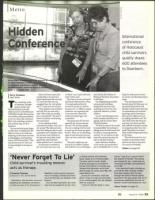

International
conference
of Holocaust
child survivors
quietly draws
600 attendees
to Dearborn.
er in Far
Harry Kirsbaum
Staff Writer
T
hey came from as far
as Australia. The little-
known and low-key
'World Federation of Jewish
Child Survivors of the Holocaust
(WFJCSH) brought 600 survivors
with children and grandchildren
in tow to a three-day conference
filled with workshops, seminars
and activities Aug. 25-28 in
Dearborn.
The international group began
in 1985, from a workshop for 60
child survivors at an American
Gathering of Holocaust Survivors
in Philadelphia, said Stephanie
Seltzer, WFJCSH president. "That
was the first time we were sort
of acknowledged as having sur-
vived:'
Seltzer had been rejected for
membership at two previous
gatherings because she was only
3 1 years old when she was
smuggled from the Lodz ghetto,
and 7 1 when she was rescued.
"They looked me up and down
and said, `But you were only a
child. What could you possibly
have remembered?" she said. "I
found out [others were] having
that experience."
At the workshop, Seltzer
remembered another child survi-
vor saying, "The older survivors
have been telling us that we can't
remember, but I remember when
the Germans took children by
the legs and swung their heads
against the walls until their
brains splashed out. I remember."
"At that point, everybody in
the room burst into tears; and
we didn't want to part with each
other;' Seltzer said.
, They kept in touch and started
meeting in different areas. When
174 people gathered strictly
by word of mouth at a hotel in
Lancaster, Pa., in 1988, an annual
conference was organized and
it has been held around the
world, including Prague and
Amsterdam.
The group takes the low-key
approach for obvious reasons,
she said. "We still have people
who are in hiding. I feel we need
to speak up, but many are appre-
hensive. There are no welcoming -
signs at hotel entrances because
some survivors would drive right
This year's conference was
hosted by the Hidden Children
and Child Survivors of Michigan
Child survivor's troubling memoir
gUts as therapy.
Suzanne Chesster
Special to the Jewish News
Felicia Bryn, like the other survivors
attending last weekend's convention
of child survivors of the Holocaust in
Dearborn, could recount a personal
story of courage, strength and endur-
ance; but hers has one element of dif-
ference.
Bryn decided long before the meet-
ings that she wanted to put her story
and CHAIM, the Children of
Holocaust Survivors Association
in Michigan:
The programming included
seminars and workshops
designed for survivors only,
including survivors who were
orphaned, abused or without
children.
Second- and third-generation
family members had their own
agenda, said Dr. Charles Silow,
CHAIM president.
"We have to assume the mantle
of responsibility for teaching or
talking about the Holocaust:' said
Dr. Silow, a second-generation
member. "As our parents are get-
ting older'and passing away, we
have to tell their histories."
Janice Starkman Goldfein,
social worker and psychothera-
pist in Southfield, led two work-
in writing and has sel ublished
Never Forget To Lie (Trafford; $25).
The book, which includes family
pictures and maps to illustrate her
journey from Poland to America, was
released last December and is avail-
able through the vanity press Web site
www.trafford.com .
-
During the convention, Bryn was
given a chance to sign and sell copies
of her autobiography. She was pleased
with the response.
"I did not write this book to make
shops for Holocaust survivors
on second- and third-generation
issues.
"The second-generation
learned about the Holocaust not
necessarily from stories told
directly to them, but by listening
to conversations and overhear-
ing things and by listening to
their parents' nightmares and
by reading nonverbal cues:' she
said. "Kids knew that their par-
ents' lives were hard, and they
had suffered tremendous losses;
in comparison, their lives were
cushy. They had a lot of food.
They weren't being hunted down
by the Nazis.
"The kids learned to be very
sensitive to the needs of their
parents and also to deny their
own needs and feelings."
Hidden on page 24
money," says Bryn, a special educa
tion teacher in Florida. "The writing
was therapy for me. I could clear my
conscience and take a long look back
at my life."
Bryn was only 5 years old when an
aunt hid her and a younger brother
from Nazi troopers who stormed
through the family's Warsaw ghetto
apartment. The young girl's first act of
survival was putting her fist into her
brother's mouth and holding him close
Never Forget on page 24
August 31 • 2006
23