
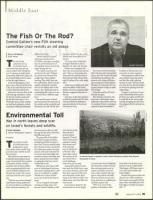

The Fish Or The Rod?
Central Galilee's new P2K steering
committee chair revisits an old adage.
Harry Kirsbaum
Staff Writer
T
he way Joseph
Ackerman sees it,
the Detroit Jewish
community has been giving
much-needed "fish" during the
war in Lebanon to Federation's
Partnership 2000 (P2K) region in.
the Central Galilee, but he wants
to find the right balance.
As the old saying goes, if you
give a man a fish you feed him for
a day, if you teach him how to use
a rod, he feeds himself for life.
Ackerman, the new chair of the
P2K steering committee, visited
the Detroit Jewish community
for the first time Aug. 21 on a
whirlwind tour to meet commit-
tee staff and volunteers, includ-
ing Auburn Hills philanthropist
William Davidson.
"Detroit should be proud:'
Ackerman said about the
$750,000 in emergency funding •
that the Jewish Federation of
Metropolitan Detroit sent to the
region during the war.
"I've talked to parents and
to the kids:' he said. "Without
the money from Detroit, they
couldn't have these shelters
working. They didn't have any
air conditioners, didn't have any
supplies. Hundreds of people
were in the shelters four or five
hours a day. I think this was an
outstanding effort. But post-war,
we should find a different equa-
tion."
The northern part of Israel
has always been the weak part of
the country as far as schools and
businesses, he said. "All the busi-
nesses are in Tel Aviv; the good
schools and universities are in
Tel Aviv.
"If you go today to Nahariya
to Migdal HaEmek to Kiryat
Shmoria, it's really sad;' he said
Homes were damaged, chil-
dren were terrorized, and now, he
said, "there are thousands and
thousands of businesses that, if
they don't get help, will go bank-
rupt. It's going to be a very tough
year."
Ackerman, president and chief
executive officer of the Israeli
defense electronic company Elbit
Systems, suggested education is
the key.
Ackerman is the first volunteer
to hold the position of P2K chair,
said Amy Neistein, Federation
associate director of Israel and
Overseas Services.
The future of the Partnership
2000 will stress the "partnership"
aspect, she said. "Israel will begin
contributing something to the
projects we're doing, with lever-
age coming from Israel's philan-
thropists or businesses. He is in
a good position to help us make
that change."
Ackerman said he will work
towards that goal.
The steering committee will
meet next in November, when
Ackerman will sit down with his
12-member Detroit counterpart,
chaired by Marti Rosenthal of
Franklin, to discuss more con-
crete steps to a new equation.
"The perception could be that
some people are giving money
and the other side is getting
money," he said. "We must make
sure that also the Jewish families
in Detroit are gaining from this
relationship.
"I expect to see more of a per-
sonal relationship between peo-
ple from our region and Detroit.
I would like to see more people
coming and going not just from
this program, but for private rea-
sons." ❑
Environmental Toll
War in north leaves deep scar
on Israel's forests and wildlife.
Uriel Heilman
Jewish Telegraphic Agency
Jerusalem
T
he people of north-
ern Israel have been
going back to more
than empty streets, freshly dug
gravesites and a beefed-up mili-
tary presence.
They also have come home to
a radically altered physical land-
scape. Devastated by fires sparked
by Katyusha rockets, northern
Israel has seen its forests obliter-
ated, its grazing lands laid waste
and its wildlife annihilated over
the past four weeks. The country
may never look the same, experts
say.
"We have very serious damage,"
said Moshon Gabay, spokesman
for the Israel Nature and National
Parks Protection Authority. "In
previous wars we did not suffer
damage like this. Every Katyusha
that falls starts a fire:'
The green hills of the Galilee
have turned orange and black,
smoldering with the remains of
forest fires. The sky, usually bright
blue this time of year, was shroud-
ed in thick gray smoke. The large
animals and many birds that live
in the area have taken flight, and
countless numbers of smaller and
slower animals have been killed
in raging fires that have turned
verdant hills to ash.
Officials say more than 7,000
acres of undeveloped land were
destroyed, including about 2,500
acres of woodlands or roughly
700,000 trees. Some of those
trees were as old as the State of
Israel.
"It's an ecological catastrophe.
Animals are dying. Trees were
burned," said Orit Hadad, an offi-
cial with the Jewish
National Fund
in Israel (Keren
Kayemet L'Yisrael).
"Even if every tree is
replanted, to bring
these forests back
to the state they
were in will take 50
to 60 years." That
means that most of
the survivors of the A charred forest in northern Israel, where Katyusha rockets have burned
thousands of acres.
war will not live to
see the landscape
food chain, even if there is not
rural area have fared. Firefighters
return to its pre-war state.
much we can do',' said Michael
have found the remains of many
Among the hardest-hit areas
Weinberger, a JNF forest supervi-
slow-moving animals, such as
have been the Naftali forest range
sor in the Central Galilee and
snakes and turtles, in burned
near Kiryat Shmona, where more
Golan Heights.
areas. Larger animals that man-
than three-quarters of the forest
Tourists who return to this area
aged to escape likely will suffer
was obliterated, and the Birya
after the war will be startled to
Forest in the Western Galilee, near from loss of food sources and a
find Israel's most popular hiking
sharp reduction in available graz-
Safed, where more than 600 acres
spots, where waterfalls pour over
ing lands, experts said.
have burned.
lush ridges, virtually unrecogniz-
"We're very aware of this
Less is known about how the
problem of disruption of the
able.
animals that live in this largely
❑
August 24 • 2006
15