

Opinion
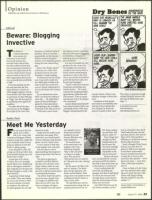
Dry Bones 8 1 'N' .44'rigi
Editorials are posted and archived on JNonline.us .
USING OUR HEZBOLLAH
ARMY IN LEBANON WE
WILL CHANGE THE
ARAB WORLD
Editorial
THE ARAB MIDDLE
EAST WILL BECOME
MORE DIRECTED, MORE
ORGANIZED,
Beware: Blogging
Invective
T
he defeat of
Connecticut's three-
term senator, Joe
Lieberman, in last week's
Democratic primary has
attracted more analysis than
any other political contest this
year. Commentators hastened to
measure the implications of the
victorious Ned Lamont's strong
anti-war stand on Iraq for this
fall's congressional election and
even on presidential possibilities
in 2008.
It was also pointed out that
this may have been the first
major election in America in
which bloggers played a critical,
if not decisive, role. Their attacks
on Lieberman on their Web logs,
or "blogs," were the driving force
in mobilizing voters against his
candidacy.
The other side of the equa-
tion, however, is that bloggers
do not play by the same rules
that govern traditional political
discourse. There is very little
accountability on the Internet.
Wild accusations and gutter
rhetoric can be standard practice
among the more zealous blog-
gers.
Some of the charges against
Lieberman, as a result, came
perilously close to overt anti-
Semitism. A small sampling:
"If Lieberman loses his Senate
seat, it may put his multi-mil-
lion-dollar graft as lobbyist for
Israel at risk. You can bet he'll
run as a 'Zionist Independent' if
he loses the Democratic nomina-
tion."
"As everybody knows, Jews
ONLY care about the welfare of
other Jews ... We might better
ignore all that Jewish propa-
ganda [by Lieberman] about
participating in the civil rights
movement of the '60s and so on."
"Lieberman cannot escape
the religious bond he represents.
Hell, his wife's name is Haggadah
or Muffeletta or Diaspora or
something you eat at Passover."
(It is Hadassah.]
It is easy to overstate the vitu-
peration of a few wackos. But
the examples were numerous
enough to move Lanny Davis, a
former Clinton administration
operative, to write in the Wall
Street Journal that he feared his
party's left had been taken over
by hate-spewing bigots.
"There's a small, but vocal pro-
Palestinian and perhaps anti-
Semitic faction ... It's a small
minority but it's getting bolder','
agreed former Lieberman aide
Dan Gerstein. "There is a grow-
ing tolerance of it in the progres-
sive community"
Lamont disassociated himself
from all such attacks. Still, it was
undeniably present. With many
bloggers unconstrained by the
UNDER OUR LEADER-
SHIP, THE ARAB WORLD
WILL BECOME MORE.. .
MORE. . .
0
www.drybonesblog.com
concept of basic civility, it may
well grow stronger in future elec-
tions.
Candidates of both parties
must make it unmistakably clear
that they will not tolerate this
sort of bigotry by those who
purport to speak in their name.
The country is polarized enough
without filling the Internet with
this kind of inflammatory gar-
bage. 0
E-mal letters of no more
than 150 words to:
letters@thejewishnews.com .
Reality Check
Meet Me Yesterday
F
or my money, the best
movie ever is Meet
Me in St. Louis. Judy
Garland and Margaret O'Brien
and great songs that, unlike this
year's Academy Award winner,
made no reference to how dif-
ficult it is being a pimp.
It was released in 1944. The
setting was 40 years before that,
in the months leading up to the
World's Fair of 1904.
A great part of its charm,
of course, lies in its nostalgic
appeal. There was a frightening
war on. Moviegoers wanted to
find a safe place in the past and
life had changed so much in the
years between.
A good deal of that change
was visible. There were almost
no cars on the streets in 1904. .
No movie theaters. Certainly
no airplanes. No radio and
few phonographs. No real lady
showed an ankle.
People took the trolley to get
where they were going. They
made their own entertainment
at home. Making a long-distance
phone call was a major event.
It was a chance to look back
to that simpler time and smile.
But, how about a movie
depicting things that happened
40 years ago today? Way back in
1966.
The physical appearance
wouldn't be all that different.
Oh, there were all those weird
hippie clothes, which are now
being revived in commercials
that aim to sell investment plans
to retiring baby boomers.
The streets would look pretty
much the same, though. Sure,
car designs are different and
there were no SUVs then. But
those are changes of degree.
The suburbs and mall culture
were already in place.
People then and now
traveled by jet and
freeway. Television was
well established.
The musical score
of the movie had to be
updated, with even a
traditional song like
"Skip to My Lou" given
a swing era arrange-
ment. The sounds of
1904 had become too unfamil-
iar. That past was truly a foreign
country.
But the music of 1966 is still
with us. Motown. The Beach
Boys and the Supremes. The
Stones and the Beatles. Their
songs seem to be played at every
wedding and they're always as
close as your radio.
The big differences come in
communication; things that are
equally profound but less vis-
ible. Home comput-
ers and iPods. Cell
phones. Cable-TV.
These things have
changed our lives
dramatically in the
last 40 years. But
who waxes nostalgic
about typewriters,
dial phones or the
lack of central air?
Medical advances
have extended life for so many
and preserved life for infants.
But little of that would show up
on the exterior of a movie set.
In fact, nothing looks dif-
ferent but everything has
changed. Isn't that an odd thing?
Of course, the time you lived
through always seems shorter
than the identical span of time
before you were born.
And 1966? Why, that was the
day before yesterday, my first
year as a baseball writer. But if
I had looked 40 years into the
past then, back to 1926 and the
Tigers of Ty Cobb and Harry
Heilmann, it would have seemed
like the edge of eternity.
Here's a thought. When Denny
McLain won more than 30
games in 1968 it was regarded
as an historic achievement
because it hadn't been done for
so long. Not in 34 years. But
more years have passed — 38 of
them to be exact — since then.
That's a little hard to believe,
isn't it?
Come to think of it, the Tigers
also were involved with a meet-
ing in St. Louis that year. I like
stories with happy endings
like that. Maybe it's time for
another. 0
George Cantor's e-mail address is
gcantor614@aol.com .
August 17 • 2006
33