

d
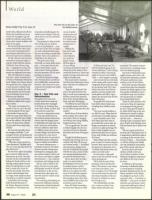
The tent city on the shore of
Grace Under Fire from page 29
hysterically, calling frantically for
Moshe, her husband, out on an
errand. We managed to get her
inside the bedroom-sized shelter,
where other tenants huddled with
most of our group.
• We learned from them that the
woman reacted this way to each
siren sound, a symptom Israel
psychologists later told us is not
abnormal under such conditions.
To help calm her and ourselves,
someone in our group began to
sing the Israeli national anthem,
Hatikvah. Soon all were sing-
ing — hugging and crying. The
connection to the land and the
people was tightened even more.
After the required 15-minute
wait after a siren, we headed out
of Haifa to Hadassah's Meirshveya
Youth Village near Zichron Yaacov.
During the year, this village hous-
es and educates troubled youth;
but for the last month, this well-
tended paradise has been home
to several families from Kiryat
Shimona and Nahariya.
Around the pool, Anat Rimer
of Nahariya talked of her experi-
ence at home.
"Our home was bombed by a
missile; it was so scary',' she said.
"I was devastated. We are used
to the bombs living near the
border for many years where it is
never quiet. But this was terrible.
We saw the soldiers. We saw the
rockets. We heard their whistle.
You just don't know where they
will fall."
She worried especially about
her daughter Michelle, 17, the
youngest of three and perhaps the
most traumatized by the constant
barrage of rockets.
"When the sirens sound here,
I have flashbacks:' Michelle said.
"It's very scary, but still, there's no
place like homey"
The two-hour ride to Jerusalem
gave us time to reflect on our
experiences up north. One man
said this trip has intensified his
feelings for Israel, and he is con-
sidering making aliyah. Several
talked of making plans to come
back to Israel soon to just be
there for the Israelis. Rose Bell,
a retired epidemiologist from
Las Vegas, made inquiries about
returning as a medical volunteer.
In Jerusalem that evening,
Rabbi Donniel Hartman of
the Shalom Hartman Institute
reminded us: "You haven't just
30
August 17 • 2006
seen pain and suffering, but the
reality of our existence. The mir-
acle is that we can live and build
here anyway.
"Our greatness is that we don't
leave. We go into our shelters
— real or psychological — and
that is part of our story. To build,
we must understand and accept
that not everything is simple and
solvable. There is no solution to
Hezbollah in the short term.
"The great news is that
Hezbollah can cause death, harm,
pain — but cannot destroy the
State of Israel. That's a great
achievement. Working together,
we're not powerless. We are stron-
ger than our enemies?'
He told the Hadassah delega-
tion: "Go back home and tell sto-
ries of difficulties, communicate
the pain. I also want you to com-
municate the strength and vitality
of this country"
Day 3 – Tent City and
Determination
Throughout the many wars
in their state's short existence,
Israelis always have managed
to let life go on. Somehow they
retain their vitality and their abil-
ity to truly live under fire.
This war is testing that truism.
In this war, whole towns in
the north are nearly shuttered as
citizens leave the danger posed
by Hezbollah and make their way
south. Some live with families
who have offered to take them
in; children escape the trauma
at youth villages; still others take
up residence in a new sort of
town like the tent city erected on
the Mediterranean at Nitzanim
between Ashdod and Ashkelon.
The town's infrastructure —
hundreds of tents for 50, toilets,
showers, laundry, dining areas,
kindergarten, synagogue, play
areas, police station, a clinic, wel-
fare service and stage for nightly
entertainment — was created in
two phases, each taking one day.
Like an oasis of safety in the
desert, this tent city now holds
6,000 people, served by 700 staff
and volunteers. So far, two bar
mitzvahs have taken place and
one birth and brit milah (ritual
circumcision).
This amazing undertaking was
financed by millionaire Russian
businessman Arkady Gaydamak,
who also is known in Israel as
g*j
the Mediterranean
owner of profes-
sional soccer and
basketball teams.
It is said he made
his initial money
dealing arms to
Angola.
Walking the
tent city's sandy
trails as the
waves rolled in,
you could see
people drying
off from dips in
the sea, talking
on phones provided at kiosks or
sitting idly in the shade of their
communal bedrooms. There were
people of all ages and ethnic and
religious backgrounds.
Nina Azuli and her husband,
Yitzchak, from Nahariya has been
there with their five children for
three weeks.
"Step into my bedroom:' she
said as she peels back the tent
flap to reveal seven mattresses on
the floor, several fans aimed at
three of her dozing children and
boxes with their belongings.
"It's difficult because there are
not enough showers and toilets,
but it's better being away from the
rockets?'
Rachel Oscar, 26, from Maalot,
sits in a plastic lawn chair a few
tents down. She's just hanging
out with her two young children,
husband and her sister.
"It's very good here she said
in broken English. Yet, she wor-
ries about the job her husband
left behind and what will happen
later.
Though the Mediterranean is
beautiful and inviting, this is no
carefree Club Med. Life does go
on for these Israelis — but there's
also depression, displacement
and loss of livelihood associated
with the war plus a sense of idle-
ness and purposelessness that
pervades the afternoon heat.
Sderot, about 20 or so miles
south, is in stark contrast.
Bombarded for the last six years
by smaller Kassam rockets
launched by Hamas from Gaza,
Sderot is not a ghost town like
some of the Katyusha-targeted
northern towns are becoming.
Here people go about their busi-
ness, mindful of the rockets, but
not driven away by them.
Mayor Eli Moyal remembers
the town's first Kassam in 2000.
"It fell in my back yard," he
told the Hadassah group in the
town's auditorium. "I saw it flying
towards me while I was having
coffee. So far, we've had 2,000 to
3,000 — we've stopped counting:'
Later he directed us to the back
of the nearby police station where
a large pile of spent Kassams take
up one exterior wall. The 2-foot
rockets have three back fins for
guidance and tips packed with
metal pellets and debris. Upon
impact, the tips peel back like the
skins of bananas.
Six people from Sderot have
been killed, Mayor Moyal says,
including three children under
age 5.
"Our most crucial problem is
our kids," he says. "More than 80
percent have an invisible disease
— post-traumatic stress. They
don't sleep; they don't want to
go outside after sunset; they are
losing concentration at school;
some turn to pills and drugs. We
have to help straighten out our
kids because they are our future.
If you raise ill kids, you will have
ill citizens?'
Mayor Moyal says the enemies
pose no threat to Israel's existence
because "they cannot win us',' but
the question is about how to be
"a healthy, functional society and
protect our kids' souls?'
For the mayor, a clear path
exists in this war and he's not shy
about speaking out.
"We've had six years of bru-
tal attacks, and no one has left
Sderot. The answer to our enemy
is we stay in our places. I am
brave enough to say it: We should
not run away from our cities. We
must keep normality in the war.
Our part as civilians is to show
how strong we are.
"We will definitely win this
war; we have no choice,' says
Mayor Moyal, tall, lanky and
passionate. The mayor's staunch
stand received a standing ovation
from the Hadassah group.
The finale to Hadassah's mean-
ingful mission came with a talk
by Benjamin Netanyahu, member
of Knesset and former prime
minister, at the Tel Aviv Hilton.
In his short speech, Netanyahu
several times drew the metaphor
between the Shiite regime in Iran
bent on the annihilation of Jews
and Hitler's sway over the Nazis
and his genocide of 6 million
Jews during World War II.
"Israel is under attack by a for-
ward unit of Iran; it's important
to understand the big picture:'
he said. "Their goal for Israel to
be wiped off the map is the new
Holocaust for Israel's 6 million
Jews. Iran's sidekick Hezbollah
says the same ... America is
starting to get it, Europeans don't
get it. [Iran's] mad ideology starts
with Jew hatred, but it doesn't end
there.
"We are in great peril; this is
the first salvo;' Netanyahu said. "It
is important to effectively achieve
a severing of this tentacle of the
terrorist octopus ... Israel should
cut off this tentacle now. World
war was initiated by mad ideolo-
gies. That's exactly what this is?'
From the sirens and bomb
shelters in Haifa to the tent
city in Sderot, members of this
Hadassah delegation understood
how different this trip to Israel
has been,
In addition to giving many
thousands of Hadassah dollars
to several projects, including
Rambam Hospital and the city of
Sderot, members of the delega-
tion pledged to go back to their
respective cities — from Boise to
Nashville — and speak out about
what they saw and heard, a story
of pain and suffering but also of
vibrancy and determination. ❑