

I
World
Grace
Under
Fire
Hadassah women witness pain,
resilience of war-torn Israel.
Keri Guten Cohen
Story Development Editor
(Keri Guten Cohen was in Israel
Aug. 7-11 on a national Hadassah
Solidarity Mission that included
an overnight stay in Haifa and a
visit to Sderot near Gaza.)
Day 1 – Haifa and Sirens
A delegation of 70 Americans
came to Israel last Tuesday as
part of a national Hadassah
Solidarity Mission, and within
mere hours we felt that solidarity
firsthand.
As we entered Haifa, a rocket
warning siren began to sound
— the first of many during our
stay there. Our bus pulled over
immediately; people scurried
to get off and up the steps of an
apartment building nearby.
Not all of us fit into the build-
ing's inner hallway so a helpful
resident, Samuel Aflalo, ushered a
group of us into his modest apart-
ment with windows that looked
out on the Mediterranean Sea.
We crowded around his small
color TV while he held his
remote, ready to switch to the
latest news. Clad only in shorts,
the calm Aflalo seemed unper-
turbed that a dozen Americans
were sharing his space. This we
learned is just what Israelis do,
especially during this last month
or so of war with Hezbollah.
Things happened fast during
this first siren; and I didn't really
fear for my life, but the adrena-
lin certainly was flowing. Only
one woman was visibly shaken
and teary, wondering aloud why
Hadassah would put us poten-
tially in harm's way.
But that's Hadassah, an organi-
zation of gutsy women who have
always put their love of Israel on
the frontline. In fact, Hadassah
has been the only organizational
mission to stay the night in Haifa
since the war.
Haifa Mayor Yona Yahav was
not surprised by Hadassah's brave
stand with his city
"I knew Hadassah would never
change its plans," he told the
group. "This is a normal part of
our world; it's become a fact of
our hard life. You've been here
when the city was busy; I hope
when you are here tomorrow it
will be better."
Yet at midday on Tuesday,
Haifa was nearly deserted. Few
cars traveled the roads, and
only a few people sat at outdoor
cafes. Businesses were dark, and
it seemed unnaturally quiet.
Another symptom of life in
northern Israel.
The mayor explained that
Haifa was prepared because of
catastrophe training undertaken
earlier this year under a Joint
Distribution Committee grant.
"We were absolutely prepared
and unified," he said of the suc-
cessful effort to put police, Magen
David Adorn (the Israeli "Red
Cross") and the military all under
one command. "We felt confident
we could run the show and con-
vey this confidence to the people.
The media was amazed.
"We wanted to convey this
message to the enemy — that no
one will stop us. Nobody. No way."
He said 11 people have died
in Haifa, and three soldiers were
injured.
"I don't see yet the end," he
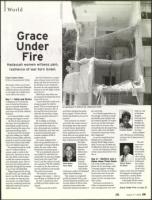
An apartment in Haifa hit by a Katyusha rocket
said before thanking the group
for its support. "You are not our
friends and brothers; you are our
partners."
This sentiment was echoed
everywhere the women went on
this nonstop three-day mission
in Israel. Sincere appreciation
came from the Israel Defense
Forces spokesmen on our two
buses, from our tour guides, from
tourism minister Itzhak Herzl,
from well-known journalist Ron
Ben Ishai,
from former
Mossad chief
Ephraim
Halevi, from
wounded
soldiers at .
Rambam
Hospital,
Haifa Mayor
from shop-
Yona Yahav
keepers and
from Malka
Goldwasser, mother of kidnapped
soldier Ehud Goldwasser.
This mission was organized
quickly by Marlene Post, a past
national Hadassah president, and
Annette Meskin of Sylvan Lake,
national missions chair, after
Hadassah's national convention at
the end of July
As a Zionist organization, we
felt strongly we belong in Israel':
said Meskin, who traveled with
her husband, Russell. "It's impor-
tant to see and feel real experi-
ences. None of us knew what
were getting into, but supporting
Israel is what we do. We didn't
necessarily want to hear sirens,
but it happened:'
As one new Israeli teen from
Ethiopia put it at Hadassah's
Ne'urim Youth Village south of
Haifa: "It was scary in Safed; and
it's difficult, but that's the way it is:'
In one very long day, members
of this mission learned how true
this is.
Day 2 – Shelters and a
Home Away From Home
Life is full of interruptions. A
phone call. An incoming e-mail.
A teenage daughter wanting a
ride to meet friends. In northern
Israel in this time of war, real
interruptions come from the
sound of sirens warning of pos-
sible rockets.
During our second day in
Haifa, we experienced several
more warning sirens. One came
while we were
in Rambam
Hospital,
learning about
emergency
facilities the
hospital built
in three days
Annette Meskin
in a base-
ment, complete
with 100 beds, air conditioning
and space for all departments to
function.
The next
siren came
while we
were eating
box lunches
on the bus
after visiting
an apartment
building hit
Sderot Mayor
by a rocket
Eli Moyal
on Nahalal
Street in Bet
Galim, not far from the hospital.
We dropped everything and
headed into a nearby shelter
scouted out by our drivers.
A distraught elderly woman
stood in the doorway crying
Grace Under Fire on page 30
August 17 • 2006
29