

Middle East
NEWS ANALYSIS
Score Card
As war ends without clear victor,
Israelis tally successes and failures.
The U.N. Security Council voted Aug. 11 for a cessation of hostilities in Lebanon.
The strongest attack on Olmert came
from the influential journalist Ari Shavit.
In a front-page Op-Ed in Ha'aretz enti-
Jerusalem
tled "Olmert Must Go," Shavit wrote, "You
cannot bury 120 Israelis, keep a million in
s a U.N.-brokered cease-fire
shelters for a month, erode our deterrent
takes effect.after 33 days of
power, bring the next war very close, and
fighting between Israel and
then say,`Oops, I made a mistake. That's
Hezbollah, criticism is growing of Prime
not what I meant. Pass me a cigar ... "
Minister Ehud Olmert's handling of the
The main arguments Shavit and others
war.
make against Olmert are that his decision
to go to war
was made hast-
ily and without
considering all
the possible
consequences;
that he was
persuaded into
believing that
air power alone
could do the
job; that he was
late in ordering
the large-scale
entry of land
forces into
Lebanon and
left the home
front exposed
to rocket fire
far longer than
necessary; and
that he did
little to allevi-
ate the suffer-
ing of people
in northern
Israel, who were
forced to spend
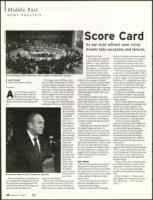
Ehud Olmert spoke on Israel TV about the cease-fire.
more than a
Some Israeli politicians and opinion-mak- month in bomb shelters.
ers are calling for his resignation. Israelis are
Olmert's perceived blunders have given
also asking more searching questions: Did
the Israeli right a new lease on life. They
Israel win or lose the war? And what are the
believe the war has dealt a lethal blow to
regional ramifications likely to be?
Olmert's plans for a unilateral withdrawal
Leslie Susser
Jewish Telegraphic Agency
A
22
August 17 • 2006
from the West Bank.
Their argument is that both
of Israel's previous unilateral
pullouts — from Lebanon in
May 2000 and the Gaza Strip
last summer — were perceived
by Israel's enemies as weak-
ness and led to heavy rocket
attacks on Israeli civilians from
precisely those areas the Israel
Defense Forces no longer controlled.
This pattern would be repeated with far
worse consequences if Israel withdraws
from the West Bank, the right-wingers say,
and without its defining idea of unilateral
withdrawal, Olmert's Kadima Party may
start to implode.
Likud Knesset member Yisrael Katz
expects a sweeping shift in Israeli public
opinion that could lead to a major shake-
up in the Knesset. To make the most of it,
he's urging the Likud to form a parliamen-
tary bloc with Avigdor Lieberman's Yisrael
Beiteinu party and to bring vote-catching
outsiders like the former IDF chief of staff,
Lt. Gen. Moshe Ya'alon -- who spoke in
Detroit this month and is mentioned as
a possible candidate for defense minister
— into the Likud.
Independent polls show that Olmert's
West Bank "realignment" plan is in
trouble. Before the war, it had more than
60 percent support; now, according to the
Dahaf Institute, 47 percent of Israelis are
in favor and 47 percent against.
Other polls show Olmert's approval rat-
ing has plummeted from 75 percent at the
start of war to under 50 percent. Worse,
less than 40 percent are satisfied with the
way he handled the war, and some polls
suggest that if elections were held today,
Kadima would crash from 29 Knesset
seats to around 16.
Two Views
Pessimists maintain that the inconclusive
fighting with a small guerilla band has
undermined Israeli deterrence and altered
the regional balance of power in favor of
Israel's enemies in Iran and Syria, and that
a wider outbreak of fighting is simply a
matter of time.
In their view, Syria may be tempted to
follow the Hezbollah model in order to
recapture the Golan Heights.
Optimists contend that the pounding
taken by Hezbollah and Lebanon actually
enhanced Israel's deterrent capacity, that
the regional power balance has shifted
in Israel's favor and that it could create
momentum for peace talks with Lebanon,
Syria and the Palestinians.
What ends up happening could depend
on the extent to which Hezbollah is able to
rearm and whether Iran is able to produce
a nuclear weapon. U.N. Security Council
Resolution 1701, on which the cease-fire is
based, calls for Hezbollah's disarmament;
Security Council Resolution 1696 urges
Iran to stop enriching uranium by Aug. 31
or face possible sanctions.
So far, however, Hezbollah is refusing
to hand over its weapons and Iran's lead-
ers say they intend to go ahead with their
nuclear program.
There are sharp differences of opinion
among Israeli pundits over whether Israel
won or lost. In a piece headlined "We
Did Not Win," Yediot Achronot analyst
Nahum Barnea writes: "Israel goes into the
cease-fire bruised, divided and concerned.
The question of what happened to Israel
in this war deserves a searching debate.
"In this war Israel was battered,
Lebanon was battered and Hezbollah was
battered. We naturally focus on the blows
we took. And they are not insubstan-
tial. The number of dead, the paralysis
of the home front, turning hundreds
of thousands of Israelis into refugees,
and perhaps the hardest blow of all: the
realization that the IDF cannot meet our
expectations."
But on the same page, Barnea's col-
league Sever Plotsker describes Resolution
1701 as a major political achievement for
Israel, "perhaps one of the most important
in its history. It can be summed up in a
phrase: Israel and the world against the
Hezbollah thugs."
Winner or loser, it's clear that Israel has
been shaken, and there could be a state
commission of inquiry into the war and
the way it was prosecuted, with tough
questions for the politicians and the gen-
erals.
If there is, Olmert — whose term of
office began with such promise just more
than 100 days ago — will be the main
target. Li