

Focus
NEWS A NALYS1S
Up In Smoke
Attack on
army post
shows failure
of Israeli
strategy after
Gaza pullout.
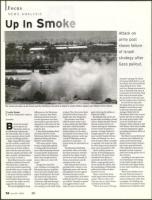
The Israeli army blew up the tunnel used by Palestinian terrorists to attack an Israeli military outpost near Kibbutz Kerem Shalom.
Leslie Susser
Jewish Telegraphic Agency
Jerusalem
B
eyond the immedi-
ate escalation, the
Palestinian attack on
an Israeli army outpost near
the Gaza border June 25 raises
serious questions about Israel's
security and foreign policies.
Right-wing politicians argue
that the incident, coupled with
months of incessant rocket fire
from Gaza on Israeli civilians,
shows that the army has lost its
deterrent capacity and that it will
take a massive, sustained opera-
tion in Gaza to restore it.
Ehud Olmert's plan for a major
unilateral withdrawal from the
West Bank also is under fire,
with some pundits maintaining
that the latest turn of events will
further erode public confidence
in the prime minister's pullback
strategy. The attack left two
Israeli soldiers dead and seven
wounded. One soldier was kid-
napped by the militants.
The attack highlighted sharp
56
June 29 a 2006
differences on the Palestinian
side. It came just days before
Palestinian factions were set
to reach agreement on a docu-
ment meant to pave the way for
negotiations with Israel, and was
widely seen as an attempt to tor-
pedo the deal.
It also raised questions about
the limits of power of both
Palestinian Authority President
Mahmoud Abbas and Prime
Minister Ismail Haniyeh.
With many splinter militia
factions acting independently
or taking orders from Hamas'
more radical leadership abroad,
it raised another fundamental
question: Does any Palestinian
leader have enough domestic _
clout to deliver on a deal with
Israel?
Though there had been
prior intelligence warnings, the
Palestinian gunmen surprised
the Israelis early Sunday morn-
ing by attacking from the Israeli
side and not the Gaza side of
the outpost. Eight Palestinian
militiamen infiltrated through a
recently dug 300-yard-long tun-
nel, coming out well inside Israeli
territory. They then turned back
toward the border, firing at the
Israelis who were facing Gaza.
Two attackers were killed
while the others made it back
to Gaza, taking Cpl. Gilad Shalit
with them. Israel demanded
Shalit's immediate and uncon-
ditional release, but the abduc-
tors insisted on the release of all
Palestinian prisoners under age
18 and all Palestinian women
prisoners in Israeli jails — in
return merely for information on
Shalit.
The Palestinian leadership
was divided. Abbas, who leads
the Fatah movement, ordered a
search for the soldier to hand
him back to Israel. Haniyeh, of
Hamas, also favored a speedy
resolution of the crisis.
Both realized they had been
presented with a chance to win
diplomatic points and alleviate
international sanctions against
the Hamas led-government.
Danny Rubinstein, Arab affairs
analyst for the Ha'aretz newspa-
per, called it "Haniyeh's moment,"
and suggested that he could
make enormous international
gains by forcing the militias to
release the soldier.
But. Haniyeh may not be call-
ing the shots: According to Israeli
sources, Khaled Meshaal, Hamas'
Damascus-based leader, is in
control, ordering the militiamen
to stick to their demand for a
prisoner exchange. Meshaal is
strongly opposed to the agree-
ment reached Tuesday between
Abbas and Haniyeh on a docu-
ment that gives Abbas a mandate
to negotiate with Israel and calls
for restricting terrorist attacks to
areas Israel conquered in 1967.
Israel's military options in
the face of the kidnapping are
not risk-free. The government
considered three options: a
commando operation to free
Shalit, a major ground opera- .
tion to smash the militias, and
the assassination of Palestinian
political and military leaders
involved in terror.
Olmert warned that Israel
would target leaders behind ter-
rorism,"wherever they were."
This was seen as a direct threat
to Meshaal and Haniyeh.
"This is the essence of the gov-
ernment's warning: The blood
of Corporal Gilad Shalit is on all
your heads, from Prime Minister
Ismail Haniyeh down. There
won't be a Hamas government in
Gaza or Ramallah, and many of
its ministers won't be alive if they
don't return the Israeli soldier
the way he left: on his feet," ana-
lyst Ben Caspit wrote in Ma'ariv.
For the first few days after
the attack, there was an uneasy
deadlock. Israel did not want
to take any action that might
endanger Shalit's life; the
Palestinians didn't want to harm
him for fear that it would untie
the Israeli army's hands. With
Israel, the United States and
European Union refusing to deal
with Hamas, which they consider
a terrorist organization, Egypt
was leading mediation efforts on
Shalit's release.
But Olmert warned that Israel
would not wait indefinitely for
results. Israel massed troops
along the Gaza border, threaten-
ing a major ground invasion.
It also imposed a land and sea
blockade on Gaza to prevent
Shalit from being spirited out of
the territories.
According to one report, how-
ever, Palestinians were hoping
to take Shalit through tunnels
beneath the Gaza-Egypt border,
an area where Israel has no way
to operate.
When Israel withdrew from
the Gaza Strip last summer, it
evolved a new military doctrine
based on deterrence rather than
occupation. The thinking was
that with the occupation of Gaza
finished, Israel would have inter-