

I
C4 orIMI
eistilit "I have
made diversity an
important aspect of
this performance,
especially among
the cast."
Freedom
Sings
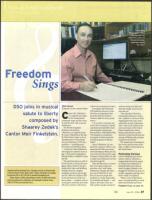
DSO joins in musical
salute to liberty
composed by
Shaarey Zedek's
Cantor Meir Finkelstein.
Liberation will be performed 8 p.m. Thursday, June 29, in Orchestra Hall
at Detroit's Max M. Fisher Music Center. Tickets, at $24-$49, are available
through the DSO at (313) 576-5111 or www.detroitsymphony.com .
Patron tickets, at $180, and benefactor tickets, at $300, both include
preferred seating and an afterglow; call Congregation Shaarey Zedek,
(248) 357-5544, during business hours.
Bill Carroll
Special to the Jewish News
C
antor Meir Finkelstein
is a relatively new player
on the Detroit Jewish
community stage, and he's about
to steal the show with a musical
masterpiece.
The Detroit Symphony
Orchestra will perform
Liberation, an original cantata
by Cantor Finkelstein, at the Max
M. Fisher Music Center at 8 p.m.
Thursday, June 29. It's perhaps
the most important of 150 com-
positions — including music
for movies and television shows
— written by Cantor Finkelstein,
who began his cantorial career at
age 14 and joined Congregation
Shaarey Zedek in Oakland County
last fall.
The event has taken on a life of
its own for the 145-year-old syna-
gogue, which, thanks to the gen-
erosity of its Laker and Weisberg
families, hired the complete
symphony orchestra and bought
out the 2,000-seat Orchestra Hall
for the performance of the two-
hour cantata — complete with an
Israeli guest conductor, more than
100 choir members, well-known
soloists and prominent narrators.
According to Jill Woodward,
DSO publicity director, it is the
first time an organization has
hired the DSO and retained
Orchestra Hall for such a perfor-
mance.
A 25-member committee has
turned the evening into a "grand
communal and interfaith event,"
said committee chairperson
Beverly Baker of Bloomfield Hills,
"It's designed as a fundraiser
in support of cultural and edu-
cational programs at Shaarey
Zedek."
Cantor Finkelstein, 54, com-
posed the cantata in 1995 to com-
memorate the 50th anniversary
of the liberation of Holocaust sur-
vivors from the Nazi death camps
of Europe. His late father, Zvi, also
a cantor, was a Holocaust survivor
who died at age 50.
"After the liberation, we vowed
that never again would such
atrocities occur," said Cantor
Finkelstein, "but they did. Since
the end of World War II, mil-
lions of innocent people have
perished as a result of genocides
in Cambodia and Bosnia — and
today in the Sudan. There are
still countless people around the
world yearning to be liberated
from the ravages of poverty, tor-
ture and war.
"Not only does Liberation
memorialize Holocaust victims,
but I updated it to focus on these
ongoing genocides and a more
worldwide concept of liberation.
Also, I want to pay tribute to the
men and women of the United
States Armed Forces, whose
bravery and ultimate sacrifice
saved the civilized world from the
scourge of Nazism and continues
to preserve our liberty"
The cantata also is dedicated to
the victims and survivors of the
Sept. 11, 2001 terrorist attacks on
theUnited States.
Performing Partners
Cantor Finkelstein uses diverse
musical styles in Liberation,
ranging from classical to gospel,
to "express the exhilaration of
being liberated and to demon-
strate the agony inherent in the
struggle for freedom; my goal was
to offer inspiration and hope for a
better world': he explained.
"When I came to the Detroit
area, I was impressed by its many
faiths and diversity and I have
Freedom Sings on page 40
June 22 2006
37