

Religious Differences
Rabbis react to
denominational
shifts,
synagogue
memberships
and Detroit's
spiritual future.
Rabbi Nevins
Rabbi Pachter
Rabbi Spotter
Rabbi Krakoff
Rabbi Yedwab
Shelli Liebman Dorfman
Staff writer
he religious profile
emerging from the 2005
Detroit Jewish popula-
tion study shows Detroit leading
a pack of more than 50 other
surveyed communities with high
synagogue membership and
service attendance figures. Local
Jewish identification numbers
follow national trends, with
Reform growing, Conservative
losing membership and
Orthodox gaining some ground.
Preliminary figures show
that 57 percent of Detroit Jews
younger than 35 years old and 64
percent of those ages 35-49 hold
synagogue membership, with
both age groups ranking No. 1 in
their categories nationally. Also
placing first are the 71 percent
of Detroit-area households with
children who hold memberships.
Overall, only half of Detroit
Jews belong to synagogues
— down slightly from 52 percent
in the 1989 study.
And Detroit Jews ages 35 or
younger ranked No. 1 for those
attending services once a month
or more, with 40 percent of
households with children also
attending at least one time a
month. The percentage of those
who never attend synagogue,
services decreased from 32 to 22
percent.
Rabbis Weigh In
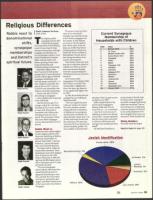
Detroit Jews have shifted slightly
in their religious identity, with
36 percent identifying as Reform,
28 percent Conservative, 18
percent "just Jewish:' 11 percent
Orthodox, 3 percent Humanist
and 1 percent Jewish Renewal.
The largest shift is within the
Conservative movement. Those
identifying Conservative dropped
from 38 percent in the 1989
study to 28 percent in 2005, fall-
ing from the fifth highest nation-
ally to 32nd place out of 53 cities
previously surveyed.
"The new demographic
study confirms what many have
sensed, that Detroit Jewry is
aging and diminishing in num-
bers, and that the Conservative
movement is particularly chal-
lenged," said Rabbi Daniel Nevins
of the Conservative Adat Shalom
Synagogue.
"Of course, it does not reflect
many of our movement's
strengths, especially the success
of our vibrant synagogues and
day schools. At Adat Shalom,
our nursery school is particu-
larly robust; many of our stu-
dents are at Hillel Day School
[of Metropolitan Detroit] and
JAMD [the Jewish Academy of
Metropolitan Detroit], and we
have strong attendance at our
services and programs.
"Nevertheless, these new num-
bers are an important catalyst to
redouble our efforts at recruit-
ment and retention through
innovative programming and
old-fashioned, person-to-person
outreach!'
At the Conservative
Congregation B'nai Moshe, Rabbi
Elliot Pachter conceded, "Our
membership is slightly lower
than a few years ago; however,
we are significantly higher than
in 1989:'
In 1989, B'nai Moshe had just
completed its new building in
West Bloomfield.
"The more significant point
is that our number of commit-
ted, active members remains
strong, reflected in attendance
at Shabbat services, programs
and education enrollment. Our
adult education classes draw a lot
of folks, both from the shul and
the community. This past year,
more than 50 of our post bar-bat
mitzvah students, grades 8-12,
were enrolled in formal Jewish
Current Synagogue
Membership of
Households with Children
Rank
1
2
3
4
5
6
7
8
9
10
11
12
13
14
15
16
17
18
Place
Detroit 2005
St. Louis
Bergen County (NJ)
Essex-Morris (NJ)
Cleveland
Dallas
Miami
Tidewater (VA)
Hartford
Sarasota
Westport (CT)
Baltimore
Boston
Jacksonville
Denver
Rochester
Monmouth (NJ)
Detroit 198
education. That is a great success
we didn't see in 1989."
Rabbi Joseph Krakoff of the
Conservative Congregation
Shaarey Zedek said, "It is no
secret that we — as a movement
— have been in the process of
redefining ourselves over the last
several years. I remain optimistic
that the Conservative movement
is solid and will become even
stronger in the months and years
ahead!'
He cited local initiatives to
/0
0
71 %
68%
65%
65%
65%
65%
64%
64%
64%
60%
.60%
60%
59%
58%
58%
. 57%
57%
increase levels of Jewish study
for Conservative congregants
and multi-synagogue gatherings
within the movement. "And we
are in the process of beginning
a renewed program of outreach
to our youth population to fur-
ther strengthen their ties to our
movement," Rabbi Krakoff said.
Rising Numbers
The study found the largest
Hand in Hand on page 20
Jewish Identification
Conservative 28%
Reconstructionist 3%
Orthodox 11%
Jewish
Renewal 1%
Humanist 3%
Reform 36%
Just Jewish 18%
IN
June 8 • 2006
19