

To Life!
HOLIDAYS
A Day At the Park
Lag b'Omer holiday celebration brings clowns, stunts and fun.
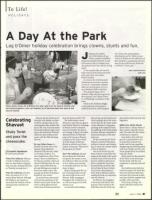
Above: Mendy Gurary, 10, of Buffalo, N.Y., gets ready to try his hand at shaving a bal-
loon without popping it. Left: Levi Shemtov, 10, of Oak Park blows flour away to find
oining in the celebra-
tion of the holiday of Lag
b'Omer, students at Yeshivas
Menachem Mendel LubaVitch in. Oak
Park hosted a May 16 outdoor event
that gathered more than 300 fun-loving
guests.
"It was a grand rally and carnival
held in honor of the festival of Jewish .
pride and unity," said student
Mendy Shemtov.
An overcast sky with forecasted
thunderstorms turned to sunshine
in time for a mbonwalk, inflatable
slide and carnival games to be set
up at Shepherd Park in Oak Park.
"The program began with a
children's rally, with charity given by
those present," said Zalman Deren,
21, of Pittsburgh, coordinator of the
event.
"Much to the children's delight,
a limo pulled up and a group of
students dressed as clowns popped
out." Guests also enjoyed games,
refreshments and live Hebrew music.
"And as if all this was not sufficient, we
then watched an amazing bicycle stunt
show by the world famous 'Perfection
on Wheels," Deren said.
- Shelli Liebman Dorfman,
staff writer
coins for charity.
Celebrating
Shavuot
Study Torah
and pass the
cheesecake.
Elizabeth Applebaum
Contributing Editor
What We Celebrate: Shavuot,
("weeks" in Hebrew), lasts two
days (in most Reform congrega-
tions, one day). It begins this year
on Thursday evening, June 1.
Why We Celebrate: Parshat
Emor (Leviticus 23: 15-21)
teaches about Shavuot. Although
the holiday is not named, we
learn about the method of deter-
mining its date, and about its
rituals.
Shavuot has the distinction of
being the only holiday not deter-
mined by calendar date, but by
counting days after another holi-
day. In this case, God commands
the Jewish people to begin count-
ing on the second day of Pesach
(Passover) and continue seven
weeks, with the 50th day being
Shavuot.
By Any Other Name: In
Exodus 23:16, the Torah calls
Shavuot Chag HaKatzir
(Festival of the Harvest), while
in Numbers 28:26-31, it is
Yom HaBikurim, (Day of First
Fruits). These are references to
the Shavuot sacrifice, which con-
sisted of offerings from the crop
of new wheat (until Shavuot,
all meal offerings were made of
flour from earlier crops). The
passage also labels the holiday a
festival of "your weeks."
In ancient times, when much
of the Jewish population of the
Mediterranean spoke Greek, Jews
took to calling Shavuot by the
Greek name of Pentecost, derived
from the Greek word for "50."
The rabbis always viewed
Shavuot as more than an agricul-
tural festival. Based on its linkage
to Pesach, and the command-
ment to remember the days of
our bondage in Egypt, the rabbis
determined that on what later
came to be known as Shavuot,
God gave us the Torah at Sinai.
So in the liturgy of Shavuot,
the day is referred to as Zman
matan Torateynu,"The time of
the giving of our Torah."
How We Celebrate: Beyond
the sacrifices, the Torah does
not specify the reasons or ritu-
als of Shavuot. What we are told
to do is rejoice and, curiously,
to remember that once we were •
slaves in Egypt.
Mystics inaugurated the cus-
tom of staying awake to study
the entire night on the eve of
Shavuot. Today, synagogues
throughout the community do
so, with morning services held
around 5 a.m.
As with all Jewish holidays,
Shavuot has specific prayers and
Torah readings, plus a few extras.
On the first day, the Torah reader
recites Akdamut, a long poem
speaking of the majesty of God,
the suffering of the Jewish people
and their ultimate restoration to
Israel, and the glory of the mes-
sianic era.
On the second day, the Yetziv
Pitgam is chanted. This poem,
written in Aramaic and compris-
ing 15 verses, has a theme similar
to that of Akdamut.
Also on the second day, the
Book of Ruth is read. Why? One
reason is that many of the events
in Ruth occur at the time of the
harvest; another is that just as
Ruth accepted the Torah and
became Jewish, so did the chil-
dren of Israel at Sinai. Further,
King David, a descendant of
Ruth, died on Shavuot; and by
reading the book, we commemo-
rate his yahrzeit.
On Shavuot, the synagogue
is decorated with flowers and
greenery. This is based on the
belief that when the Torah was
given, Mount Sinai was lush with
vegetation.
Milk It For All Its Worth:
Shavuot has a culinary theme of
dairy cuisine, especially cheese-
cake. The reason for dairy foods
on Shavuot is a mystery.
Some believe that until God
gave the commandments con-
cerning which animals were
kosher and the laws regarding
slaughtering and kashering meat,
aside from Temple sacrifices, the
Jewish people had to be satisfied
with dairy foods.
Others point out the proximity
of the Torah verses discussing
the first fruits with the com-
mandment to separate meat and
milk.
One tradition states that Jews
waited so long for the Torah that
they were exhausted afterward,
and when they returned to their
tents they fixed the simplest food
possible, which was dairy.
In the Song of Songs, the
Torah is likened to honey and
milk. ❑
June 1 • 2006
41