

Opinion
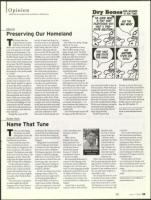
Dry Bones KINGOu ll..PI,It
Editorials are posted and archived on JNonline.us.
Editorial
Preserving Our Homeland
T
he Zionist idea that
inspired Israel's creation
held that even if all Jews
didn't move to the Jewish state, all
were to be partners in its estab-
lishment and development. The
Jewish National Fund, founded at
the fifth Zionist Congress in 1901,
was a practical way to make that
idea a reality while raising money
to buy land. The JNF's.founding
resolution made the connection
clear, stating: "The fund shall be .
the property of the Jewish people
as a whole."
Much has changed over the
past 105 years. There are many
worthy ways to bring Jews and
their friends together in support
of Israel. But as the custodian of
the land of Israel for Jewish peo-
ple everywhere, the JNF still pro-
vides a unique and vital place in
that partnership and in Israel's
future. While we are busy fight-
ing anti-Semitism, advocating
for Israel and building our own
communities, the JNF reminds
us that the Jewish homeland is a
work in progress that demands
their attention.
Though the scope of JNF
activity is broad and deep, it is
best known for its tree-planting
program and its once ubiquitous
fund-raising "Blue Box." But in
addition to planting 240 mil-
lion trees, the JNF has built 180
dams and reservoirs, developed
250,000 acres, and created 1,000
parks throughout Israel while
maintaining educational and
environmental programs. In
doing so, it has successfully con-
nected Jews the world over with
the Jewish state, giving them a
personal stake in the land that
still prompts Jews who visit
Israel to ask to see their tree, or
at least imagine that any of the
ones they see could be theirs.
While the JNF once helped
establish the prospective borders
of Israel through land purchases,
today it is less concerned with
setting borders than with what
takes place within them. While
forest development and draining
swamps were vital to reclaiming
fertile land and stable soil, today
the JNF maintains Israel's forests
while focusing on technology
and water treatment to meet
the needs of Israel's people and
THE 6000 NEWS
Is THAT MOST
PALESTINIANS NOW
WANT A TWO-
STATE SOLUTION!
industry.
But while some things change,
others say the same.
With a population of more
than 7 million people, Israel
needs to look south. The JNF's
Blueprint Negev — an ambitious
long-term plan that envisions
developing the southern 60
percent of Israel into a desirable
place to live and establish busi-
nesses — recaptures the pio-
neering spirit of reclaiming and
resettling the land.
The first five-year goal is to
bring a quarter of a million new
people to the region, with anoth-
er quarter million during the
following five years. To do so, the
JNF will partner with the Israeli
government and other social
action and social service groups
to strengthen existing com-
munities and establish 25 new
ones by providing infrastructure
— water desalinization and res-
ervoirs key among them — to
attract business and industry so
the residents can build homes
and find jobs.
The environmental impact will
be huge, and the JNF must bal-
ance costs and benefits as they do
with all projects. While seeking to
manage and minimize any harm
in the Negev, the project will help
relieve overpopulation and envi-
ronmental stress further north.
More than 70 percent of Israelis
live in the triangle between Haifa,
Tel Aviv and Jerusalem, taxing the
environment and raising prop-
erty values beyond the reach of
many young families.
The JNF is proof that
multi-culturalism, that
has been a positive
thing.
Other nations
blessed with ample
land, population and
natural resources could
not harness them to
benefit their people
because of cultural
impediments. Mexico
is a prime example.
But expressing dedication to
country in the language used
in the home seems inoffensive
enough to me. Let's hear more
voices in more languages proudly
hailing the Land of the Free and
the Home of the Brave. A cho-
rus always sounds better than
a monotone. Just as long as the
event that follows is conducted in
English.
I prefer that to an entirely
separate anthem. When Nelson
Mandela made
his visit to Detroit
several years ago,
"Lift Every Voice
and Sing," the "black
national anthem,"
was played at the
Tiger Stadium cer-
emonies. The song
about the banner
was not heard. That
bothered me.
What I also find troubling is
that the growing Spanish-speak-
ing minority in Detroit is power-
less. They are the major ethnic
presence in the southwest part of
the-city, and Vernor Highway is
essentially a calle.
But at-large elections for coun-
cil members leave them without
a voice on the city's legislative
body. Worse than that, it overtly
tells Hispanics to move on to the
suburbs instead of making a life
drybonesbtog.com
Zionism is not just about poli-
tics; it is also about practicalities.
With so many groups and arti-
cles written about the health of
the "soul" of Israel, we must not
forget the health of the "body"
The JNF works to keep that body
healthy. And we must work to
keep the JNF healthy. 0
Send letters of no more than 150
words to: letters@thejewishnews.
com .
Reality Check
Name That Tune
T
here are many things
that bother me about
immigration issues. But
singing the national anthem in
Spanish isn't one of them.
Francis Scott Key may have
been a terrific lawyer, but he
wasn't much of a songwriter. The
lyrics are obscure. The syntax is
tortured. The big lines come only
at the very end of the chorus. The
language is archaic. That's why
singers get all tangled up in the
words or forget them altogether.
It is the song that Congress
chose for the anthem, however,
and so it has a deep emotional
impact. But nowhere does it say
that it has to be sung in English,
no matter what President Bush
may think.
The recent move in Congress
to make English the official
language of the United States is
a different matter. The Spanish
rendering of the anthem, in fact,
touched off alarm bells among
those who fear that AMerica is
on its way to becoming officially
bilingual.
Bilingualism has threatened
to tear Canada apart for years.
It remains an issue that pops up
from time to time in Belgium.
The Basque separatist movement
in Spain is fueled by language
differences. In my mind, it is the
major barrier to Puerto Rico ever
becoming a state. Any move to
conduct official proceedings in
a language other than English
should be rebuffed.
But the even deeper fear is that
language shapes culture. The
political structure, legal system
and founding philosophy of
the United States are based on
Anglo-Saxon models. Although
you're not supposed to utter such
thoughts in this glorious age of
in Detroit.
Every major American city
that experienced population
growth and economic revival
since 1970 did so because of
immigrants. Mayor Kwame
Kilpatrick, in his last state of
the city address, indicated that
the city must attract and retain
more immigrant residents and
businesses if it hopes to slow its
population loss.
But the politics of Detroit
are exclusionary by design, and
those who hold the power are not
about to give it up to any other
group.
That's .a disaster in any lan-
guage.
George Cantor's e-mail address is
gcantor614@aol.com.
June 1 s 2006
35