

I
World
Detractors
Dinah A. Spritzer
Jewish Telegraphic Agency
Osweicim, Poland
Leven years ago, at cer-
emonies marking the
50th anniversary of the
liberation of Auschwitz-Birkenau,
misunderstandings between
Poles and Jews ran so deep that
even a rabbi's desire to say the
Mourner's Kaddish reportedly
disturbed some Polish politi-
cians.
In fact, there were so many
debates over the tenor of the
event that two separate ceremo-
nies were held: one for Jews, the
other arranged by the Polish
government.
Fast forward to the May 28
visit by Pope Benedict XVI. Not
only was Kaddish recited, but a
whole new Catholic sensitivity to
Jews was on display — even as
Poland struggles to battle xeno-
phobia and anti-Semitism, some-
times from Catholic sources.
But the pope's visit was a
source of unity. When meet-
ing former inmate Henrik
Mandelbaum, who was forced
to burn the bodies of his fellow
Jews in the Birkenau crematoria,
the normally reserved Benedict
kissed him on both cheeks; the
latter blushed in gratitude.
Poland's chief rabbi, U.S.-born
Michael Schudrich, not only
said Kaddish in the presence of
the pope and the country's top
elected leaders, but also recalled
those non-Jews who risked their
lives to save Jews from the gas
chambers.
The pope prayed with clasped
hands as Simcha Keller, direc-
tor of the Jewish community of
Lodz, sang El Maleh Rachamim,
the solemn prayer for the dead.
He also asked some difficult
questions: "In a place like this,
words fail; in the end, there can
be only a dread silence he said,
"a silence Which itself is a heart-
felt cry to God: Why, Lord, did
you remain silent?"
Forced in his native Germany
to join the Hitler Youth as a teen,
Benedict said: "The rulers of the
shouting "Poland is for Poles."
The previous Shabbat, some
young men shouted anti-Semitic
slogans at the rabbi and other
worshippers.
Rabbi Schudrich connected
the ascension of Giertych and the
league, which garnered 8 percent
of the vote in the 2005 parlia-
mentary elections, with these
events and other recent incidents,
including anti-Jewish threats
sent by text message to Jewish
student leaders and the stabbing
of an anti-fascist by skinheads in
Warsaw.
"There is a price to letting in
extreme rightists into the govern-
ment. It empowers xenophobic,
homophobic and anti-Semitic
members of society:' Rabbi
Schudrich said.
Marcinkiewicz is a strong ally •
of Jewish causes, but he needed
the league so that his conser-
vative Law and Justice Party
could have a majority in the
Parliament. "For their political
stability they have opened up
the floodgates of hatred:' Rabbi
Schudrich said.
Marcinkiewicz's adviser
on Jewish affairs, Agnieszka
Magdziak-Miszewska, disputes
ing the Nazi salute, according to
this characterization. "There is
media reports.
zero tolerance by the prime min-
The league has its roots in the
ister for anti-Semitism:' she said.
National Democratic movement,
She quoted what Marcinkiewicz
which advocated violence against told Israel's ambassador to
Jews in the 1930s and was led by
Poland, David Peleg, during a
Giertych's grandfather. In dozens
May 19 meeting:
of interviews, Jews and non-Jews
"Bringing representatives of
said they worry that Giertych's
the All-Polish Youth into the
rise had empowered
government could give
the impression that
the small segment
of Polish society
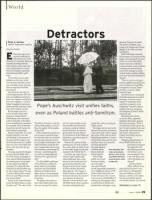
Pope Bene dict XVI
the Polish government
views gray estones
will tolerate racism
that is intolerant
and xenophobic.
during a vi sit to the
and xenophobia. This
Auschwitz -Birkenau
is not only false, but it
Several high-
profile acts of anti-
concentrat ion camp
will be absolutely con-
on May 29 . demned:"
Semitism leading
But the problem
up to the pope's
didn't suddenly arrive
visit upset Poland's
when Giertych became a min-
Jewish community, estimated at
up to 10,000 in a country of 38
ister. There are still questions
million. Rabbi Schudrich was,
about the influence of Radio
Maryja, a Catholic radio station
for the first time in his 15 years
that has periodically spewed
in the country, assaulted May 27
anti-Semitic rhetoric over the last
coming out of synagogue, when
a man hit him in the face and
attacked him with pepper spray,
Detractors on page 30
Pope's Auschwitz visit unifies faiths,
even as Poland battles anti-Semitism.
Third Reich wanted to crush the
entire Jewish people, to cancel it
from the register of the peoples
of the earth."
Rabbi Schudrich and others at
the ceremony praised the pope
for what they said was an honest
and moving expression of love
for all people, including Jews. But
Rabbi Schudrich noted that the
pope "stopped short of decrying
anti-Semitism, and although his
visit was a wonderful gesture
to us all, not mentioning anti-
Semitism was a glaring omis-
sion."
The chief rabbi's sentiments
were echoed by a number of
Jewish observers, including
Auschwitz survivor Kalman
Sultanik and Rabbi Andrew
Baker, director of international
affairs for the American Jewish
Committee.
The pope's visit came at a
time when Polish-Jewish rela-
tions are soaring. The country
has the largest number of and
best-attended Jewish festivals
in Europe, countless Catholic-
Jewish initiatives and massive
government financial support
for the Museum of the History of
Polish Jews, expected to open in
Warsaw in 2009.
However, the specter of anti-
Semitism has not been erased in
the country that was home to one
of the world's largest Jewish com-
munities before World War II.
Less than one month ago, an
extreme-right Catholic party
whose politicians have a long
history of anti-Jewish and anti-
gay positions joined the coali-
tion government at the request
of Prime Minister Kazimierz
Marcinkiewicz. The League of
Polish Families is presided over
by Roman Giertych, the country's
new minister of education.
Giertych is formerly head of the
All-Polish Youth, whose members
have been photographed giv-
June 1 • 2006
•
29