

World
Jewish-Presbyterian Ties
As church meeting nears,
divestment issue remains divisive.
Rachel Pomerance
Jewish Telegraphic Agency
Atlanta
A
s Presbyterians across
America gear up for
their biennial assem-
bly, the legacy of the last such
meeting is still roiling the Jewish
community and the church's own
members.
Two years ago, the Presbyterian
Church USA passed a resolution
calling for "phased, selective
divestment in multinational cor-
porations operating in Israel." .
Those who long have followed
Jewish-Protestant relations
weren't surprised.
"It was the culmination
of decades — not years, but
decades — of hostility toward
Israel and Zionism, not by the
rank-and-file members of these
churches, but by some of the
leadership," said Rabbi A. James
Rudin, senior interreligious
adviser for the American Jewish
Committee, where he staffed the
interfaith department for
38 years.
The passion ignited by the
divestment resolution at the
last General Assembly is likely
to erupt again at the June 15-22
meeting in Birmingham, Ala.
What happens there will have
a lasting impact on the already
strained relationship between
Jews and the entire Protestant
community. The estimated 3 mil-
lion Presbyterians in the United
States influence the other white
mainline Protestant churches in
this country, whose members
number more than 20 million.
Presbyterians are considered
the "conscience" and reason of
the Protestant community, serv-
ing as something of a "swing
vote Rabbi Rudin said.
Indeed, after the Presbyterians'
2004 resolution on divestment,
several other Protestant com-
munities took up the issue. The
Methodists decided to study
their options; the United Church
of Christ, also known as the
Congregationalists, endorsed
divestment but did not cre-
ate a process to enact it; the
Episcopalians considered but
rejected divestment; and the
Lutherans rejected a divestment
resolution, and instead passed a
resolution to invest in coopera-
tive ventures between Israelis
and Palestinians.
What will happen in
Birmingham is anyone's guess,
though both Presbyterian and
Jewish officials predict that no
immediate action on divestment
will be taken.
Leading Issue
According to Ethan Felson, asso-
ciate executive director of the
Jewish Council for Public Affairs,
"the prevailing wisdom" is that
a recommendation proposed by
the General Assembly commit-
tee to appoint a committee for
continued debate on divestment,
without halting the divestment
process, will pass.
Soon after the 2004 resolution,
the group's committee charged
with assessing the church's stock
portfolio for potential divestment
expanded the criteria of compa-
nies to include companies that
support Israel's presence in the
West Bank; its separation barrier;
settlement building and violence
to either party in the conflict.
The committee is still in its
investigative stages. It has already
begun initial talks with three of
the five companies in question.
The Presbyterian Church says it
has targeted the following corn- .
panics:
• Caterpillar, because the
Israeli military uses its equip-
ment to demolish Palestinian
homes and construct roads for
Israeli settlers in "the occupied
territories";
• Citigroup, due to charges
that it has transferred funds to
Palestinian terrorist groups;
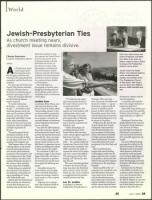
Elder Rick Ufford-Chase, Rev.
Clifton Kirkpatrick and Rabbi
Eric Yoffie of the Union for
Reform Judaism meet in 2004
to discuss the Presbyterian
Church's call to divest.
Jewish Council for Public
Affairs Vice Chairman Geoffrey
Lewis and Reverend Bill
Goettler, the minister of the
First Presbyterian Church
of New Haven, view Israel's
security fence near Kalkilya
during a 2005 interfaith mis-
sion.
• ITT Industries, for supply-
ing communication devices to
the Israeli military used in "the
occupied territories";
• Motorola, because it also
supplies the Israeli military with
communication devices and
takes "advantage of the Israeli
government policy of delaying
or prohibiting the importa-
tion of modern equipment into
Palestine"; and
• United Technologies, for
providing helicopters to the
Israeli military that have been
used in attacks against suspected
Palestinian terrorists.
More than $65 million is at
stake — the combined shares of
Presbyterian Church stock in the
aforementioned companies. The
MRTI committee has made no
requests for action by the compa-
nies, said a church press officer.
The meetings were about "fact
finding" and "information shar-
ing," she said.
The more immediate question
is whether the church will con-
tinue to go down the divestment
path or reverse course. To some
extent, the issue can be viewed as
a struggle between the denomi-
nation's ministers and laity.
Lay Vs. Leaders
According to an internal
Presbyterian USA poll taken in
November 2004, more laity —
some 42 percent of members and
46 percent of elders — oppose
divestment, compared with 28
percent of members and 30
percent of elders which favor it.
Meanwhile, pastors favor divest-
ment by 48 percent to 43 percent
and specialized clergy favor it by
64 percent to 24 percent.
Furthermore, the church said
the poll showed that "despite
widespread media attention:'
most Presbyterian laity were
not even aware of the decision
of the 216th General Assembly
to "begin a process of phased,
selective divestment" of compa-
nies profiting from the Israeli
occupation of the West Bank and
Gaza.
But it would be hard to
imagine that anyone heading
to Birmingham could miss the
subject, given the sheer number
of proposals on divestment sub-
mitted to the church by regional
presbyteries for the upcoming
assembly.
Nearly one-fifth of the 137
proposals to be considered at the
assembly address divestment.
Some want to press forward
with the divestment process,
many others aim to rescind the
original resolution and express
serious concern about the dam-
age the issue has done to Jewish-
Presbyterian relations and the
church's reputation.
A committee will condense
them into a single resolution or
propose an alternative.
Some 3,000 clergy and lay peo-
ple are expected at the assembly.
Of these, 534 individuals — half
clergy, half laity, are eligible to
vote.
Palestinian Christians have
deeply influenced the church by
framing the Israeli-Palestinian
issue in terms of "libera-
tion theology:' portraying the
Palestinians as powerless vic-
tims who must be freed from
their ostensible oppressors, the
Israelis.
The most influential group
espousing this platform is the
Sabeel Ecumenical Liberation
Theology Center in Jerusalem,
which sponsors conferences
around the world and speak-
ers at Christian gatherings, and
advocates divestment from
Israel. Jewish groups, and many
Christians, call Sabeel a corrupt-
ing influence.
Christians for Fair Witness
in the Middle East holds news
conferences about Sabeel nearly
every time the group holds a
meeting in America, said the
Rev. Roy W. Howard, an executive
committee member who is pas-
tor of Saint Mark Presbyterian
Church in Rockville, Md. ❑
.
June 1 • 2006
25