

To Life!
Count Me In
A JARC program brings children with disabilities into the classroom.
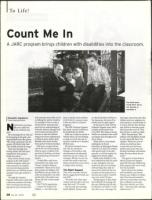
The Kleid family
of Oak Park: Aaron,
Jill, Hannah, 2,
and Noah, 5
Elizabeth Applebaum
.
N
Contributing Editor
oah Kleid is just about
like every other boy
in the world, but not
quite.
He is learning how to read and
he loves going to the park, play-
ing basketball and video games.
"He's really a great kid:' says his
mother, Jill Kleid of Oak Park.
"He's lovable and full of energy."
Noah also has high-func-
tioning autism. But that hasn't
stopped him from going to
Jewish day school.
Noah and his family are par-
ticipants in the JARC School •
Inclusion Program, which pro-
vides assistance for children
who have developmental dis-
abilities but can still find success
alongside same-age students in
school.
Through the Inclusion
Program, JARC pairs a child with
a classroom assistant who helps
with everything from learning
appropriate play (interpersonal
28
May 25 2006
and communication skills can be
a challenge for autistic students,
for example) to how to make a
school project. Assistants also
must have an understanding of
Orthodox Judaism (though need
not be observant themselves)
because to date the Inclusion
Program has been implemented
at Yeshivat Akiva, Yeshiva Beth
Yehudah, Beth Jacob, Darchei
Torah and the Yeshivah Gedolah.
JARC picks up about 80 per-
cent of the cost of the program,
which is open to children -with
any kind of disability, with fami-
lies contributing a fee based on
income.
"It really fills a void in our
community," says Chaya Leah
Tinman, Inclusion Program
coordinator. "There are so many
older parents [of children with
disabilities] who say, 'When my
child was young there was noth-
ing like this in the Jewish com-
munity. We had to look outside
for help.'"
(The P'TACH organization
— Parents for Torah for All
Children — also offers assis-
tance to special-needs children
in the form of a resource room.
It does not offer an inclusion
program.)
The JARC Inclusion Program
has meant a world of difference
for families like the Kleids.
Noah was 2 when he started at
Yeshivat Akiva. He had challeng-
es early on; but by the time he
turned 3, school was "a disaster:'
Jill Kleid says.
Jill and her husband, Aaron,
met with the school psy-
chologist, with teachers, with
administrators, but ultimately
took their son out of Akiva. In
retrospect, Jill says, no one was
at fault. But much as they had
always wanted their son at Akiva,
it simply wasn't working.
The Right Support
Then Akiva counselor Roberta
Martin suggested the Kleids con-
tact JARC.
"We spoke with Chaya Leah
Tinman, and she told us, We can
make this work," Jill recalls.
The first step was assessing
Noah's abilities. Tinman went
to school and observed Noah in
the classroom; she knew all he
needed was the right support.
So she went to work with her
Inclusiori Program team, which
includes professionals from
every field. They began training
Noah's new assistant, who would
accompany him throughout the
day at school.
Today, Noah is 5 and attends
kindergarten at Burton
Elementary in Huntington Woods,
where he is in classes for children
with special needs. In the after-
noon, he is at Akiva's regular kin-
dergarten for Jewish studies.
Noah's main disability is that
he is awkward socially, his moth-
er says. Though he tries and
wants to be part of everything,
he'll say things that make no
sense in the context of the con-
versation or that make sense to
him but not to others. "And he's
very, very active," Jill says.
Tinman agrees. At first, Noah
had a difficult time sitting still,
she says. Working with his aide,
he learned to sit still for 15 min-
utes, then longer and longer. He
also began interacting with other
children and now completes his
school projects. Academically, he
is on par with the class, Tinman
says. And he is learning a great
deal beyond the story of a holi-
day and how to make an aleph.
When Tinman hears, "But
children with disabilities should •
be with others like them:' she
explains: "When you come to
school, you don't just learn
to read and write. You learn
patience and social rules; you
develop friendships and relation-
ships. You learn about the real
world."
"Our goal is to have Noah at
Akiva full time and indepen-
dent:' Jill Kleid says. Without the
JARC program, this never would
have been possible.
But it isn't just the children
with disabilities who benefit,
Tinman says. Children in Noah's
class "have learned sensitivity
and how to treat others who may
have a different set of needs.
They learn that he's not a 'bad
kid' — he's a kid with a disorder
called autism."