

Arts 8z Entertainment
•or
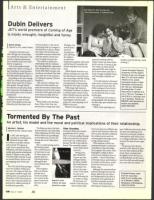
Naz Edwards, Babs George and
Mark Rademacher in Coming of Age
Dubin. Delivers
JET's world premiere of Coming of Age
is nicely wrought, insightful and funny.
Susan Zweig
Special to the Jewish News
As Maurice Chevalier once
said, "Old age isn't so bad when
you consider the alternative." Not
exactly a ringing endorsement,
just a situation made.more toler-
able by comparison.
•
Such is the mindset of play-
wright Kitty Dubin's Coming of
Age, enjoying its world premiere
at the Jewish Ensemble Theatre in
West-Bloomfield through May 21.
Depending on the eyes through
which it is. viewed, getting older is
either about what's lost or, thank-
fully, gained. Through Dubin's
lens and the scrutiny of her three
main•characters, the familiar sub-
ject matter gains a trio of distinct
perspectives.
Fighting the clock with every-
thing she can muster is Sarah
Simon (the palpably intense Naz
Edwards), each day closer to 60
and every glance in the mirror
confirming what is no longer as
decidedly hers to flaunt. Rather
than dissect the emotions and
inevitable occurrences that loom
with that marker, Sarah's resis-
tance to aging consumes her.
This stands to splinter her
relationship with her husband, -
Ben (the delightfully understated
Mark Rademacher), and her best
friend, Holly (Babs George), who
transforms seamlessly from dish,
tag to dish due to the constancy
• of a Bohemian painter (Thomas
Hoagland).
Only someone willing to face
reality and vanity head on can
make the necessary internal fixes.
In doing so, Sarah has the chance
to become whole again and redis-
cover the person that drew her
husband and friend to her long
ago.
While hardly novel, the play's
Same Time, Next Year con-
struction (at a cottage near Lake
Michigan over
several years)
serves its
intended pur-
pose, allowing
the audience
to watch how
personal wrestling with the
Sarah's.preoccupation with youth
subject matter (an almost thera-
and the loss of it intensifies the
peutic exercise, Coming of Age
friction with those who love her
was written as Dubin herself
most.
approached 60), what might be
Gillian Eaton's direction is, as
pat in lesser hands turns into a
always, crackling and crisp. With
nicely wrought, insightful, funny .
her adventurous musical choices, and thoroughly enjoyable eve-
one was perhaps only left wishing ning.
for more unexpected and var-
•
As to informing her characters'
ied expressions of days passing
inner selves, it doesn't hurt, either,
beyond the time-lapse of clouds.
that, among the many lives Ms.
While stage-right intensive,
Dubin manages to have lived in
Christopher Carothers' set depicts her background notes, it turns
a summer home worthy of envy.
out she spent 26 years as a psy-
Diane Ulseth's properties lend the chotherapist.
place a lived-in, cozy feel. Mary
Certainly, time, the construct
Copenhagen's costumes aptly
being grappled with throughout
project the internal goings-on of
the show, slips past without even
Dubin's characters.
realizing it.
Thanks to the playwright's
Which, when operating as it
should, is a lot like life has a habit
of doing. 0
Jewish Ensemble Theatre's
production of Kitty Dubin's
Coming of Age runs through
May 21 in the Aaron DeRoy
Theatre in the Jewish
Community Center in West
Bloomfield. Performances
are 7:30 p.m. Wednesdays
(excluding May 17, when
there will be a matinee at 2
p.m.), 7:30 p.m. Thursdays, 5
and 8:30 p.m. Saturdays and
2 p.m. Sundays. Tickets are
$28-$37, with discounts for
seniors and students.
(248) 788-2900.
Tormented By The Past
An artist, his model and the moral and political implications of their relationship.
Morton I. Teicher
Special to the Jewish News
I
n 2001, after halting con-
centrated on writing poetry,
Elizabeth Rosner made
her debut as a novelist with the
well-received The Speed of
Light (now in paperback from
Ballantine). The book won prizes,
medals and awards, including the
Harold U. Ribalow Prize and the
Prix France Bleu Gironde. It used
an unusual literary device to tell
an intriguing story of love and
loss.
Two of the book's three protago-
nists were children of Holocaust
survivors. The impact of their par-
ents' agonies resulted in pain and
suffering that was matched by the
tribulations of the third character,
whose Latin American family was
destroyed by soldiers hunting for
revolutionary guerrillas.
44
May 4 • 2006
The Holocaust also is the back-
Time Traveling •
drop for Rosner's new book, Blue
During the Holocaust, Merav's
Nude (Ballantine; $22.95), which
grandmother hid in a barn,
features Merav, the granddaugh-
where a German soldier, Danzig's
ter of a Holocaust survivor, and
father, discovered her. He aimed
Danzig, the son of a Nazi storm
at her heart but couldn't shoot
trooper.
because "he fell in love with her
She is a model, posing nude in
beauty" She eventually came to
life drawing classes.
Israel, where Merav
He is a San Francisco
was born.
art instructor in one
Danzig, born
of whose classes she
after World War
appears. Both are
II, grew up in an
frustrated painters,
unhappy family;
although he had
his father' couldn't
once achieved some
find work because
success.
he had been "too
They recognize
close to the inner -
that he is German
circles" of the Nazis.
and that she is
As soon as he
Israeli, but neither
could, following his
one is aware of the
art studies, Danzig
Rosner's no vel
special connection
left Germany and
reflects her back-
they have to each
settled in San Francisco.
ground as a poet.
other.
Merav, whose child-
iN
hood was spent on a kibbutz, also
came to San Francisco, where she
had a cousin. She had completed
her military service and was
recovering from the tragic end to
a long-lasting romance.
What happens to these two
malcontent people is examined
in flashback scenes that relate
their poignant life stories. Their
biographies unfold as Merav
removes her clothing to pose as
a model — first in Israel, then
in Danzig's classes and, finally, in
his studio in Point Reyes, north-
west of San Francisco on the
Pacific coast.
Although the movement back
and forth through timeand the
abrupt shifts from one charac-
ter's background to the other is
sometimes a bit confusing, the
storyline inexorably proceeds.
Rosner writes beautifully,
reflecting her background as a
poet. Unlike her first novel, where
the pain and suffering of her
characters eventually yielded to
emancipation and release, there
is no happy ending here. There is,
however, the hope of.new begin-
nings.
The great 'promise Rosner
showed in The Speed of Light
has been fully realized in Blue
Nude. She is a talented and
thoughtful writer who has suc-
cessfully fleshed out the charac-
ters of two fully rounded people
who come alive for readers.
Elizabeth Rosner reads
from her novel Blue
Nude 2 p.m. Sunday, May
14, at Borders, 34300
Woodward, in Birmingham.
(248) 203-0005.