

I
World
ANALYSIS
Victoriou •
Leslie Susser
Jewish Telegraphic Agency
Jerusalem
hud Olmert's Kadima Party has
won the Israeli election and will
have enough support to form
the next government — but the party
did not fare as well as expected, and will
have to accommodate the socio-economic
demands of Labor, its likely coalition
partner.
Exit polls Tuesday night gave the cen-
trist Kadima 29 seats, left-tending Labor
22 seats and the right-wing Likud Party
11 seats.
Yisrael Beiteinu, a right-wing party
that nevertheless backs West Bank with-
drawal, was one of the biggest winners
on the night, garnering 12-14 seats. Shas
and United Torah Judaism, two fervently
Orthodox parties, won 10-11 seats and
five to six seats, respectively, while the
Pensioners won six to eight seats and Arab
parties won seven to eight seats.
Voter turnout was 63 percent, by far the
lowest in Israel's history.
Most significantly, the center-left parties
— Kadima, Labor, the Pensioners, IvIeretz
and the Arab lists -- together have around
70 seats in the 120-member Knesset.
That means that the right wing and
religious bloc — Likud, Yisrael Beiteinu,
National Union-National Religious Party,
Shas and United Torah Judaism — have
only 50 seats between them, 10 less than
they needed to stop Olmert from forming
the next government.
The three big election surprises were
Kadima's relatively poor showing, Yisrael
Beiteinu's emergence as the third-larg-
est party ahead of Likud, and the strong
showing of the Pensioners, who were not
expected to win any seats.
How did Kadima win? For one, Likud
leader Benjamin Netanyahu's scare tactics
— raising the specter of an Iranian-
supported, fundamentalist, Hamas-led
Palestinian entity on Israel's doorstep
30
March 30 • 2006
— backfired. Those he frightened didn't
necessarily see him as the leader best-
equipped to deal with the threat, and
many of them voted for parties further
right, such as Yisrael Beiteinu.
-
Many others moved to the center, back-
ing Olmert's plan for unilateral disengage-
ment from the Palestinians-as the most
rational way of dealing with the Hamas
threat. And though Likud lost much of its
traditional Sephardi working-class base
to Labor, with its strong socio-economic
message, Labor lost even more of its mid-
dle-class Ashkenazi voters to Kadima and
the Pensioners.
Olmert's Options
In recent elections, the straw poll results
have closely approximated the actual
count, and if the numbers hold up this
time, Olmert will be prime Minister with
wide coalition options.
He has made support for his plan to
establish new borders between Israel and
the Palestinians a condition for joining
his coalition. That rules out the hawkish
National Union-National Religious Party
and the Likud, and makes Labor the most
natural coalition partner. •
Around the Kadima-Labor core,
Olmert will be able to choose one or more
additional coalition partners from the
Pensioners, Meretz, Yisrael Beiteinu, Shas
and United Torah Judaism.
Ideally, he would like to achieve a bal-
ance between left and right and between
secular and religious parties. That would
entail a broad-based coalition of between
70 and 90 Knesset seats.
Whatever form the coalition eventually
takes, Olmert will have a clear . majority
in the Knesset for his plan for separation
from the Palestinians, which is likely to
become the centerpiece of his new admin-
istration.
Because Olmert made his intentions
crystal-clear before the elections, right-
wing opponents of the plan will not be
able to demand a referendum on the
n lio n d lei /J TA
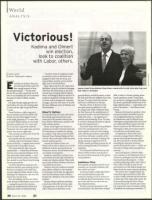
Kadima and Olmert
win election,
look to coalition
with Labor, others.
Interim Israeli Prime Minister Ehud Olmert stands with his wife Aliza after they cast
their votes in Jerusalem.
grounds that he misled the nation, as they
did with Ariel Sharon's pullback from Gaza
last year. To a large extent, the election
itself was a referendum on the plan.
The plan will be at the heart of the
new government's guidelines: It calls
for a large-scale Israeli withdrawal from
the West Bank and the establishment of
permanent borders with the Palestinians
within four years — by negotiation, if
possible, and unilaterally, if not. The plan
is certain to dominate the political agenda
in the new Knesset's term.
The second major item in the guidelines
will be the administration's socio-eco-
nomic agenda. As the price for bringing
Labor into the government, Labor leader
Amir Peretz will make a number of key
socio-economic demands, including rais-
ing the minimum wage from $730 to
$1,000 a month, providing pensions for all
and increasing the basket of subsidized
medicines.
The Pensioners will back him up, and
Olmert will be forced to incorporate at
least part of these demands in the govern-
ment guidelines.
Ambitious Plans
Both agendas, the political and the socio-
economic, are extremely ambitious. But
how realistic are they?
To set new borders unilaterally, Olmert
will need international, especially
American, backing. It's by no means cer-
tain that the Bush administration will see
eye-to-eye with him on where the new
lines should be drawn.
The key Atherican document on the
territorial issue is the Bush letter of April
2004. It refers to "already-existing major
Israeli population centers" being taken
into account in setting, permanent borders,
but doesn't specifically mention any of the
large settlement blocs — Ariel, Etzion and
parts of Jerusalem — that Olmert wants
to keep.
Moreover, the American position is that
permanent borders should be the prod-
uct of negotiations between Israel and
the Palestinians, and it's difficult to see
Washington recognizing borders that Israel
sets unilaterally. Olmert argues that with
Hamas in power on the Palestinian side,
Washington is likely to be more receptive
to Israeli ideas on the border issue.
To implement a Peretz-style socio-
economic package, Olmert will have to
approve increased government spend-
ing. The trick will be to do that without
impeding the impressive economic
growth of the past few years — which was
achieved, to a large extent, through fiscal
austerity.
Much will depend on Olmert's diplo-
matic initiative on the Palestinian track. If
it leads to a prolonged cease-fire, that will
help Israel's growth prospects — while,
possibly, postponing conflict until a future
time. It also will make it easier for the
government to cut the defense budget and
release funds for socio-economic spending.
The bottom line: Though Kadima did
worse than expected, Olmert will be able
to form a stable coalition and will not have
to shelve any of his major policy goals. But
his personal prestige has been compro-
mised by the party's relatively poor show-
ing, and his first order of business will be
to establish his leadership credentials. ❑