

T
C 0 V
R
Falash from page 33
Beta Israel who had kept their
Jewish faith and identities
— and facilitated their aliyah in
Operations Moses and Solomon
in 1984 and 1991 — Israel
turned away the Beta Israel who
had abandoned Judaism gen-
erations ago when
their ancestors
converted. These
people are called
Falash Mura.
Israel's policy
on the Falash
Mura changed in
the 1990s, largely
due to advocacy
by American Jews
and vocal protests
by relatives of the
Falash Ivlura who
had Made it to
Israel.
sons in Judaism and all hope that
embracing the Jewish faith will
help get them to the Jewish state.
Abeyna Worku, 33, came to
Gondar from the nearby village
of Alefa four years ago. Most of
Alefa's residents have left for
Gondar, but some
200 remain in the
village, he said.
"Most of my rela-
tives are in Israel
and I want to join
them," Abeyna says.
"Israel is good since
it's the promised
land from our
grandparents."
It is difficult to
prove the Jewish
heritage of these
Ethiopians, most of
whom were practic-
ing Christians until
Mixed Roots
they were told they
In the coun-
needed to embrace
tryside of Gojam
Judaism to be eli-
province, the
gible for aliyah. As
Falash Mura can be
a result, they are
Michael Horowitz, top,
found in clusters
not petitioning to
and Joel Tauber
of mud-and-straw
immigrate to Israel
huts built amid
under the Law
eucalyptus trees.
of Return, which
Though they pray .in a
grants automatic citizenship to
Christian church and hang pic-
anyone with a Jewish grandpar-
tures of the Virgin Mary in their
ent.
home, these people call them-
Rather, Israeli officials are veri-
selves Beta Israel. Many of them
fying whether the Falash Mura
have relatives who have gone to
qualify for aliyah under Israel's
Gondar and Addis Ababa, some
Law of Entry, a humanitarian
of whom have made it to Israel.
law designed to enable relatives
Those who have left their vil-
of Israelis to immigrate to the
lages and-gone to live in the cit-
Jewish state.
ies, closer to where Israel's repre-
So rather than having to come
sentatives in Ethiopia work and
up with documents proving
live, say they have ceased their
they are Jews, which nobody in
Christian practices. Some don
Ethiopia has, these Ethicipians
are trying to prove they are
yarmulkes while in the Jewish
aid compounds, many take les-
the immediate relatives of
34
March 16 • 2006
Ethiopians already in Israel.
Some estimate these
Christians constitute up to 30
percent of Ethiopian olim.
The eligibility verification
process for Ethiopian aliyah is
slow and painstaking, and it is
plagued by the problems of try-
ing to verify who is related to
whom when there are no birth
certificates or written records.
It also requires running an
operation simultaneously in
Israel and Ethiopia and weeding
out the liars from the truth-tell-
ers among people who know
that demonstrating one's ties to
Jewish kin is a way to get a free
ticket out of Africa, automatic
Israeli citizenship and access to
a broad array of social services
in Israel.
Unending Stream
More than 75,000 Ethiopians
have immigrated to Israel since
the early 1980s. Because it is so
costly to absorb these immi-
grants in Israel, this means the
stakes are extremely high both
for Israel and for the Ethiopians
seeking aliyah.
Some of the Falash Mura's
advocates accuse the Israeli
government of indifference
or racism in dragging its feet
on accepting these Ethiopians
as immigrants. There are
Ethiopians who have
been waiting in Addis
Ababa and Gondar
for as long as eight
Barbara Horowitz
of West Bloomfield
visited with some
Ethiopian Falash
children.
years, impoverished by the loss
of their livelihoods in their
move to the city, susceptible to
the HIV-infected prostitutes
and dependent on assistance
like the American Jewish Joint
Distribution Committee's feeding
program for young mothers and
their babies.
For their part, many Israelis,
including some Ethiopians,
blame the Falash Mura's advo-
cates with creating this state
of ongoing misfortune. The
critics say groups like the
North American Conference
on Ethiopian Jewry (NACOEJ),
which has been the primary
advocacy and aid group for
Ethiopian aliyah in the last
decade and receives funding
from Jewish federations, created
a crisis of internal displacement
in Ethiopia by maintaining their
aid compounds.
NACOEJ rejects such argu-
ments, saying that if not for their
work, not only would Beta Israel
migrants starve in the cities, they
also would be far less prepared
for life in the Jewish state once
they arrived there. This claim
is belied, however, by the cur-
rent situation in Addis Ababa,
where the community continues
to survive despite the closure of
NACOEJ's compound 18 months
ago following legal troubles.
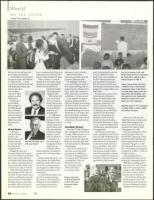
Far left: A group of 150 new
Falash Mura arrivals is welcomed
to Israel after landing at Ben
Gurion Airport on Feb. 8.
Above: Falash Mura kids take
a Hebrew class in the Gondar
compound; many of the teach-
ers know little more of the lan-
guage than the students, and
are expected to be replaced by
Ethiopian Israelis once JAFI
takes over the compound.
Opposite page: In the synagogue
in Addis Ababa in March 2003,
the women sit apart.
Some worry that once the
Falash Mura now in Gondar and
Addis Ababa emigrate, thou-
sands more will show up and
demand to be taken to Israel.
That happened in 1998.
This time, Israel plans to have
the Jewish Agency take over
the NACOEJ compounds, which
provide food aid, schooling and
some employment but are not
residential. The goal is to shut
the compounds down as soon as
the current group of immigrants,
estimated at 13,000 to 17,000, are
brought to Israel.
Acknowledging that U.S.
Jewish federations had a role in
keeping the compounds open in
1998, Robert Goldberg, chair-
man of the UJC, said, "In some
way, we've encouraged these
people to come. Nobody's per-
fect. We do our best, and we
have the best of intentions."
Meanwhile, Israel's Foreign
Ministry signed a deal with
the Ethiopian government last
fall on coordinating the aliyah
eligibility verification process,