

World
ON THE COVFR
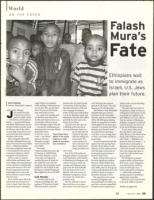
Falash
Murals
Fate
Ethiopians wait
to immigrate as
Israeli, U.S. Jews
plan their future.
Uriel Heilman
Jewish Telegraphic Agency
Addis Ababa, Ethiopia
ust outside the gates
of the Jewish aid corn-
pound in Addis Ababa
— a shantytown of decrepit tin
shacks — overcrowded homes
and debris-filled byways beckon.
Barefoot children stumble amid
the flotsam, part of the milieu
of stray dogs, mule-drawn carts
and mendicants that comprise
the dusty street scene.
Here, among the fetid smells
and homes fashioned from scrap
metal, live several thousand Falash
Mura — Ethiopians linked to
Jews whose progenitors converted
to Christianity but who now are
returning to Judaism in a bid to
immigrate to the Jewish state.
They've come to slums in
Addis Ababa and Gondar from
rural villages, abandoning farms
and occupations as blacksmiths,
potters and weavers to live near
the aid compounds and, more
importantly, to be close to the
Israeli officials in whose hands
their fate rests.
Every month, some 300 of the
luckier ones are selected to be
taken to Israel. Once there, they
are granted Israeli citizenship,
j
taught Hebrew and Judaism
months after the United Jewish
while residing in absorption cen- Communities (UJC) launched
ters. In time, they are provided
Operation Promise, a $160 mil-
about 90 percent of the funds
lion campaign for overseas
they need to buy a home.
needs. Of that total, $100 million
It is a generous package, and
is to go for Ethiopian aliyah and
one that has more than a few
absorption; the other $60 million
Israelis and American Jews con-
primarily for elder care in the
cerned there will never be an
former Soviet Union.
end to Ethiopian aliyah. This fear
The goal of the five-day trip
— and stories of Ethiopians per- to Ethiopia and Israel was to
petrating deceit to escape Africa's motivate federation leaders to
desperate poverty
go out and raise the
by way of a visa to
Young Falash Mura
money. So far, more
Israel — has stalled gather in the Israeli
than $45 million has
plans to end mass
embassy in Addis
been raised. "The
Ethiopian immigra- Ababa for pre-depar- money needs to be
tion to Israel by the ture orientation.
there, and all the rest
end of 2007.
flows," said Howard
The Israeli
Rieger, president and
Cabinet decided three years ago
CEO of UJC.
to bring up to 26,000 Falash
Even if the $100 million for
Mura from Ethiopia to Israel.
Ethiopian aliyah is raised quick-
A year ago, Israel agreed to
ly, the lion's share of the burden
expedite the pace of aliyah for
of absorbing the Ethiopians will
the 20,000 the state was told
continue to rest on Israel. On
remained. New procedures would average, each Ethiopian immi-
double the rate of aliyah to 600
grant costs the state $100,000
persons per month, bringing all
over the course of his or her
those eligible by the end of 2007.
lifetime. And more money for
Ethiopian immigration means
UJC Mission
less money for Israel's other-
A 36-hour visit in early
pressing needs.
February to Ethiopia by a del-
"It's very difficult to absorb
egation of 70 American Jewish
them, and there are so many
federation leaders came five
poor Israelis who need help, too:'
said Nachman Shai, director
general of UJC Israel. "This will
happen, but it will take time."
Joel Tauber, a West Bloomfield
philanthropist and national
chairman of UJC's Operation
Promise, said the increase from
300 to 600 Ethiopians making
aliyah was supposed to be done
and budgeted by the Israeli gov-
ernment in December, but Prime
Minister Ariel Sharon's stroke
has held back the operation
until May or June, enough time
to elect a new leader and form a
government.
"A small American Jewish del-
egation met with [acting Prime
Minister Ehucl] Olmert in late
February, and he reaffirmed that
that's the policy of the state of
Israel once the government is
formed," Tauber said.
Money will not solve some of
the most significant problems
that have riddled Falash Mura
aliyah since its inception in the
early 1990s, after the final group
of practicing Ethiopian Jews were
airlifted to Israel en masse in
Operation Solomon in 1991.
The conundrum: haw many
potential immigrants exist
among Ethiopia's 70 million citi-
zens, how to stymie unqualified
Ethiopians from emigrating to
Israel and the cost of absorbing
the immigrants.
The most important piece of
the puzzle, by many accounts, is
nailing down the final list of who
is and who isn't eligible for ali-
yah. Without such a list, officials
fear, the number of Ethiopians
seeking to emigrate to Israel will
continue to grow and there will
be no end to Ethiopian aliyah.
"I hear stories about Israel
from the elders," said Guade
Meles, 46, one of the Falash NIura
living in the Ethiopian country-
side. Guade — Ethiopians are
known by their first names — is
from the town of Ismallah, in
Ethiopia's rural Gojam province.
"They told me there are benefits
there. My cousins have gone to
Israel. My wife's brothers have
gone to Israel."
The Ethiopians seeking to
emigrate today call themselves
Beta Israel, a caste designation
associated with the smithing
trades the Ethiopian Jews —
known pejoratively as Falashas
— traditionally performed
during centuries of prohibition
against land ownership.
While the Jewish state decided
in the early 1980s to welcome
Falash on page 34
March 16 2006
33