
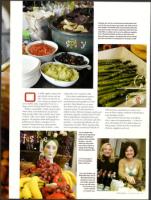

Certainly, one can live on chili alone, but most people need
a yin for the yang of steamy, spicy foods. Left: A big vessel of
store-bought or homemade salsa and guacamole along with
assorted corn chips and olives complement chili's heat. And
salad offers a cooling crunch, as do an additional vegetable.
Below: Roasted asparagus, pictured, or green beans are
fresh and easy to prepare — just drizzle olive oil over the top
and roast uncovered in a baking dish for 10 minutes at 425F.
n chilly nights, soups and
stews both warm and sat-
isfy. They can also be an
easy entree to prepare and
serve buffet-style, especially if you've a
large crowd of Super Bowl fans to please.
Chili is, essentially, a thick soup or stew.
Most often, it includes beef, liquid and
chili powder. But what it really starts with
is flavor. The word "chili" is Spanish for
pepper. All peppers (from bell peppers to
poblanos) are chilies, whether raw or
cooked. Ground down to chili powder,
chilies are what give chili its kick — and
makes the stew uniquely chili.
Like other combination spices,
such as curry, there are endless
combinations and qualities of chili
powder. Most blend tWO or more
hot chilies that are roasted, dried
and pulverized. To this powder is
added cumin, Mexican oregano, garlic and
sometimes paprika, another kind of chili.
These ingredients, integrated into one
mixture, are what we commonly call chili
powder — invented specifically for the
preparation of chili. When making chili,
you can purchase commercial blends of
chili powder, experiment to create your
or find a happy medium of doctoring a
store-bought powder.
Beyond the chili powder, everything
else is open to interpretation — a fact we
took advantage of in the chili recipes on
these pages, which star the unexpected
chicken, eggplant and veal.
ONVI1
Opposite: Rather than
serve chili in large bowls
— which are difficult to
balance while watching
the game — mix-and-
match your mug collec-
tion to allow revelers to
sample all the offerings,
like this Vegetarian Chili.
Left . A cornucopia of
fruits and vegetables
lends a festive air.
Right: Julie Schlafer and
Natalie Newman, both of
West Bloomfield, help
themselves at the self-
serve buffet, appointed
on one end with drinks,
hors d'ouevres and
straws clustered
in a ceramic vase.
JNPLATINUM • I F It
\
01 , 1 ,
• 2 I