

Arts & Entertainment
From
Svetlana
With
ore
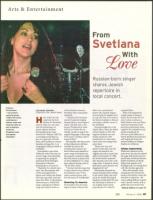
Russian-born s nger
shares Jewish
repertoire in
local concert.
Svetlana
Portnyansky:
"I will perform
cantorial pieces,
Yiddish folk songs,
contemporary
Hebrew songs and
classical works as
well as Russian
romances,
Broadway tunes
and popular
standards."
Suzanne Chessler
Special to the Jewish News
H
ello, Dolly," the title
song from the Jerry
Herman hit Broadway
musical, takes on a new aura
with the performance of
mezzo-soprano Svetlana
Portnyansky. It has trans-
formed into "Shalom, Dolly" for
a recording and perhaps as
part of a repertoire of world
music she'll perform in concert
Saturday evening, Feb. 11, at
Congregation Shaarey Zedek in
Southfield.
Portnyansky, a part-time
California cantor who tours to
concert stages internationally,
is appearing in a program
sponsored by the Michigan
Association of Russian
Speaking Jewry in America.
"Basically, it's a Jewish reper-
toire," says Portnyansky, who
will be accompanied by a
pianist and violinist she linked
with years ago while entertain-
ing in New York. "I will perform
cantorial pieces, Yiddish folk
songs, contemporary Hebrew
songs and classical works as
well as Russian romances,
Broadway tunes and popular
standards.
"I represent the European
school of cantorial singing
because there is more improvi-
sation with that style. I also
present Tchaikovsky's music
with lyrics written for me.
Usually, I prefer to sing in the
original languages of the songs.
If the music is Italian, I like to
sing in Italian."
Portnyansky, who has record-
ed four albums she will have
available for sale on the
evening of her concert, can
look to those past interests or
newer songs as she plans out
her program. Audiences might
hear her present a prayer, such
as "Avinu Malkeinu," or a long-
time cultural favorite, such as
"Ba Mir Bistu Shein."
"I do have favorite songs that
I sing at almost every concert:'
the performer says. "I love
many cantorial pieces, and I
love the music of Tchaikovsky."
Defecting To America
Portnyansky's love for music
began at home in Russia. Her
father was a professional
pianist \vho enjoyed singing
and teaching his daughter how
to sing. She went on to study at
the Gnesin Academy in Moscow
and began to build a career in
her homeland.
Touring brought her to the
United States, where she defect-
ed from Russia in 1991. Her
engineer husband, son and
mother joined her a few
months later at a time when
travel rules were easing in her
native land.
"Russia was very anti-
Semitic at the time:' says the
singer, now based in Los
Angeles and with a second son
added to the family. "In 1988,
the Jewish theater reopened
after 40 years, and I was a solo
singer there. I started to receive
hate letters, and it became very
dangerous for me."
Portnyansky resumed her
formal education after settling
in the United States. She stud-
ied at the Jewish Theological
Seminary in New York'City and
the University of Judaism in
Los Angeles, both schools
preparing her for cantorial
responsibilities.
While still employed by
Temple Isaiah in Newport
Beach, she has taken her tal-
ents to cities as distant as
Haifa, Buenos Aires and Tokyo.
American experiences that
have been particularly mean-
ingful for her included record-
ing the soundtrack for
Survivors of the Holocaust, a
Steven Spielberg documentary,
and singing the American
national anthem at Dodgers
Stadium in California.
Always Improvising
While solo concerts are her
main focus, she also has shared
the stage with Jewish and non-
Jewish stars. Jewish performers
Debbie Friedman and Dudu
Fisher, both popular with
Michigan fans, are among those
with who she has appeared.
When Portnyansky wants
relaxing time for herself, she
heads to the kitchen, where she
also likes to improvise. She
enjoys adding different ingredi-
ents to Jewish cuisine, such as
gefilte fish and matzah balls.
Song & Dance on page 44
February 2 a 2006
41