

Metro
he stands in moments
of comfort and conven-
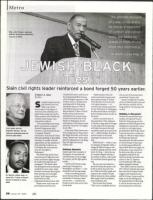
Rep. John Conyers marched
with Dr. King along Woodward
Avenue in 1963.
ience; but where he
stands at times of chal-
controversy."
Slain civil rights leader reinforced a bond forged 50 years earlier.
Robert A. Sklar
Editor .
Civil rights activist
Kathleen Straus: "All our
rights are protected when we
work for each other."
Dr. Martin Luther King, Jr.
honed his "I Have a Dream"
theme in Detroit in June,
1963.
20
January 19 • 2006
trengthening the partner-
ship between Jews and
blacks was a lesser-
known aspect of the legacy of
America's most celebrated civil
rights leader, a long-serving U.S.
House member from Detroit told
a Martin Luther King, Jr. com-
memoration audience.
.
"This partnership in the strug-
gle for social justice continues:'
declared Congressman John
Conyers, Jr., who keynoted the Jan.
13 program "Beloved .
Community" at the Max M. Fisher
Federation Building in Bloomfield
Township. "A number of Jewish
organizations are key members of
the Leadership Conference on
Civil Rights, the most powerful
voice for civil rights in
Washington!'
The partnership derives from
American Jewry's fight for social
justice and human rights through
its social service agencies and
synagogues. "The moral values
that prompted Jewish involvement
matched the same values within
the black community that inspired
black churches and civil rights
groups:' said Conyers, who has
represented the 14th
Congressional District since 1964.
Despite some rocky times, the
partnership overall has been
exceptional, Conyers said. Dean to
the Congressional Black Caucus,
which he helped organize in 1969,
Conyers cut his civil rights spurs
marching with Dr. King along
Woodward Avenue in 1963. At
Cobo Hall on that June day, Dr.
King honed his "I Have A Dream"
theme, which would become
embedded in the American psy-
che just two months later at the
March on Washington for Jobs
and Freedom. That historic march
paved the way for the Civil Rights
Act of 1964.
In the early 1960s; Detroit was a
fund-raising stop for King cohorts
like Ralph Abernathy and Andrew
Young. "Detroit was a fairly useful
place for helping finance the fledg-
ling civil rights movement:'
Conyers said.
Defining Moments
Conyers gave these examples of
the imprint of interracial and
interfaith bonds on the struggle
for equality and the fight against
racism:
•Jewish and Christian clergy
marching in Montgomery,
Birmingham and Selma — arms
interlocked and braving danger.
•Twenty-something martyrs
James Chaney, Michael Schwerner
and Andrew Goodman, a black
and two Jews — joined by the
freedom march cause and in their.,
brutal death.
•Rabbi Joachim Prinz, the
American Jewish Congress presi-
dent, spiritual leader of Temple
B'nai Abraham in Newark and a
civil rights champion — he
served on the steering committee
for the 1963 March on Washington
for Jobs and Freedom and helped
lead civil rights protest marches in
the South.
Conyers recounted when Dr.
King attended a 1963 conference
of northern clergy held in Chicago
to 'seek support for the growing
civil rights movement and only
one person stood up to answer the
call — Rabbi Abraham Heschel, a
revered teacher at the Jewish
Theological Seminary in New
York.
Rabbi Heschel — white, a scion
of a long line of ChasidiC rabbis, a
refugee of Hitler's Europe, a role
model for helping make the world
better. Dr. King — black, the son
of a southern Baptist minister, a
descendant of slaves, a role model
for nonviolent dissent against big-
otry.
The two men were joined in a
spiritual kinship that spoke to the
bereft as well as the power bro-
kers. With God as their guide and
steeped in the tradition of both
biblical testaments, these unlikely
allies urged racial reconciliation,
never buckling to fear.
They became dear friends.
"They came to symbolize that his-
toric period of the Jewish-black
partnership',' Conyers said.
Conyers recalled the oft-repeat-
ed line of Rabbi Heschel, who said
that when he marched with Dr.
King, he felt he was "praying with
my feet."
.
Building A Movement
Seeds for the Jewish-black part-
nership were planted 50 years'
before Dr. King sprang onto the
national scene by leading the 1955
Montgomery bus boycott, a semi-
nal event in civil rights history
precipitated by Rosa Parks' refusal
to give up her seat to a white pas-
senger. In 1909, Jews helped found
the NAACP, the National
Association for the Advancement
of Colored People. In that same
era, Jewish groups lobbied the
state of New York to bar bigotry in
public places. Later, research on
the destructive effect of school
segregation initiated by the
American Jewish Committee was
a factor in the U.S. Supreme
Court's landmark 1954 ruling
against segregated schools.
Rosa Parks moved to Detroit in
1957 with her husband, Raymond:
Later, she joined Conyers' run for
Congress and remained on his
staff for 20 years. Conyers said her
single act on that Montgomery
bus inspired Martin Luther King,
Jr., who at the time was just 26
and studying for his doctorate.