

E it t
Ar -
ON
Lainrr
_1 e n;
THE BOOKSHELF
Climb Every
ountain
Chronicling a claustrophobic childhood
from Orthodox Chicago to the top
of the world.
Sandee Brawarsky
Special to the Jewish News
rlene Blum describes her new
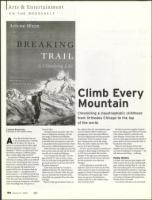
book, Breaking Trail: A Climbing
Life (Scribner; $27.50) as an
answer to a question she has often asked
herself, as she did on Annapurna in the
Himalayas. "What's a nice Jewish girl from
the Midwest doing at 21,000' feet, going
down a knife-edged ridge all alone?"
In mountain climbing parlance, breaking
trail refers to creating a path across difficult
terrain. In her climbing and in her pioneer-
ing work as a chemist, Blum, 60, has broken
much new ground. She organized and
helped lead the first all-woman climb up
Denali in Alaska — the highest peak in
North America — in 1970 and was the first
American woman to attempt Mt. Everest in
1976. Two years later, she led the first-ever
team of women up Annapurna I, the subject
of her bestselling book Annapurna: A
A
54
January 12 * 2006
Woman's Place.
A Berkeley-based researcher with a doc-
torate in biophysical chemistry who has
also taught at Stanford and Wellesley
College, Blum was one of very few women
in the field when she began her career. She -
is responsible for having several toxic chem-
icals, used in children's sleepwear, banned.
Asked about fear, she laughs and says that
she's a person who will only ride her bicycle
on trails, not on roads and highways.
"I try to ignore fear',' she says. "I'm very
goal-oriented. If I want to climb a moun-
tain, I'm so focused on the goal that I don't
pay much attention. I will even take risks if
the goal is important!'
In the book, she links her tenacity to
childhood adversity. The child of divorce,
which was rare in the late 1940s, she grew
up in an overprotected, Orthodox home,
where little was expected of her other than
marriage.
From an early age, she found a haven in
the outdoors from the claustrophobic apart-
ment she shared with her mother and
grandparents, where the smoke-filled air
was full of fighting and the blaring sounds
of television. Then, the outdoors meant
their Chicago street, and for the young
Blum, the colder outside, the better. That
was her first taste of freedom.
The first time she climbed a mountain, as
a student at Reed College in Portland, Ore.,
in 1970, she was hooked. She loved the
splendor of the high snow-covered peaks
and the serenity she felt. At once, she knew
that the mountains were where she
belonged.
As she explained at recent talk at the
Explorer's Club in New York City, she finds
clarity and focus on top of mountains and
engages in a kind of "extreme meditation"
The experience of being up high, "when
where you put your foot determines
whether you'll live or die stills her other-
wise overactive mind.
But there have been tragedies along the
route of her hiking career. She has lost some
of her closest friends to avalanches and
other disasters. Several times, she vowed
never to climb again, but then invitations to
places she'd never been enticed her back to
the glorious steep slopes.
However, once she gave birth to her
daughter, now 18, she gave up the danger-
ous kind of climbing for more gentle — but
still arduous and daring — trekking.
Family Matters
For those who associate great heights with
roller coasters, this is an eye-opening book,
great armchair reading. Blum is a very like-
able and humble guide, with an optimistic
spirit. She details her adventures, capturing
the natural beauty she encounters, the chal-
lenges of climbing with and leading others,
and cultural exchanges with people from,
literally, all over the world.
As a woman and also as a Jew, she faced