

o n
Struggling To Make The Grade
With its educational system slipping, Israel moves to test school reform program.
Dina Kraft
Jewish Telegraphic Agency
Tel Aviv
he environmental-stud-
ies teacher kneels with a
group of second-graders
in a garden patch as together
they plant a row of cabbage
seeds, digging just deeply enough
to protect the plants they will
become. The seemingly ordinary
activity is a first for the Gderot
School in central Israel.
The money to hire Gderot's
first environmental studies
teacher is one of the benefits of
being among 200 schools partici-
pating in the government's pilot
program that aims to revitalize
Israel's much-maligned school
system.
"It's the beginning of a
change," said Niza Vider, princi-
pal of the Gderot elementary
school, which serves a cluster of
moshavim near Rehovot.
The pilot program was
launched this year. It comes as
Israel's schools are considered to
be in dire straits. Students place
near the bottom on international
tests compared to their Western
counterparts. Students have to
scramble for attention in large
and crowded classes, and rates of
school violence — mostly in the
form of severe bullying — are
high. Teachers are underpaid
and, in some cases, considered
underqualified.
"The kids from Israel, for them
school is like camp. There is no
discipline or regulations. You do
what you want," says Eitan
Stoller, 30, a civics and history
teacher at Lady Davis Amal High
School who was voted best
teacher in Tel Aviv last year in a
local magazine poll. He has
enforced a strict code of conduct
in his classes that has proven
successful.
But in many of Israel's class-
rooms, an atmosphere of chaos
reigns. Teachers struggle to con-
trol classes with as many as 40
students. Both parents and stu-
dents complain that the school
system has become a place less of
intellectual stimulation than of
boredom.
In what may be a case of self-
fulfilling prophecy, low teacher
expectations contribute to the
downward spiral.
Zemira Mevarech, an educa-
tion professor and vice rector of
Bar-Ilan University, and two col-
leagues recently completed a
study that found Israeli teachers
to be among the least demanding
in the developed world.
"It's amazing how little we
demand," Mevarech said of
teachers' expectations for stu-
dents.
Trying to ensure that students
pass matriculation exams at the
end of high school, teachers tend
to spoonfeed information rather
than challenge their students to
think creatively and critically, she
said.
Given the failure to push stu-
dents, perhaps it's not surprising
that an international survey in
2003 ranked Israel 33rd out of
the top 41 developed countries in
science, 31st in
math and 30th in
reading.
"It's really low. We
were shocked to see
it," Mevarech said.
Israel's academic
elite warn that if the
education system
doesn't improve, it
could have cata-
strophic conse-
quences for the
country's ability to
compete interna-
tionally. Technion
professor Aaron
Ciechanover, who
shared the 2004
Nobel Prize in
chemistry with an
Israeli and an
American .colleague,
said the educational
system is plunging
Israel into a "quiet
crisis" that doesn't
receive the attention
it deserves.
"Unless rapidly corrected, this
choking of brainpower will soon
erase the admirable progress
Israel has made in joining the
First World. It will destroy the
opportunities and the future that
Israel's people deserve. It will
also decimate the great source of
pride Israel has bestowed on
Jewish communities around the
world:' Ciechanover wrote in a
recent essay.
"At this dangerous juncture,
the government must make edu-
cation a high national priority.
Earmarked support from Jewish
communities world-wide is now
more crucial than ever:' he con-
tinued. "Only if Israel will be able
to supply the world's best-
trained, most creative and
knowledgeable workers will the
nation's economic independence
and social progress be assured."
Some educators say the Israeli
school system has been on a
downward slide for two decades,
attributable to a range of factors,
from shrinking budgets to the
challenges of teaching an espe-
cially diverse student body.
Low salaries make it increas-
ingly difficult to recruit and
retain qualified teachers.
Furthermore, the structure of the
Education Ministry — which
oversees several distinct bureau-
cracies because of divisions
among secular, religious, Arab
and alternative schools — has
made it difficult to streamline
educational management.
Compounding the problems,
Israel has one of the largest gaps
in the Western world between
wealthy and poor students.
Poorer students consistently per-
form below those who come
from wealthier homes, and the
gap between what rich and poor
students achieve in school is
greater in Israel than almost any-
where else in the world,
researchers said.
"Poverty is linked with almost
everything bad in education,"
said Tom Gumpel, an education
professor at Hebrew University in
Jerusalem and Virginia
Commonwealth University,
whose expertise is school vio-
lence and special education. The
single biggest predictor of
whether a student will need spe-
cial education is family income,
he said.
Poverty is at its most intense
among Israeli Arabs, who make
up about one-quarter of Israeli
students but whose educational
levels remain consistently below
those of their Jewish counter-
parts. The Arab sector has higher
drop-out rates, and fewer Arab
students complete matriculation
exams.
Israel spends as much on edu-
cation as many developed coun-
tries do — about 8.6 percent of
GDP — but results continue to
fall short.
Student performance in the
major cities is considered better
than in towns and villages.
Experts say that may have more
to do with the higher socioeco-
nomic level of the urban stu-
dents' parents than with the
schools themselves.
In addition, teachers in urban
areas often are wealthier and bet-
ter educated than their counter-
parts in the periphery.
Israel maintains its image as a
country of innovators thanks in
part to its universities, all of
which are research institutions.
The research focus drives much
of the innovation emerging from
Israel, as the universities push
students to excel academically.
The army also is a major factor
in Israel's status as a force in
fields like high tech. Many of the
country's top technology entre-
preneurs served in army units
that focus on high-tech research
and development.
The challenge facing the edu-
cational system today is to lay the
necessary groundwork earlier,
during the years of every child's
regular schooling, experts say.
"In the classroom, what helps
most is if the student is motivat-
ed and positive. When they have
this spark in their eyes, we can
Israel's Schools on page 36
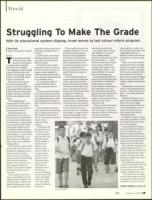
Photo by Brian Hendler/JTA
January 5 @ 2006
35