

To Life!
Spiritual
Stripe
A weaving project has
students and adults
wrapped in Judaism.
I Elizabeth Applebaum
I Contributing Editor •
B
efore walking into the
room less than 30 min-
utes earlier, Sydney
Schaefer, 11, knew nothing about
weaving. Now she sits at a loom,
her feet pushing pedals, her
hands pulling the thick, white
thread back and forth. Already
she has created half a tallit,
which she plans to wear when
she becomes bat mitzvah.
"It's a little hard when you first
get started," says Sydney, of
Bloomfield Hills, "but now it's
fun."
Give Michael Daitch a few
minutes and he can teach anyone
to weave. He's got a sure method,
which basically means sitting
down at the loom and getting to
work. Daitch and James
McCutchen, of Coat of Many
Colors (CMC) Handweavers, do
all the prep work, which is sub-
stantial. They arrange the
strings, threading them through
hundreds of tiny loops and slots,
tying them, twisting them in
what seems like a complicated
math problem. All the weavers do
is sit down and start.
Recently Daitch and
McCutchen have been helping
children, and some adults, weave
tallitot at local congregations.
Thanks to a grant from the
DeRoy Testamentary
Foundation/Alliance for Jewish
Education, Daitch brings the
looms right to the children, who
complete their tallit in about four
hours.
Daitch and McCutchen, both of
Macomb County, started CMC
eight years ago, working mostly
with chenille and creating table-
ware. It was thanks to another
job that the tallit program was
initiated. When not weaving,
Daitch is the office manager for
the Jewish Community Council.
A colleague learned about
Daitch's interest in weaving and
asked, "Do you do tallitot?"
• "Of course!" Daitch responded.
Well, he wasn't actually making
them at the time; but he was
interested.
So he did some research. What
would be the most "user-friend-
ly" fibers for such a project? What
are the halachic rules for making
a kosher tallit?
Working with the DeRoy grant,
Daitch developed a program to
teach tallit-making to local
Jewish groups. The first of these
was at Temple Shir Tikvah, where
19 pre bar- and bat-mitzvah stu-
dents weaved tallitot — not for
themselves, but for children in
Russia. The tallitot were sent
through Women's American ORT.
Daitch's next stop was Temple
Shir Shalom, where students like
Sydney Schaefer are creating tal-
litot to use when•they become
bar or bat mitzvah.
The program is optional (stu-
dents come two evenings to com-
plete their tallit) and, because the
program is funded by the DeRoy
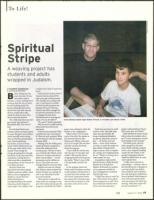
Artist Michael Daitch helps Nathan Freund, 11, of South Lyon weave a tallit.
grant, costs nothing for either the
student or the congregation.
Tiffany Steyer is 25 and mak-
ing her first tallit. Her mother is
the cantorial soloist at Shir
Shalom, and Tiffany works part
time at the temple. She was inter-
ested the moment she heard
about the program.
"I had a tallit for my bat mitz-
vah," she says. "It was plain and
smaller!' She loves the idea of
wrapping herself in the large one
she makes. "When I wear a tallit,
I feel spiritually covered:' she
says.
As the students work, both
Daitch and McCutcheon are there
to offer guidance. McCutcheon is
a retired nurse who always want-
ed to learn to play piano. But he
has come to love weaving in gen-
eral, and this art project, as well;
placemats and scarves are his
specialty.
Daitch has six looms on which
students work. They look large
when open, but fold flat. He
brings coordinated threads in
sea-greens, deep blues and pur-
ples — all vibrant, rich and
sweet — from which students
can select to make the stripes on
their tallitot. Though Daitch
helps everyone create a template
for a design, he's easygoing about
the art. "There's no wrong way to
make stripes:' he says.
Among those impressed by
Daitch's talents is Rabbi Michael
Moskowitz of Temple Shir
Shalom. He'd heard of a number
of art programs available for
local congregations and picked
Daitch's right away
"I didn't just want an artist:' he
says. "There had to be an educa-
tional component, as well." As he
has watched the students work,
he has seen them gaining "a
greater understanding of what a
tallit means than ever before!'
Rabbi Moskowitz enjoys seeing
which colors the students select,
and "it's nice having them around
the building [in the evening]."
The DeRoy grant will next
fund a program at Kol Ami,
where Daitch will help students
weave a new chuppah (wedding
canopy) for the temple. In the
spring, Congregation Shaarey
Zedek has asked Daitch to work
with students there.
"A tallit can be used for so
many things — not just a bar or
bat mitzvah but for a chuppah, or
receiving a baby," says Daitch,
whose students have included a
boy with Asperger's syndrome (a
form of autism). Daitch hopes to
work with more special-needs
men and women, who often love
weaving. "What they create will
become an heirloom." Li
January 5 - 2006
17