
Obituaries
Obituaries are updated and archved on JNOnline. corn.
A Zest For Life
I Leonard Pager
1 Copy Editor
idney M. Hiller has been
described as living the American
Dream. Reaching adulthood dur-
ing the Great Depression, he created a
business that developed into a six-store
supermarket success story.
Beginning with his first meat market.
on Michigan Avenue in Detroit, he later
founded. Shopping Center Markets, now
known as Hiller's Markets, with locations
in West Bloomfield, Commerce, Berkley,
Plymouth, Northville and Ann Arbor.
While he was the father of a son and
daughter, his "third child — and his
favorite" was his business, said his son,
Jim Hiller, the company's current owner.
"His business was his love and affection!"
S
Mr. Hiller, 92, of
Franklin, died Dec. 7,
2005, after a short illness.
A member of Temple
Beth El, Mr. Hiller also
had interests aside from
business and family. He
enjoyed horseback riding,
Sidney Hiller
traveling, boating and
fishing and loved to read
books on history and biblical archeolo-
gy. After buying a condo in Harbor
Beach, Fla., he continued being active in
outdoor activities there.
"My father, not for a moment, ever lost
his zest for life,' said his son. "His legacy
for all of us is 'life is to be lived."'
Mr. Hiller, a strong supporter of the
Jewish National Fund and Hadassah, was
passionate in his aid to the State of
Always The Teacher
Keri Guten Cohen
Story Development Editor
N
athan Roth was a presence —
within his family, at his syna-
gogue, at work, even at Barnes
and Noble bookstore cafe that served as
•
his "office" after retirement.
A Holocaust survivor who escaped
death many times, Mr. Roth, 81, died Dec.
9 of congestive heart failure and peripher-
al vascular disease just two weeks after he
and his wife, Edith, celebrated their 60th
anniversary. During the Shabbat service at
Congregation B'nai Moshe, where they
have been longtime members, Mr. Roth
rose from his wheelchair for an aliyah. He
also used the opportunity to tell the con-
gregation how much it meant to him.
For 10 years, he served as ritual com-
mittee chairman. He also was a devoted
Hebrew teacher who only stopped teach-
ing his adult class a few weeks ago. At
Shabbat services, he was a stable fixture,
making his way through the congregation,
pausing to good-naturedly harass the
men, kiss the women and hand out copies
of articles he found important.
Learning and teaching were lifelong
avocations. His granddaughter, Elana Roth
of New York City, began her eulogy with
words of instruction from her grandfa-
ther: "Slow and loud." She recalled how
before her bat mitzvah she spent an entire
104
December 15 • 2005
day in his office, reciting her drash (reli-
gious essay) "over and over and over again.
He coached me for what seemed like end-
less hours ... it remains one of my
strongest memories of my bat mitzvah."
As another example of how her grand-
father shaped her and his other grandchil-
dren, she told of the basement in her
grandparents' home, filled with supplies
from the office art department, where Mr.
Roth constantly encouraged his grandchil-
dren's creativity. "He taught us to think and
to push our creative limit;' she said.
Both she and her father, Robert Roth of
Farmington Hills, emphasized Mr. Roth's
love of words and distain for "word pollu-
tion." He'd say things powerfully and
meaningfully in the fewest words possible.
These attributes fit a man who made
advertising his profession, first at a news-
paper in Ohio, then at the Detroit Free
Press and finally at WB. Doner & Co: for 20
years as an advertising account executive.
Mr. Roth was born in Welky-Bereszna,
Czechoslavakia, the youngest of eight chil-
dren. At Passover in 1944, while at yeshiv-
ah in Budapest, he returned home only to
be deported with his family to Auschwitz,
where he remained for six months before
going to the Lavorzno work camp.
A true survivor, Mr. Roth escaped death
during the war once because he convinced
an engineer he was a plumber, another
time while on a death march, once after
Israel, ‘vith his most cher-
ished project being the
planned development of vil-
lages and businesses in the
Negev Desert to boost Jewish
population in that region and
sustain Israel as a Jewish
state.
"Anyone who donates [to
the project] is honoring my
father's name," said his son.
Mr. Hiller frequently told
his son and daughter over the
years that supporting the State of Israel
is necessary not only for that nation's
future "but also for our future."
Mr. Hiller also assisted the children's
asthmatic section of Children's Hospital
in Denver.
Born in New York City, Mr. Hiller
moved with his family to Detroit when.
he was 2. He graduated with honors.
from Detroit Central High School and; as
. •
class president, was offered a chemical
engineering scholarship to the
University of Michigan. But his parents,
who lost nearly all of their assets during
the Great Depression, needed him to
work to help support the family. He gave
up the scholarship and went to work as a
cheese salesman. His supervisor, James
Alexander, told him that he was too good
for the company and should go out on
his own with the owner's help.
Mr. Hiller took the advice and went to
work for a meat company as a inspector.
In 1941, Mr. Hiller opened a small meat
market on Detroit's west side. Because
most of his customers were Polish, he
learned to speak the language.
Expanding his meat market four years
later, he opened the first of his six super-
markets. The stores now have about
1,200 employees — which he called his
extended family.
His employees knew he loved them, said
books, and they did."
being discovered hiding in a farmhouse,
Mr. Roth also had a drive to educate
still another time when he was caught by a
himself.
patrol.
"He had a voracious
He returned home, where
appetite for knowledge until
he remained silent in a room
his last days:' said his son,
for three months. Then, he
who tells of looking in his
met his wife, Edith. They
father's portable calendar and
married in 1945, eventually
finding the written words —
making their way to a dis-
"vacuitrobsequious','"per-
placed persons camp in
functory" — to be learned
Bomberg, Germany
later. "Look it up" was one of
In 1950, they immigrated
his favorite phrases.
Nathan Rot h
to America, ending up in
Mr. Roth died as he lived
Dallas, where he became
— with his strong will and his intense
involved in theater, even
love for his wife intact. Though in a coma
considering acting as a
during his last hours, his son said, "He
career.
opens his eyes, turns to my mom and
Years later, in Detroit, the
gives her the broadest smile, then purses
couple participated in the
his lips [in a kiss], closed his eyes and
Jewish Community
died."
Council's speakers bureau,
Mr. Roth is survived by his wife, Edith
telling high school students their
Roth; sons and daughter-in-law,Viktor
Holocauststories for more than a dozen
Roth of Dallas, Robert and Terri Roth of
years.
Farmington Hills; daughter, Lisa Welford
"Nate did role playing with the kids','
of Bloomfield Hills; grandchildren, Elana,
Edith recalled. "He would ask them to
Samson, Dena, Reuben, Kendall, Rachel,
imagine soldiers on their block and corn-
Mindy.
ing into in their room, and no one on the
Interment was at Oakview Cemetery.
block does anything to help. He would ask
Contributions may be made to Congrega-
them, `What would you do?'"
Always the teacher, Mr. Roth was a regu- tion B'nai Moshe, 6800 Drake, West
Bloomfield, MI 48322; Jewish Academy of
lar at his bookstore "office,' where he
would drink coffee and recommend books Metropolitan Detroit, 6600 W. Maple, West
Bloomfield, MI 48322; Hillel Day School,
whether people asked him to or not.
32200 Ivliddlebelt, Farmington Hills, MI
"He had a drive to educate others ... the
man had no shame Robert Roth said. "He 48334. U.S. Holocaust Memorial Museum
in Washington, D.C. Arrangements by
would give book reviews to people in
Hebrew Memorial Chapel. El
Barnes and Noble, tell them to buy the
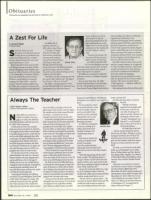
Scanned image of the page. Keyboard directions: use + to zoom in, - to zoom out, arrow keys to pan inside the viewer.
December 15, 2005 - Image 104
- Resource type:
- Text
- Publication:
- The Detroit Jewish News, 2005-12-15
Disclaimer: Computer generated plain text may have errors. Read more about this.